Hi all, I need an endurance road frameset in steel or ti . I want to put my Campy Chorus 2x mechanical groupset, Campy disc wheels, Growtec mechanical disc brakes. Would like it as light as possible. Any help would be appreciated. In the USA. Thanks.
Lynskey and Litespeed make titanium frames in Chattanooga, for competitive - sometimes to the point of difficult to believe - prices. Both make stock frames, not custom, but for many models one can choose internal vs external routing, and some other features. Look for sales.
I‘ve had a Lynskey MTB since 2021 with which I’m 100% happy.
4 Likes
Thanks , I will check them out.
I have a 12 speed Campy Chorus 12 speed hydraulic brake group on a custom steel frame (an Item 4) from Bishop Bikes. https://bishopbikes.com In the past I had Moots frame that I really liked, but I like the Bishop more than I liked the Moots.
3 Likes
I have a Lynskey road rim brake bike since 2015, no interest in replacing it. Check their website or chat with one of their reps online. While not offering true custom builds; I seem to remember they would build a frame to requested dimensions for a reasonable fee.
1 Like
I don’t think you’d go too far wrong with either, but all things considered, a titanium would build up somewhat lighter that a steel frame, for less money.
That said, a titanium bike would also;
- Be less prone to rust, especially if you live close to the coast or similar environments. Also applicable to temperate climates, where salt is used to remove ice from roads, etc.
- Be fine, if left exposed, unlike steel, which would require some form of coating, i.e. paint, etc. Stainless steels like Columbus XCR would be similar to titanium, but would cost a fair bit more.
1 Like
On the titanium vs steel durability point, I think a steel frame can last as long as a Ti frame. Bishop coats the inside of his frames before the customer gets the frame. Also, the housing stops at the top of the down tube, the entry port for the rear brake housing on the down tube and the exit port on the NDS chain stay, the water bottle braze-ons, the FD hanger, the housing stop on the DS chain stay, and the rear drop outs (mine are thru axle dropouts) are all stainless steel.
I’m sure there are other custom steel frame makers that add similar touches to help ensure that their frames will last as long as any other frame of any material.
2 Likes
Oh, for sure. I suggested steel’s susceptibility to rusting based on the OP’s consideration for the material, in the absence of any mention of a budget. Mid-tier and higher brands would certainly be more meticulous in their finishing treatment. But I don’t think the same could be said for the more budget-oriented options, which might forego some of these prep/finishing work, in favour of cost savings.
The suggestion was given more from a generic material standpoint, to cover the bases.
2 Likes

1 Like
For production steel, I’ve been tempted by Fairlight, Fit, Function, Form - Fairlight Cycles but shipping and tariffs to the US are painful right now. In the US I’d probably have Ritchey on my list. Road Bike Frames, Steel Road Bike Frames
For custom, a riding buddy has been very happy with his Curtlo. HOME - Curtlo Cycles
3 Likes
Lynskey has a good price on their 2024 gravel frame at the moment. It has clearance for 700c x 45 so I think that’s an endurance bike in 2025?
2 Likes
I think the frame material is not the primary concern. Either are great materials that will last decades. I live in wet ass Seattle and there are loads of steel bikes from the 70s and 80s still on the road leading hard lives as commuters.
IMO some consideration are budget (steel is cheaper), aesthetics (which looks better to your eye), geometry (custom vs different production geometries), tire clearance, and need for mount points (are you going to mount fenders and/or a rack).
You did mention weight being important to you, but the weight difference is pretty small. Titanium is probably like a half pound lighter for high end Ti and steel. For budget Ti like lynskey vs a similarly priced steel frame the weight is probably the same.
4 Likes
There are so many custom builders out there doing steel and Ti, who could take your request and do something really special, if you have a little higher budget. Again, with a little higher budget, Moots (already mentioned) and No. 22 Bicycles, and probably others make beautiful frames, probably lighter than most.
Also, there is a group on Facebook called Titanium Bikes - sell, trade, Stare… where you could get recommendations, especially for local builders. And drool at pics of gorgeous and unique bikes.
2 Likes
I have a Ritchey Montebello. It’s marketed as a randoneuring bike but it’s more like an all-road/endurance gemoetry. Very comfortable ride, surprisingly light build (19 lbs with ultegra/carbon wheels). I do find the geo a bit too endurance for my liking, but overall it’s a good bike.
Before I got the Ritchey, I had a Fairlight on order, but it get delayed twice and was going to end up taking something like 8 months to get delivered which was entering the kind of lead time for an actual custom frame.
FWIW a friend of mine has a Bishop and loves it. It’s a beautiful bike, but noticeably heavier than my Ritchey.
2 Likes
No wrong answer. Both are fantastic materials, well-suited to the purpose. If you’re considering custom, I’d also recommend DeSalvo. Mine is Ti — I live in Chicago, where road salt is used about as liberally as anywhere on planet Earth, and I wanted not to worry about it too much anymore — but AFAICT Mike DeSalvo (the builder) is equally proficient in both materials.
For off-the-shelf, my personal experience has been that there are more and better-priced well-riding steel than titanium frames on the market. Crust or Soma come to mind as very good value — I have a steel Soma ES (no longer made) myself, which has enjoyed many years of use including in horrible conditions and has a lot of life left.
I may get yelled at on this forum for saying this, because it’s a sometimes-untrue generality. Nevertheless, assuming you do not have Unlimited Money: The weight differences between well-designed Ti and steel road frames are small bordering on immaterial. On average, I have found Ti frames I have ridden to be a bit stiffer and steel frames to be a bit more flexible. In an endurance frame, I’d have a slight bias toward steel for that reason. In reality, either material can be built to showcase either property — that’s just what I have perceived to have experienced personally on bikes I have ridden personally.
2 Likes
Another thing to consider is that if you have a non-painted titanium frame, scratches can be easily removed with a scotch-brite pad. I have a Lynskey GR300 gravel bike and have done this with several scratches and can no longer see where they were.
I have never ridden a steel road bike, so can’t attest to the ride quality, but my titanium bike is shockingly plush compared to my carbon bikes.
My last ride on a steel bike was too far back to be meaningful, but I’ve continued to ride a fair bit of different titanium bikes, so happy to share some anecdotal insights.
Bike 1 is a custom set-up, with double-butted tubing everywhere, except for the chainstays and seatstays. All tubes are straight, with no bends, except the chainstays. Downtube is 50mm in diameter. Geometry is between the endurance/racy spectrum, but closer to the latter. There’s still some flex to be found in the frame, if you’re really going for it. Hard accelerations from standstill is just a smidgen more sluggish than a comparable carbon frame, but otherwise imperceptible. While the titanium shock absorption is there, I’d describe it as being a lot more linear than a well-made carbon fibre bike, which feels more progressive to me. Frame with ISP weighs slightly under 1,300g (~2.9lbs)
Bike 2 is a circa 2010 titanium rim-brake bike with straight gauge tubing everywhere. Main triangle has 1.5” tubing all round. FWIW, and for its vintage, it was pretty stiff, but nowhere near that of Bike 1 or current carbon fibre bikes. The s-bend seat stays do take a bit of shock off poorly finished roads, as it does harder accelerations. It would have been great for an endurance build, if not for the geometry, which is a little more aggressive than Bike 1, but I was more flexible then. Weight, also with ISP, weighs somewhere about 1,500g (~3.3lbs)
Bike 3 is an off the shelf Voodoo Juju with straight gauge tubing throughout. It also features an internally reinforced seat-clamp junction, to handle the heavier loads when the rear rack and panniers go on. This bike is, for all intents and purposes, endurance-oriented, and rides like it. On this bike, I care less about poorly surfaced roads, or about its weight. This bike lets me ride for ages, without much care or concern about its generally well-being. The clear coats starting to disintegrate, after about 5 years, and countless kms in all sorts of condition, but otherwise, it’s in mint condition. Frame is around 1,500g (~3.3lbs).
So, as far as I can tell, the overall feel of titanium comes down to tube sizes and shaping, as much as material selection itself. You can pretty much get a titanium bike up to decent stiffness (and responsiveness) levels, but that’ll come at the cost of (some) comfort, since there’s no magic carbon fibre dust here. Or you could have the titanium bike set up to be plush like Bike 3, but then it’ll probably be a little more portly. It’ll take the hands (and brains) of a highly experienced custom builder to get you closer to the best of both worlds, if that’s what you’re after.
And FWIW, I weigh about 65kgs (~ 143lbs), for those still reading.
6 Likes
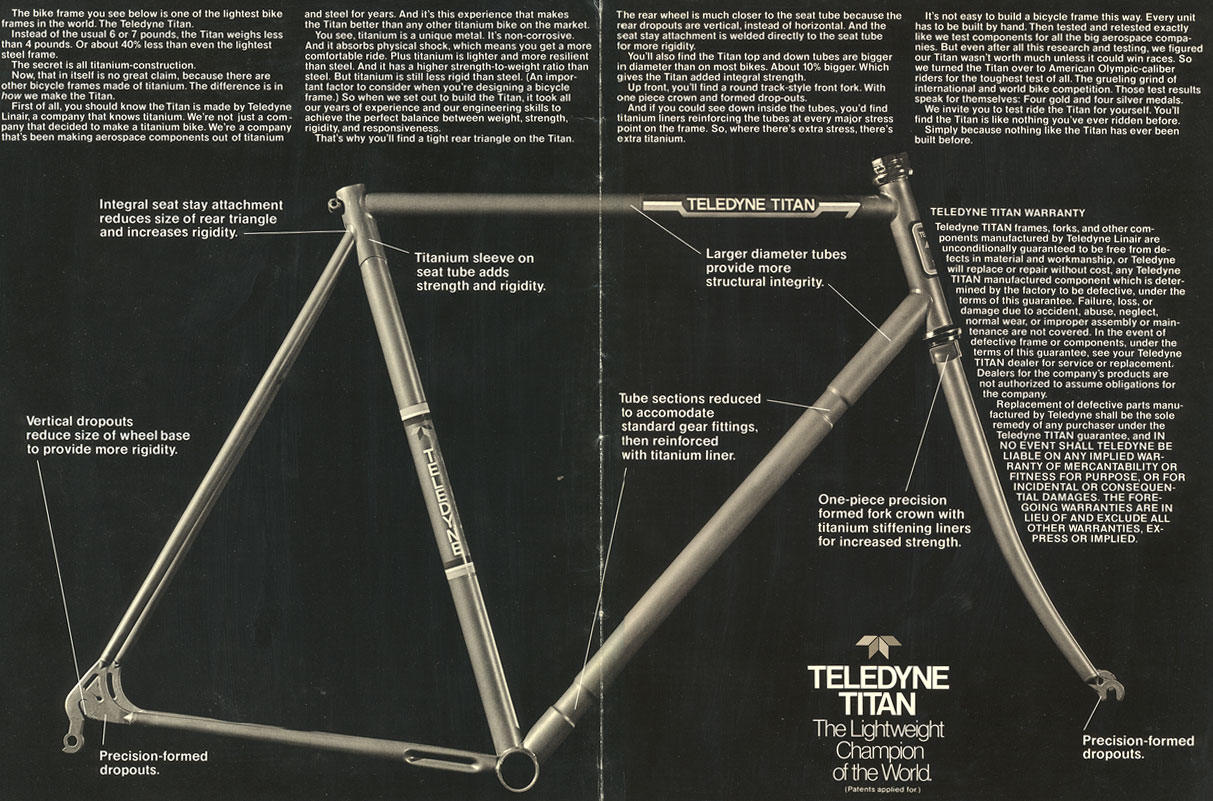
Yep, it’s all about tube diameter, wall thickness, tube shape. If you look at table with Young’s modulus for different metals, you’ll find that Young’s modulus for titanium alloys tends to be on the order of half that of chromoly steel. This is borne out by what I’ve read about one of the first Ti bikes, the Teledyne Titan. It had frame tubes roughly the same size as steel frames. It was a lot lighter than a lot of steel frames at the time, but those skinny-ish Ti frame tubes provided a noodly ride (that might be an insult to wildly overcooked noodles). Today’s Ti frames have larger diameter tubes to provide more stiffness.
A number of frame builder have said that frame material is not the primary factor determining ride quality and performance. I think Rob English was one of those builders.
2 Likes
The Titan was soooo cool at the time. It got lots of side eye but if it was right for you, a cool thing to have. Note the down tube - reduced size for clamp on shifter and housing bosses. I wonder what bikes would be like now if electronic shifting had been a thing back then. I had a chance to buy a Titan when I was in college. It was too small for me, which was good for my very meager budget. But do I wish now that I had it just for having its sake? Absolutely. Thanks for posting about the Titan.
1 Like
I would echo the tubing choices making a difference. I rode a 853 Pro Team frame with poor tubing selection and it was a noodle, to the point of being dangerous at speed. It was actually a nice material just poor design. I’ve ridden a few Ti bikes that were quite expensive and they were spectacular. Also well designed. I think both can be good as stated but if I have the option I’d pick a Moots Ti all day.