I’ve long said that road pros should use gearing that allows them to pedal their most-efficient RPMs on the parts of the course where the biggest differences are likely to be made. For Vuelta GC stages, this often means sustained 20% gradients.
It was striking to see Anna Van der Breggen mostly spinning (or at least, relative to Paula Blasi who finished 2nd) up Les Praeres. You can find GIFs about halfway down in Abby’s stage writeup (although it doesn’t appear that I can link them directly). Of course there’s some personal choice on pedaling RPM, and super-steep gradients introduce additional factors that can influence efficiency. So this doesn’t mean that Blasi would have benefitted from different gearing.
But I suspect lots of riders would benefit from being able to spin higher RPMs, especially if they crack (or aren’t on their best day) the ability to spin becomes more important and could make a difference to minimizing time losses.
I remember Roglic using a SRAM mullet 1x setup for at least two stages in the last week of the 2023 Giro. He did a bike change before the final climb on one of the last mountain stages, and of course for the super-steep finishing climb of the st.20 ITT. But I think that was a 40t with 10-42 cassette. He’s a noted prefers-to-spin rider.
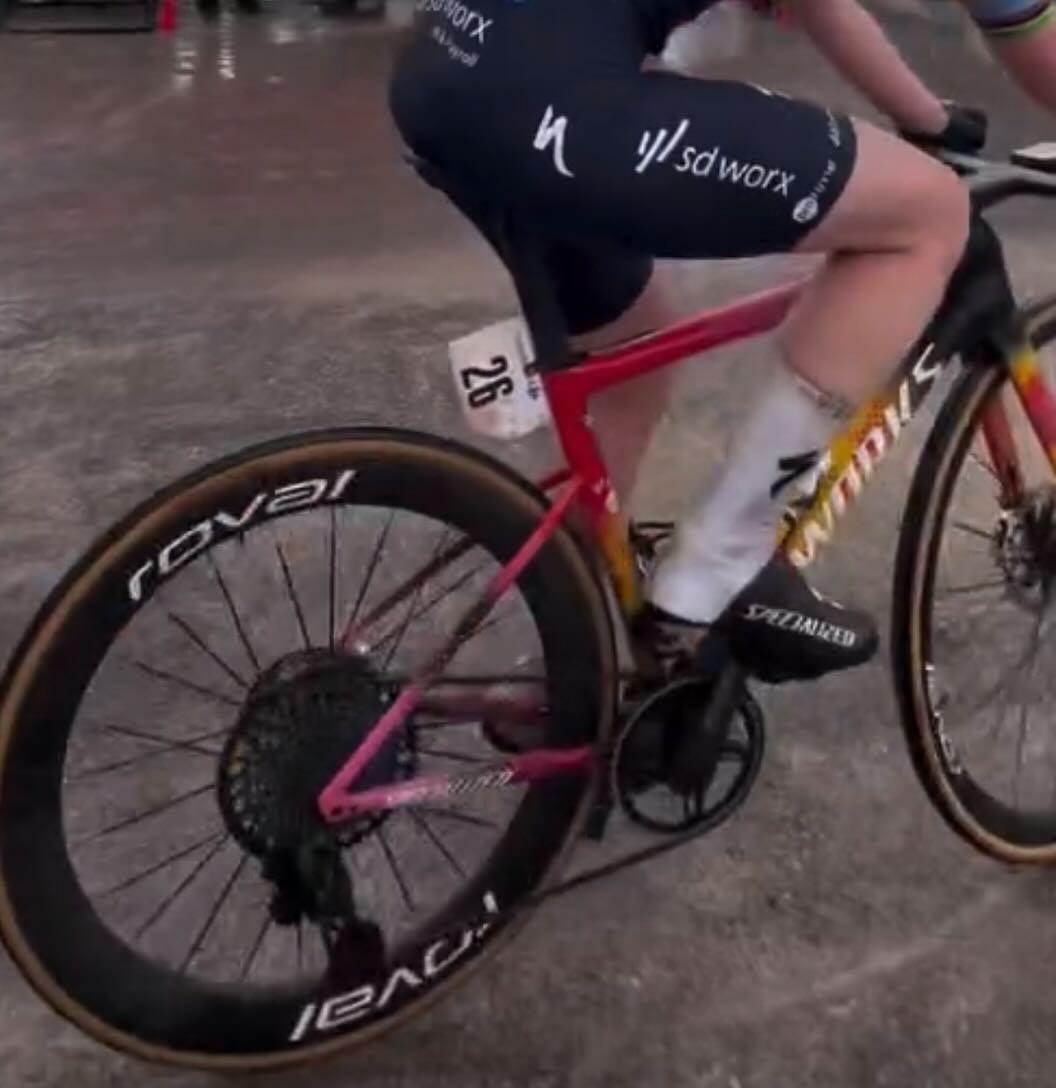
Vlado Michalec (commenting on Abby’s article linked above) thinks that AVDB must have had a 46t chainring b/c it’s non-aero (whereas SRAM makes 48 and 50t in aero, which SDW would have used). He is also pretty sure the cassette was 52t large sprocket. If correct, AVDB is 46x52 = 0.88 ratio. He linked to this screenshot-of-VueltaFem-IG-video (I’ve pasted a cropped version of that photo below).
Someone else commented that Shimano’s HG-native options don’t go as low, and the lowest you can go is 34x36 (0.94 ratio). Is this true, and even if so are there common approaches that Shimano teams use to go lower?
Also - am I overestimating the value of being able to pedal at optimal RPMs on race-making steeps? Videos of pros in the 1980s show most riders climbing at lower RPMs than today, but I’ve figured that was an adaptation to the limits on available gearing - with 2x6 or 2x7, gearing range really competed with gearing spacing. Maybe they talked themselves into climbing-at-lower-RPM-than-flats being more efficient, or maybe they just adapted and thus climbed at lower RPM even when they weren’t in their lowest gear. That said, it’s still striking to hear former pros (e.g., a neighbor friend who raced for 7-Eleven) talking about choosing gearing that would allow them to pedal 50 RPM on the hardest climb of The Milk Race (UK). There was also an ego component sometimes - I remember Lance talking about mocking riders who chose a 27t large sprocket (in 2x9 era with 39t inner chainring) for hard TdF climbing days. Of course Lance is probably more of a bro/egoist personality, but it’s fascinating to hear these details not being weighed about what’s-going-to-maximize-performance.
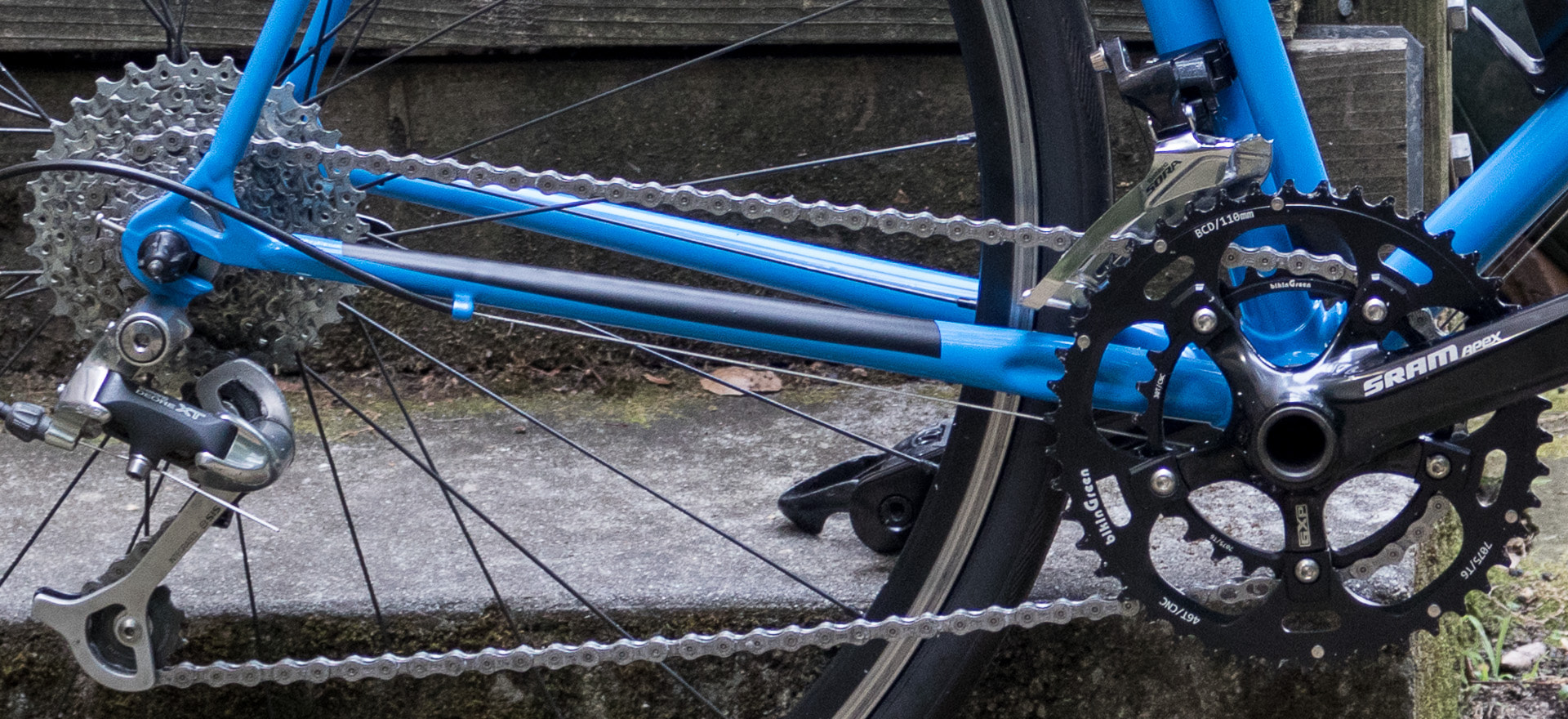
Only marginally related: my decidedly non-pro gearing on an old road frame with somewhat-less-old gearing. 46/30 chainrings designed to fit a 110mm-BCD 5-bolt spider (they work with smaller bolts that thread into the inner chainring, lined up with teeth because 30 is divisible by 5) and 12-32 cassette.
More related: If Shimano is limited to 34t inner chainring, are there similar hacks for modern 4-bolt spiders which allow smaller chainrings, or anything else made by Shimano that allows a sub-34 inner ring while keeping road chainline?
Or would Shimano teams need to go weirder (non-HG rear wheel if Shimano doesn’t make anything larger than 36t sprocket for HG freehubs) and/or non-Shimano crankset to get a smaller inner ring?
Shimano has 30 inner ring on the GRX cranks (source: it’s on my bike ). Or would the issue then be the 46 big ring limitation on the flat? They could always go with some GRX or MTB 1x stuff, if they really wanted to, no?
The Bikingreen rings Tim has are available in 4 bolt too (48x31 or 46x30), but the chainline moves inboard ~2-3mm so might not work on Shimano 12 where the road chainline has moved out 1mm. And of course they’re not Shimano rings so not sponsor-correct.
Macho has always been a big thing re racing gearing, with a lot of people invested in not having or using low gears to prove how “strong” (or stupid) they are. At the other end, having the highest gear possible has always been fashionable, as has claiming to “need” it. FWIW, I’ve always been a spinner, and have very often passed riders on climbs who were standing at much lower RPMs, even when they had numerous lower gears available.
Don’t GRX cranks have a wider chainline than road groups? This is the thing I miss about square-taper. You could usually make chainline work by swapping the BB.
Top teams running non-sponsor-correct rings “because Shimano’s stock gearing puts us at a disadvantage to SRAM teams” would be a heckuva kick in the pants. Would be even funnier with “Shimano" badly painted or decal’ed on.
Not sure that the bikinGreen rings would work, or whether they’d shift well, but posted mine as an example.
Ah, macho gearing ego. At least it’s a competitive disadvantage, so there’s some justice in the world
Shimano systems can absolutely run the same type of setup as AVdB did.
1x is no issue (plenty we’re doing that at Roubaix with Shimano), and judging by the photos of AVdB, the ring size would be fine for fitting to a Shimano road crankset.
Yes HG is a problem, but nothing stopping the teams switching out to a wheelset with MS freehub, or just switching the freehub (most wheel brands have hubs with switchable freehubs). Any team without this option on their wheels could get creative and use non-sponsor correct parts, which is hardly a new thing to do.
The new electronic GRX and MTB mechs work with Shimano road shifters.
In other words, a 10-51 1x setup for Shimano teams is entirely do-able.
It’s also possible for them to switch to a GRX rear mech on the 2x and run an 11-40 or maybe 42 cassette to broaden the range without loosing the top end (not officially supported, but it works fine).
I think the better question is ‘why didn’t they think to do this?’. The answer most likely team culture and/or resources and/or no-one tasked with this kind of stage specific planning.
The other thing is AVdB probably switched bikes, which does add a little extra complication beyond just the mechanics having to switch to the mullet setup, so this is always likely only practical to do for one or two key riders in the team (but the 2x GRX with 11-40 that I mentioned could be doable for the whole team).
Yes, but would be no issue at all. MTBs have even wider chainline but everything still worked fine when they had similar chainstay lengths and same hub width as current road bikes (I.e before 29er wheels and boost hubs).
11-40/42 cassettes are available from Shimano, but only in 11 speed, so not really a viable option without changing most of the bike. There are Chinese cassettes in 11-39/40/42/45 etc x12, but I can’t imagine the pro teams using these…
1x XTR with the 10-45 cassette should give a low enough gear with okay gaps at the bottom end - but things get pretty ugly up higher.
I’m sure there’s a “pros shouldn’t need a bailout gear” mentality. I wonder. Among mere mortals I know that being able to spin for a minute and refocus can make a huge difference, and with pro-level recovery abilities I suspect the same applies to them.
Anytime you suggest that a lower gear might be valid or useful somebody always says, “Whaddaya need that for, to climb a wall?” Similarly, suggestions that one might have no need for 55x11 are met with derision. If you’re in a pro peloton doing 80km/h on a slight downhill with a tailwind things are rather different to riding solo or in a brevet but IME the majority of racing cyclists are incapable of understanding this. BITD 42x18 was the norm here in Sydney, with 42x21 being seen as a cop-out.
Perhaps the biggest beneficiaries of modern gearing are the sprinters who can now pedal home on mountain stages much more easily.
What I meant is that 1x chainring would be too-far outboard relative to the cassette, which would introduce a legit wattage penalty in the lowest gears - something to be avoided in setup for a stage where you’re gonna do most of the decisive climb in the largest sprocket or two.
That said - it looks like Shimano teams do have plenty of ways to get low enough gears - having some Microspline freehub bodies around for your GC riders on these sorts of stages is not a big deal at all, and just use a GRX rear mech.
Given that ability-to-have-the-right-gearing doesn’t seem to be an issue, it’s back to ego is dumb, and thankfully, a competitive disadvantage here. (Kasia’s SRAM 2x drivetrain getting stuck in the big ring for this year’s Fleche Wallone finish not included, just a different kind of disadvantage for which she can’t be blamed.)
It remains wild to me that - in a sport based around physiological output - people either don’t care about maximizing performance, or are incurious enough to not be interested in understanding how to maximize performance. As luap said, this applies to some other tech choices as well. Over the pats decade pro teams did tire-width uptake pretty well, but lots of riders have been resistant on choosing aero over weight even when the evidence is super clear they’re making the wrong choice.
I think the don’t-use-low-enough-gearing worse thing is worse, though, because people aren’t just being wrong about what-makes-them-fastest, they (or at least some of them) are constrained by some “just be tough” idea which is independent of what makes them fastest.
In my experience, both in the bike biz and racing, the limits companies place on gear combinations are to both insure optimal performance and to handle legal issues. So that said, I do what works for me. My road bike is conventional, Campagnolo Record 39/53 with a 11-32. I’ve occasionally run a 34t for steeper climbs. The gravel rig is Shimano GRX 34/52 with a 11-42 cassette. That 52t should technically not work, but it does fine. The key link between the two is making sure the chain length handles big-to-big and don’t cross-chain past mid-block. Teams can and do use these adaptations because they can work and may only need to do so for one day.
As for spinning vs grind, I got into the sport in ‘70, racing in the ‘80’s. The train of though was if you can’t get up a hills in a 42-21 somethings wrong with you. We were young, strong, and had no clue. Sort of like Lance, but minus the psychological (pathological?) issues.
Search out older news posts for the Giro and Tour (last 10-15yrs) and you’ll see a number of pros - domestics if you will - running 34t inner ring cranks as a bail-out. And why not? Lead out the GC rider as long as poss in the 52 or 53, then survive to the line within the cutoff time.
So what about the higher end. That’s what a bike swap is for, as I’m sure AVdB executed. She seemed to be using a 10-50 or 10-52, judging by the size of the thing in the photos, with a 40t or similar size up front. I very much doubt she used that for the whole stage and presumably did a bike swap at an appropriate moment in the run towards the climb.
Shimano have 9-45 a d 10-51 cassettes for micro spline.
Getting gearing wrong really is unforgivable. You can type a few details into a webpage to work out the speed you’ll be going and the gearing you’ll need for a reasonable rpm.
 ). Or would the issue then be the 46 big ring limitation on the flat? They could always go with some GRX or MTB 1x stuff, if they really wanted to, no?