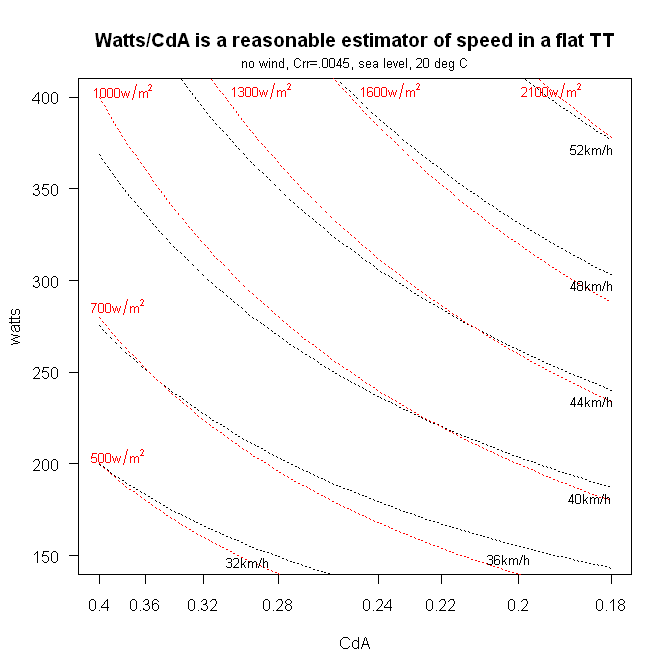
Sometimes it’s useful to get rough estimate of CdA from your power and speed, either as a sanity check or as a baseline starting point for more careful analysis. In those cases, here’s a rough ballpark estimator for CdA given power and speed.
21 Likes
Crr 0.0045 
Plus extra text to make up the content of the post
Is weight not relevant at all in a flat TT? Was expecting the Y axis to be watts-per-kg…
Not in a flat TT, no. It may impact your CdA, but that is covered by the chart.
1 Like
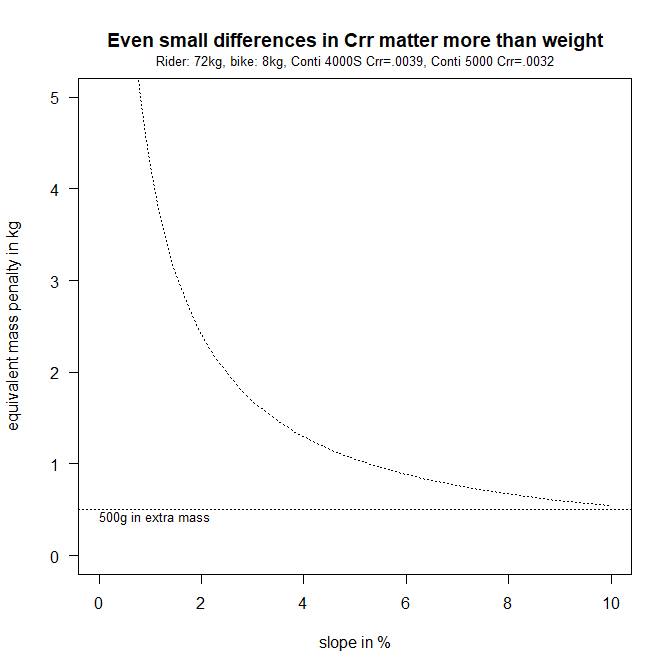
I wouldn’t say “not relevant at all” but I’d say “only a teeny tiny bit relevant.” You know what matters more? The Crr of your tires, even when it’s steep. This is for a difference in Crr of .0007 between the old Conti 4000S and the Conti 5000S; the difference between the Conti 5000 with a butyl tube and the tubeless Conti 5000 is about .0005.
6 Likes
Out of interest assuming the TT is completely flat, and CdA differences are all covered by the chart, what is the teeny tiny penalty for additional weight? Initial acceleration but then isn’t that balanced out pretty quickly?
Wow! I really need to reconsider my Bontrager hard case R3s setup with TPUs!
Total mass enters the force equation in three places: rolling drag (=Crr m g) , acceleration (= m a), and changes in elevation. If the course is completely flat, you can ignore the changes in elevation. So, even on the flat, there’s a teeny tiny penalty for additional weight: but for Crr of something like .005 (=1/200) that means that the penalty in rolling drag is about 1/200th of the change in mass. (That’s if we ignore the gravitational constant, but it’s a constant so it just scales things up or down).
2 Likes
That’s interesting, thanks.
it is such a great opportunity to have you here! I am quite deep into testing using your method, but I have a few points that make me a bit unsure about how confident I can be in my results/interpretations of the measurements. If I can freeze CdA or Crr, all the results seem to make sense in relation to each other. But with my current testing being about Crr and how suspension affects Crr, CdA and Crr change at the same time with a lot of tests. My protocoll is to first do a test on tarmac to find the CdA. This is done as an out-and-back on a road that starts flat before going into a slight downhill. I do 3 laps at different power levels. The thinking is that the speed differences should allow me to separate CdA and Crr, and I can get to quite high speeds without huge effort (that most likely would affect my posture on the bike). What I do is using the python script by dhanek on Github, searching for the combination of CdA and Crr that results in the smallest total error (usually below 1 m) for the 3 laps.
Then I go and do testing on gravel, again 3 out-and back laps with some elevation change. Here I use the same power for all laps, because I found that Crr apparently can be quite sensitive to speed on gravel. In the analysis I use the CdA found on tarmac. Now what makes me a bit unsure about how confident I can be with those results:
- The Crrs I find are surprisingly low. For example on tarmac, it matches exactly what Bicycle Rolling Resistance measured on rollers, while to my understanding normally you would measure a bit higher. And on gravel (which I would classify as somewhere between cat. 1 and ca. 2) I get as low as 0.0083, while @John_Karrasch measured 0.0086 on cat. 1.
- Moving the GPS gates can easily change the Crr by +/-0.0002 on gravel
Do you have any advice how to check the accuracy of the results? What would you say is a typical range of error?
Jonas: In general, you can get reasonable relative rankings by freezing either CdA or Crr but if you need actual estimates of the two (we don’t, always – but sometimes we do) you probably have to go to the trouble to estimate them simultaneously. John Karrasch discusses that here: Gravel Tires - Slicks, Tread or otherwise - there is no "best" - #146 by John_Karrasch
2 Likes
I’ve had this thought for a while, but am I just an absolute sail of a human being? I ride 0.0046crr tire (GP5000 AS TR 35mm) and my speed when doing ~320 watts is never over 35km/h even on relatively flat roads
The likeliest possibilities are that your power meter is off, or you’re 200 cm tall, or you’re a parachute. If you’re not that tall, check your power meter.
I did a dual recording session on my Tacx Neo 2T and my PM (Rival E1 single sided crank) was pretty close and within a few watts at efforts >10 seconds (sprints were a bit farther out but I don’t know which was ‘wrong’). I am 185cm and not super broad shouldered, but I am not slamming my stem on a relatively tall stack gravel bike (Checkpoint). No aero helmet, but relatively tight clothing and a 40cm handlebar.
I do have a speed sensor (just a Bontrager speed/cadence one) so I will try and find a suitable course for some aero testing before it gets too cold here. Maybe then we can see how aero a brick is 
This is your problem. Single-sided PM’s aren’t accurate or consistent enough for reliable testing / evaluation.
If you’re desperate enough, you can do aerotesting with a coast down protocol (where you know the power is zero). It takes longer and if you can’t rely on your power meter then all the information for the analysis is going to come from speed and changes in speed, so you’d absolutely want to use a dedicated wheel speed sensor.
If you’re riding a Checkpoint and you’re 185 cm? Hmmm. Maybe your power meter is reading okay.
1 Like
Napkin math is 0.50±0.003 CdA`, assuming stated ~0.0046 Crr, random sea-level Air Density, and ‘perfect’ vacuum chamber static conditions.
That CdA is not unheard of, and IME more common in the real world than one might except if stepping out of hyper-aero conscious, highly optimized niche bubbles. Where seemingly everyone has Sketch Magoo 0.195 CdA or better (which would grant 47kph for 320w, over the initial stated 35kph)
3 Likes
I concur. If the power meter is right, the ballpark CdA is 0.50 m^2, which probably isn’t unusual for a 185cm rider who isn’t optimized on a gravel bike. As an aside, a sheet of A4 or letter-sized paper is around .062 m^2, so 0.50 m^2 is around 8 sheets of paper. At 35 km/h, reducing CdA by a sheet of paper is worth a bit more than 30 watts.
3 Likes
Hey. 
Firstly if your pavement ain’t smooth it’s possible that tire is higher CRR.
CdA wise, I’m 175 cm and around 0.370 hoods position on my checkpoint with 50 mm tires. Really depends on lots of things with that though.
1 Like