Wheelbase, trail, and affordable aero frameset options

I’m looking to buy an aero frameset to build up with components I already have. I’m after something that’s definitely an aero frame rather than an all-rounder, while at the same time being able to function (more or less, if not optimally) as an all-rounder - so not a really agressive, uncompromisingly full-on option like the Factor One or Ridley Noah Fast.

I’m also looking for something moderately affordable - so not a Cervelo S5 or a Pinarello Dogma F.

I’m fairly geometry-savvy, so I know what fits me and how to compare two frames to within a millimeter or two in terms of contact points when fully set up.

I’m currently looking at the Quick Pro ER1 (size M) and the new Merida Reacto V5 (size S). Both of these bikes would work well for me in terms of fit, but I’m concerned about other aspects of geometry that may affect handling and ride feel. I’ve historcally favoured bikes with trail figures in the high 50s and relatively short wheelbases. However, the Quick Pro in my size has a rather long trail of 64mm and a moderate wheelbase of 987mm, while the Reacto has a long wheelbase of 992mm and a moderate trail of 61mm.

I’m thinking that both options may be compromises to some extent, while also that having more stability for descending might not necessarily be a bad thing (I’m not the most confident of descenders). But I’m wondering how these two different aspects of geometry, both of which are supposed to make bikes feel more stable at speed, will compare in practice. Subjective reports of the ER1 suggest that it can be a little unresponsive in steering (which makes sense with the high trail figure), while ride reports of the Reacto with its long wheelbase (and also incidentally, high BB at 66mm drop) seem nonetheless quite positive.

Any other frame options I might not have considred? I’d be looking at the Scott Foil and Cube Litening Aero if they weren’t both near the end of the lifespans of their current versions.

5mm of wheelbase is IMO very unlikely to make a detectable difference unless the front to rear distribution is vastly different. Ditto about a few mm of trail, 55 and 64mm don’t feel much different, but more trail and stability is a bit nicer on descents, for me at least.

If you’re going to agonise about 1 or 2mm then maybe you should get a custom and nail everything down.

Expert opinions seem to differ considerably on whether a few mm of trail or wheelbase can detectably affect handling. I do know that I’ve had a bike with a long wheelbase in the past and another bike with a high trail figure and didn’t particularly like either of them, although that could have been as much to do with fit in the first case and a noodly front end in the second…

Custom isn’t really an option for an affordable aero CF frameset, but TBH I think my issue is as much to do with knowing what geometry I want as regatds trail and wheelbase, rather than availability of off-the-peg options.

For in-budget fast trail… normally what I recommend for folks in your similar situation are:

  • Seka Spear
  • Ribble Ultra SL R
  • Factor Ostro
  • Any one of the Treks Anagrams
  • Soloist

Spear has option of M vs MR. So you can truly fine-tune Stack vs Reach. Which based on your post seems right up your alley given your experience. Drawback of course is finding a dealer could be hard based on where you reside.

Ribble, heh. Yeah. Hey the trail is fast.

Ostro I’m sure you’ve already looked at and maybe passed up, given you mention The One. Ostro less aggro, but also slipping seatpost and kind of an old frame by today’s standards.

Trek Madone Domane Emonda Anagram… if you can find one on a nice sale price you can have your fast trail. But it comes down to your true budget.

Soloist is kinda “The People’s” Cervelo. And Cervelo models have fast trail across the board. I get S5 is out of the picture, so Soloist is there to fill that budget niche. But maybe you’re looking for something more aero, but configurability of it is nice.

Otherwise… ya you’e prolly looking at non-Sworks Tarmac but I’m purposely leaving out all the typical Halo Bikes because I’m sure you’ve done your research and considered all the obvious choices.

So maybe the only two ‘weridos’ are Spear and Ribble. Given you’re already discovered QuickPro, Merida, and the others.

Either way good luck on your hunt. No matter what you choose you will love it once clipped in.

1 Like

That’s because by themselves they don’t convey enough information. In my opinion, the more useful metrics are front normal trail / rear normal trail and front centre / rear centre.

FNT is front horizontal trail * sin(HT) so for the Merida it’s about 57mm. RNT is (wheelbase - horizontal trail) * sin (HT) so for the Merida it’s about 889 mm. The ratio between the two is 6.4 %which is slightly on the high side and IMO this will tend to bias the bike towards bum steering AKA steadiness. A ratio under 5.5% would bias the bike towards hand steering, AKA twitchiness.

Rear centre is SQRT( CS^2 - BBD^2) so for that bike is 405mm, leaving 587mm at the front (WB - RC). This ratio is also slightly high and again IMO biases the bike towards bum steering.

Since the bike has a fairly high BB and shortish wheelbase, the bias towards bum steering is probably appropriate but I cannot predict whether that suits your riding style.

I couldn’t do the calculations for the other bike because their website is showing a certificate error but if you give me the HTA, CS length and BB drop I can work it out.

4 Likes

I have a Domane (trail 59, bb drop 80, chainstay 420, wb 1010) and a SuperSix (trail 58, bb drop 71, chainstay 405, wb 980) and they handle very differently.

I’m not sure which of the geometry differences is the cause or even if the reported numbers are correct (what size tires are those trails with, do they actually differ by only 1 mm). In any event, a few mm can make a big difference in handling.

The SuperSix is more fun to ride so long as the pavement is good and the descending speeds are < 45 mph. The “better” bike depends on the terrain.

Wow, that’s really interesting, and a whole new rabbit hole for me to go down! I’ll be calculating these metrics now for all of my previous bikes to see if I can detect a pattern..

I have an Excel spreadsheet I can probably add those calculations to, but for the Quick Pro, the HTA is 72, fork offset 45, chainstay length 408, wheelbase 987, BB drop 70 (seat tube angle is 74).

Thanks for that! I already have an “all-rounder” so would be looking more towards the mostly-full-on aero options. I hadn’t really looked at the Ribble because can’t find much on how it rides, reviews etc. Also, while I’m looking for value for money, I’m not necessarily wanting a budget option - for the Merida I’d opt for the higher-end carbon layup. I just resent paying £5000+ for a frameset, as would be the case with the S5s, Pinarellos etc.

1 Like

I’m with Mark that FC & RC are interesting metrics in regards to handling.

Stepping back, all metrics are really interesting – both in isolation and even more importantly how they all combo with each other. Given you are interested in self studying, will lean in a bit more than what was asked to hopefully get your thoughts going.

One way to approach bike handling is to split into 3 Major Categories, with the understanding that all Three Categories must come together after inspecting each value.

Category One: Basic Frameset Metrics in Isolation

  • Trail / Rake
  • Head Tube Angle (HTA°)
  • Front Center (FC)
  • Rear Center (RC)
  • Bottom Bracket Drop (BB drop)

Category Two: Finishing Kit

  • Stem length (impacts steering)
  • Bar width (impacts steering)
  • Stack Height
  • Saddle
  • Crank Length
  • Pedal
  • Tire Model, Width, PSI (impacts Trail, Wheel Flop, Distance from Ground to BB, cornering feel)

Category Three: Rider Side Final Fit & Form

  • Rider weight distribution between FC and RC
  • Final Saddle Position(s)
  • Cleat position
  • Grip (ex: drops vs hoods, etc)
  • The literal speeds the handling is optimized for
  • Overall Skill
  • Rider Adaptability

The reason FC/RC are interesting is they govern where the Front and Rear wheel may land in relation to where you sit. Imagine holding the Trail constant, and extending the Front Wheel waaaaay out in front of you the size of a football field, vs pulling it inwards right below you as if it were almost a unicycle. Intuitively, these two fictitious FC frames would ride extremely different, despite exact same Trail. Coming back to reality, most FC/RC’s will be within a “reasonable” range but still easy to have 10mm’s of FC difference when comparing extremes.

The takeaway is the individual geometries in Category 1 needs evaluation as a system.

Now overlay the fact that everyone’s bike fit over any same frame will likely be different. The final fit is a combination of morphology, fitness, and preference. Understanding one’s Category 3 bike fit gives clues towards Category 2 – how the bike ends up being finished. As mentioned, a 90mm stem vs a 130mm stem is going to have different granularity over any fixed trail. Same for 42cm bar vs 36cm bars – let alone all permutations of Bar vs Stem vs stack height.

Tires impact effective Trail as well. But we know how much of a dominating effect tires that are even 5psi off can have on handling, even before the few mm’s of effective Trail that narrow vs wider road tires can have.

So without going thru all the nooks and crannies of how all the items listed and NOT listed above interplay … one approach is to understand fit then work towards geometries, then keep iterating. In other words, Category 3 → drives Category 2 → drives Category 1 → can re-drive Categories 2 and 3 … and as fitness changes and understanding improves … this cycle iterates endlessly.

To re-iterate, whatever you pick you will love. Because learning is the journey and all this stuff is really difficult to learn from books – gotta look at some geo’s that look ‘interesting’…

… then clip in and find out. :slight_smile:

So without going thru all the nooks and crannies of how all the items listed and NOT listed above interplay … one approach is to understand fit then work towards geometries, then keep iterating. In other words, Category 3 → drives Category 2 → drives Category 1 → can re-drive Categories 2 and 3 …

I think I sort of do that already. Although I have a tendency to be conservative, i.e. I know my saddle position relatve to BB, my reach to the hoods, bar drop relative to saddle etc., and I then work towards finding a bike frame with a geometry that allows me to implement those measurements while also ideally maintaining the same or similar stem length, trail, etc. and not having a stack of spacers. I’ve experimented a bit with bar width recently and come to the conclusion that 38mm at the hoods is probably ideal.

I’m a bit of a control freak and wary of changing several things at the same time, lest I don’t like the result and can’t figure out why I don’t.

But perhaps I need to experiment more. E.g., if I moved to the Quick Pro I think I’d need to get a 120mm stem instead of my usual 110mm, as while this will increase my reach by 5mm, a 110mm stem would decrease it by 5mm, and a 5mm greater reach from the BB to the bars might be an excuse to move my saddle forwards 5mm and explore a slightly more “progressive” fit.

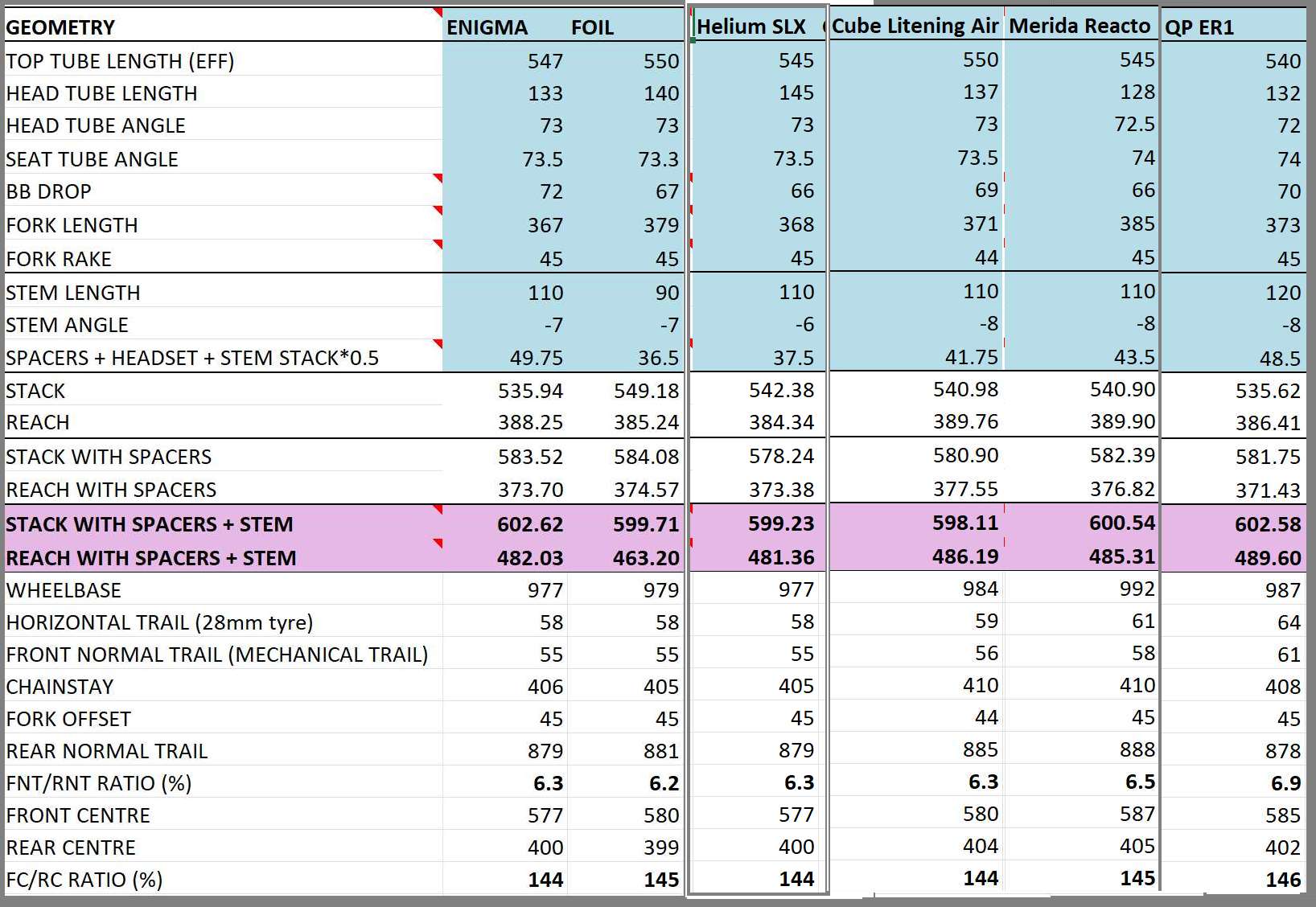
So, I got around to calculating FNT/RNT ratio and FC/RC ratio for all of my bikes as well as the Gen V Merida Reacto (size S) and Quick Pro ER1 (size M). All trail figures were calculated for 28mm tyres.

The remarkable thing is how similar nearly all of them are! All of the road bikes I currently have, including three rim brake bikes and one disk brake (the Cube Litening Air) have FNT/RNT ratios (expressed as percentages) between 6.2 and 6.3, and FC/RC ratios of between 144 and 145 (they all also happen to have 73 degree HTs, although the disc brake bike has longer chainstays and wheelbase). (Note that the (rim brake) Foil currently has bars fitted with longer reach but shorter stem, so while “reach with spacers and stem” is less, this is compensated for by bar reach).

The Merida is also rather similar with FC/RC of 145, but a slightly greater FNT/RNT ratio of 6.5.

The QP is perhaps the outlier with FC/RC of 146 and FNT/RNT of 6.9.