Hello Escapees!
I wanted to share my journey of using AI to become a better cyclist, or, as you’ll see later, a better endurance “athlete.” Why share this, you might ask? I wanted to reflect on how my perception of AI tools has changed, and how much they’ve impacted my life over the past few months. I went from being a huge skeptic in January to finding ways to leverage them today, to level up at work and to take my sporting life to the next stage.
Maybe a bit of context is needed here before jumping to my prompts. I am a mechanical engineer working in the field of vehicle dynamics. While I am specialised in trucks and buses, I have already coded a Matlab model to help me decide what type of bike will make me a faster commuter. I am also first and foremost a mountain endurance athlete, spending most of my training time trail running, mountaineering, and alpine climbing. I discovered proper cycling in 2022, when my father, freshly retired, wanted to race his first 1,000 km road ultra. I was keen to try the race with him and completed it before the cutoff time, despite having ridden just 2,000 km in training before. My back and my butt still remember, and I was surprised that ultra-road riders don’t drink beers on course. So much to learn still.
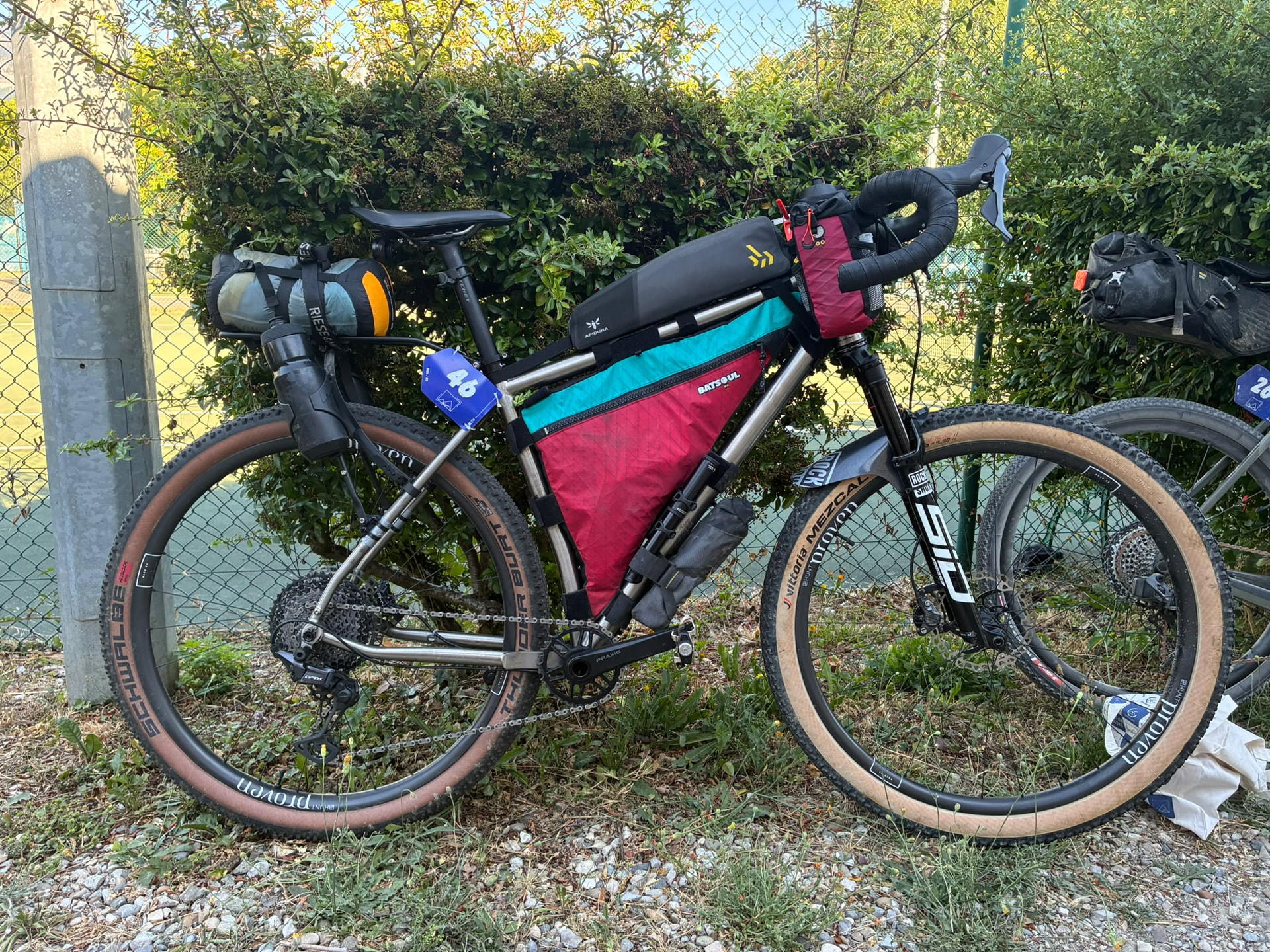
I am now racing (or, better said, wanting to race) in ultra MTB races and did complete the Elevation Vercors race last July, a breathtaking 350 km MTB race in the Vercors mountains, France. I completed the race in 42 hours, riding a monster gravel titanium drop-bar equipped with a 110 mm SID fork and 29 x 2.25 tyres. It was a blast to ride but, despite numerous bike fits and Pilates sessions, my back was in pain for weeks afterwards, and the descent in the drops and on the rough trails convinced me that flat bars are the way to go if I want to still enjoy such races.
Looking to try once more this race, I sold the monster bike and was on the market for a flat bar one. Lying on the couch, pondering why doing ultra if it is to feel so miserable during recovery, I started to use AI, asking it questions and advices about which bikes to consider if I wish one day to ride the Silk Road and the Hellenic Mountain Races. Such prompting gave not so interesting answers, AI looking at the major bike brands website in search to marketing materials listing such races, and suggesting that I shall buy bikes I knew would not be comfortable to ride. Thinking that AI is rubbish in niche application, I changed tactics.
I didn’t know how to find a geometry chart at that point, but I used the Bikeinsight website to compare potential successors with the bikes I already owned. That gave me the idea to use AI to learn what the angles and distances in a bike’s geometry mean for bike dynamics. Here’s the key point: I’m an expert in vehicle dynamics, so I can tell when AI is giving nonsense. It’s been my biggest lesson in 2026: to use AI to expand your skills, you need to build your own expertise first.
Technically speaking, I am using the Claude system, allowing a connection to Notion. This means that I am prompting Claude with questions and asking it to store the answers in a Notion page. Using this method, I ask AI to list all angles and distances that make up a bike’s geometry. Then, I ask AI to define the influence of each parameter on bike handling and comfort. Something I have found useful this year is to ask AI to audit its own work, using Notion to let it forget that it wrote it.
Now that I have this bike-geometry cookbook, I asked once more what geometries I should consider if I want to race such ultra races. During the process, I refined the requests, suggesting that I need a bike that is a better climber while still feeling safe on descents, as race positions are earned on the climbs and descents are more for resting. Having now a list of angles and distance ranges to consider, I ask what bikes could cover such ranges, and AI gives me much nicer suggestions. Again, you need to be knowledgeable in the field in which you are using AI. While not knowing all brands and models, I knew I was on the right track seeing Sour Pasta Party and Fairlight Holt in the final selection.
Next step is to see if I can recycle my 110mm SID fork. Most of the geometry figures were given for a 120 or 130mm sagged fork, meaning I wasn’t sure that fitting the 110mm fork wouldn’t push the angles outside the ideal range, specifically for the head and seat angles. So I did something I find very cool with AI: developing an HTML visualization tool. To do so, I prompt it to find the mathematical relationship between all distances and angles of the geo chart, and pass it to me in a Markdown file (a text file that’s very handy to manipulate), so I can double-check the equations. Looking okay, I then ask it to create a tool allowing me to select a bike from this suggested stable and pick different fork lengths so I can see the impact on both head and seat angles.
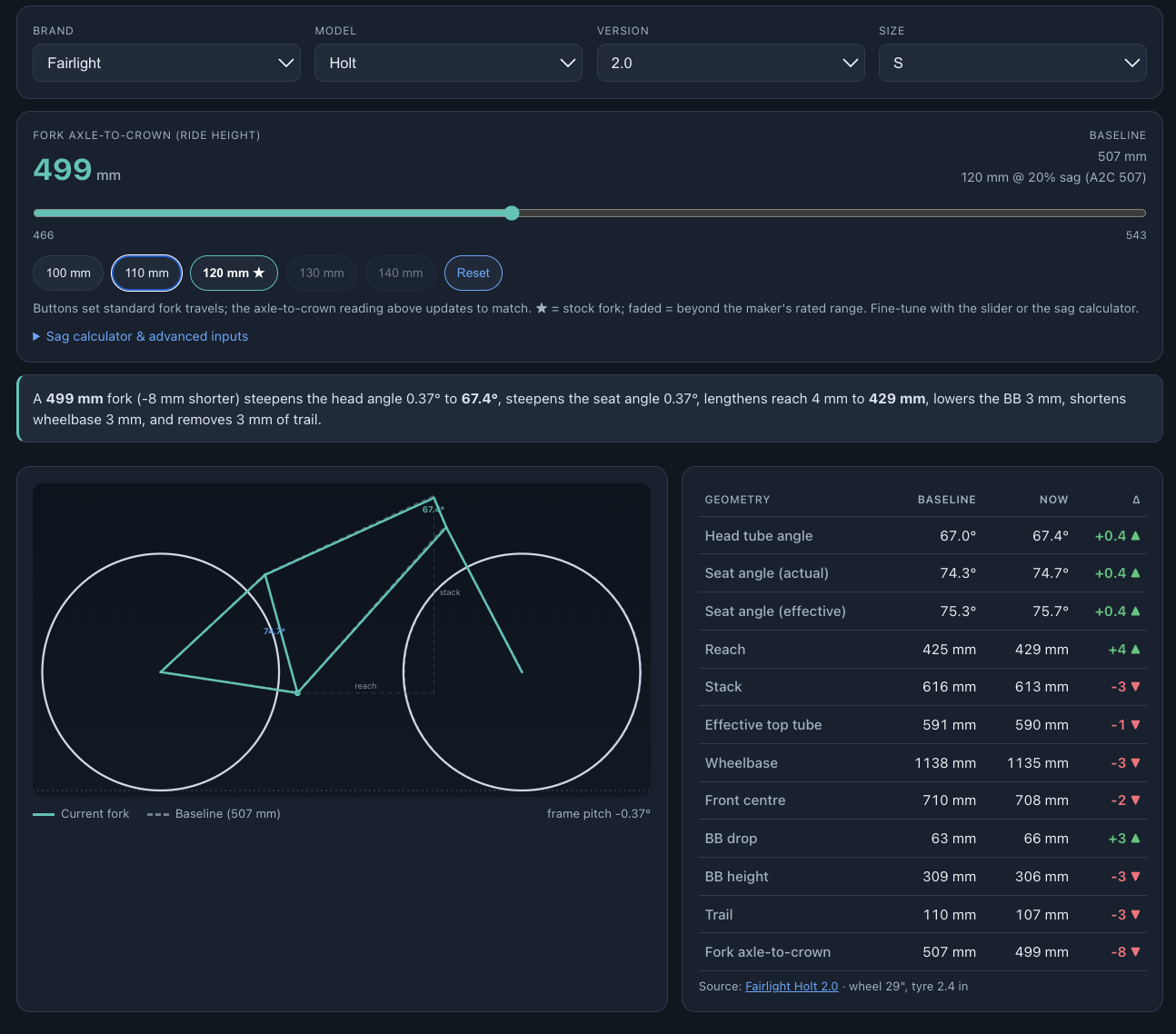
All of this ‘work’ made me consider, in the end, that my next bike will be either the Fairlight or the Sour. Finally, I selected the Fairlight, as it might have better corrosion resistance, and Fairlight offers to mount the headset and bottom bracket at their shop. But the Sour was so beautiful in white.
Next: how I use AI to develop a race planner and a race cockpit; how I used it to finalise the build kit; and how I use AI to develop my own version of TrainingPeaks and reverse the relationship with my coach.