Hi everyone,
I’m an avid fan, mid packer, listener of the pod (and member), basically your neighborhood chopped unc. I’m also a grad student who recently completed a project based on some research regarding the UCI’s points system and the incentives for a ProTeam. Anyways, I think it’s pretty cool and I haven’t seen this type of research out there looking at the points system and the outcomes they lead for ProTeams.
I also built a tool to help identify races on the calendar with high points density relative to a weaker field. This includes a ProTeam Risk Monitor with metrics I identified as important for managing wildcards and promotion. I would love to get some feedback, and please let me know what you think of the app.
https://yxm9w8kqyomp59utudywjt.streamlit.app/
happy to answer questions on the methods, and also share more research on the topic!
3 Likes
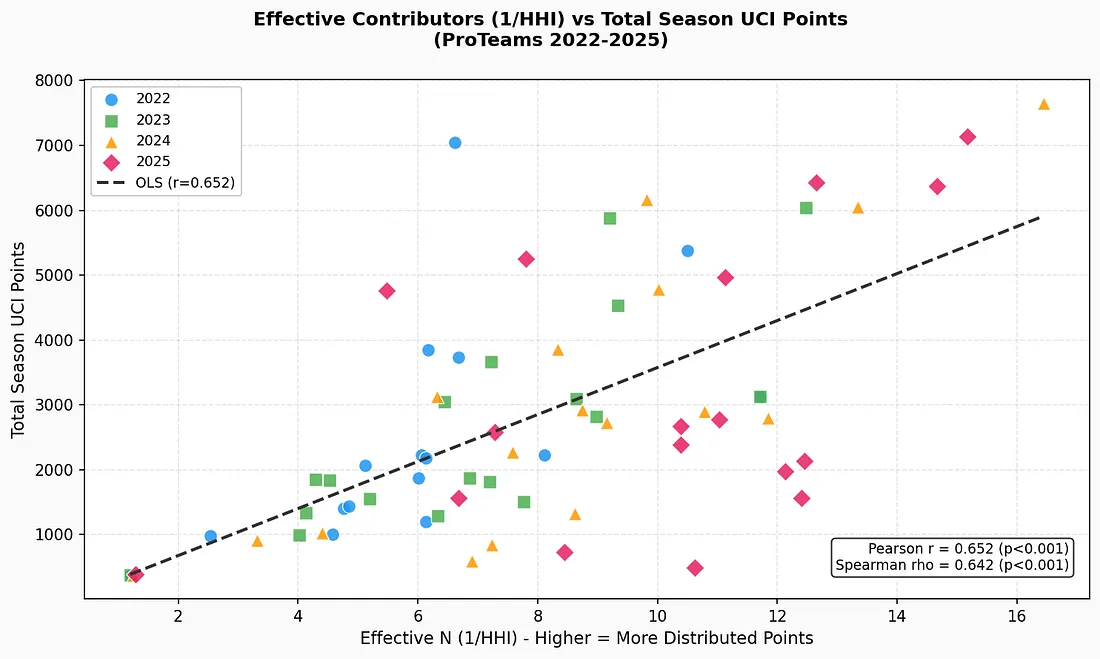
I wanted to share a quick look at some research I have been doing on what actually makes a ProTeam successful. It turns out that having a few big superstars might not be the best way to win. Looking at the data from 2022 to 2025, the teams that were successful were the ones with a deep roster where everyone was scoring points.
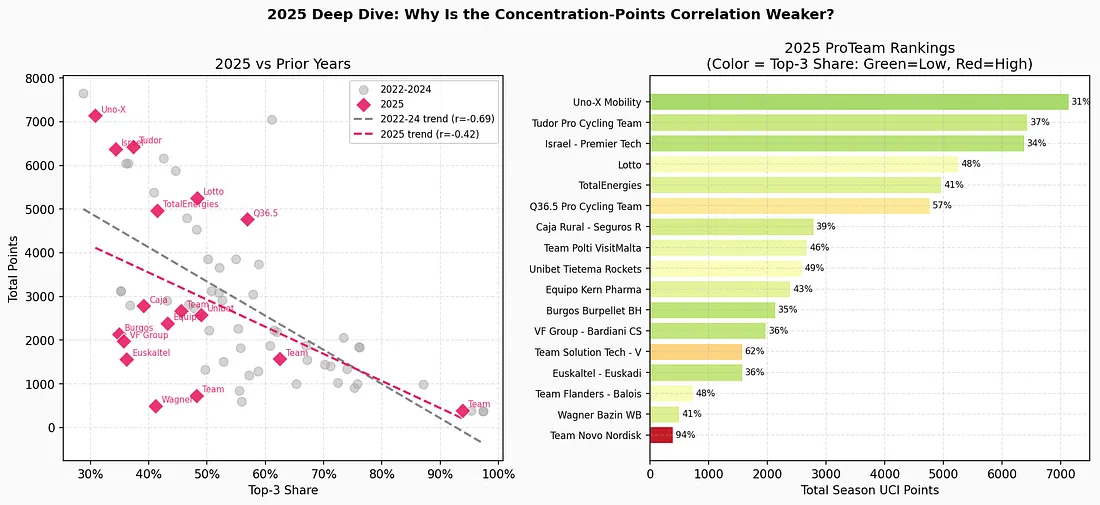
Think of it like this: when a team relies way too much on just its top three riders, they often hit a “Top-Heavy Penalty.” The numbers show that these teams averaged about 1,841 points per season. But teams that have more depth and consistency they have riders contributing points averaging 3,787 points. That is a huge difference!
To keep track of this, I use a simple metric called Effective N. It basically tells us how many riders are contributing. The best teams like Uno-X Mobility often have 15 or more riders scoring regularly. On the flip side, teams at the bottom usually have fewer than 3 riders doing most of the work, which makes them really vulnerable.
While a couple of teams in 2025 managed to win big with just one or two elite riders, the overall trend over the last four years is super clear. A superstar can definitely win you a race, but a deep and well-rounded team is what wins you the whole season. For any team trying to climb the rankings, investing in the whole group is a much safer and more rewarding path than just banking on one person.
I have attached the charts below so you can see how the numbers look. It is a really interesting way to see how teamwork actually pays off in the long run!
1 Like
Other than preventing relagation is there a benefit to having more UCI points?
Yes! For 2026, the top 3 ProTeam (from the 2025 season UCI world ranking ) get automatic entry into all UWT events, with the optionality to refuse entry.
This is very important because this gives a lot of flexibility of your calendar (you can race any UCI race from .UWT to local .2 races). Not only does this provide a team w/ the best opportunities for wins/points, but also allows you to provide sponsors the exact coverage they would want in return.
Additionally, these guaranteed entries in UWT races helps guard these team’s position by the nature of higher points density per race, for example a up to 60th place get awarded points for a 1.UWT race.
But even if you are not a top 3 ProTeam (from the previous year) you can still get the coveted wildcard entry into a grand tour, but eligibility is contingent on if you are a top 30 team in the rankings.
The nature of this drives a lot of decisions on calendar selection, roster/transfers, and ultimately tactics on race day.
One of the best examples of are the uni-bet rockets. I’m working on a case study of this right now, but from my view they’re executing all of these things really really well.
1 Like
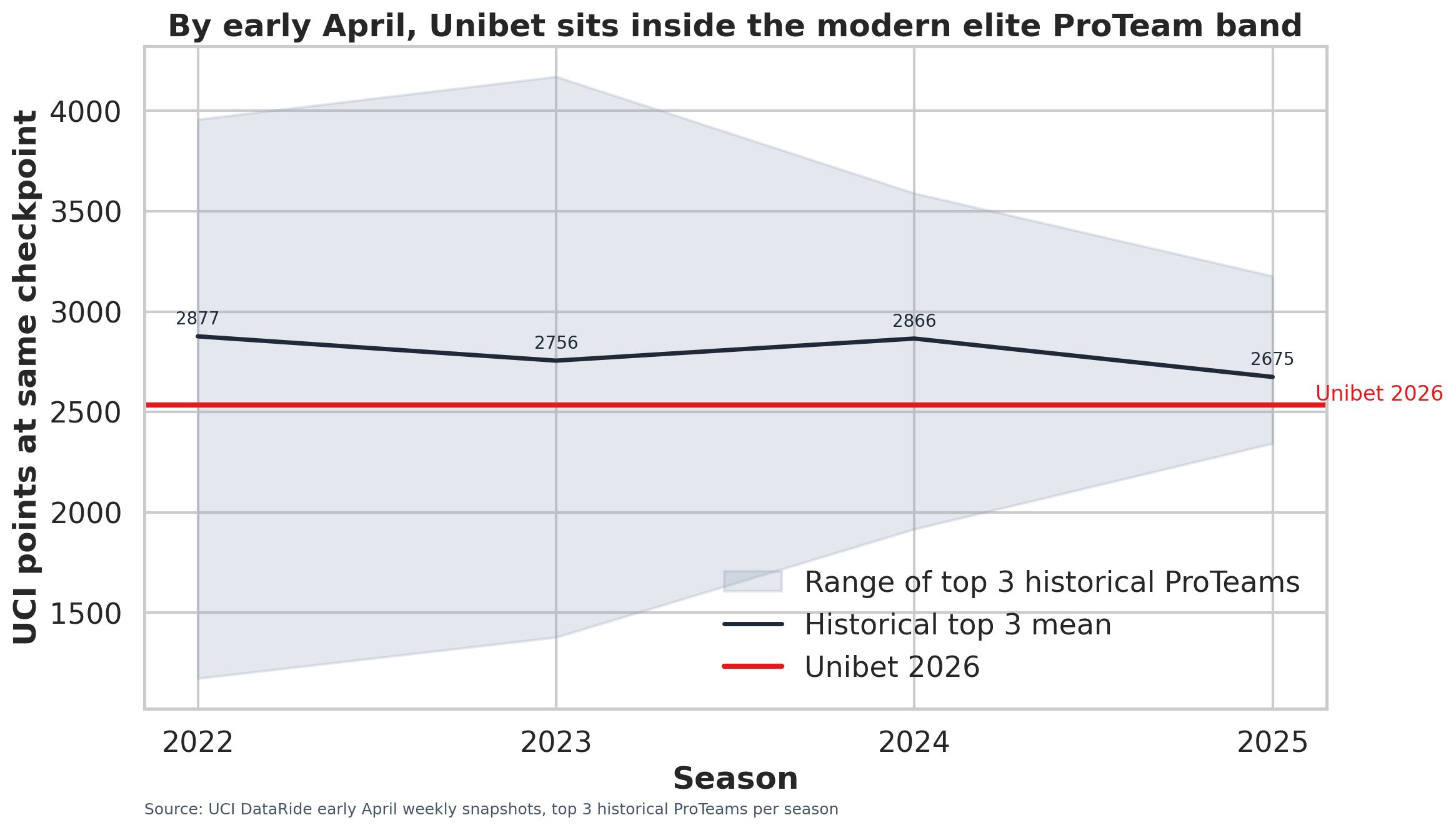
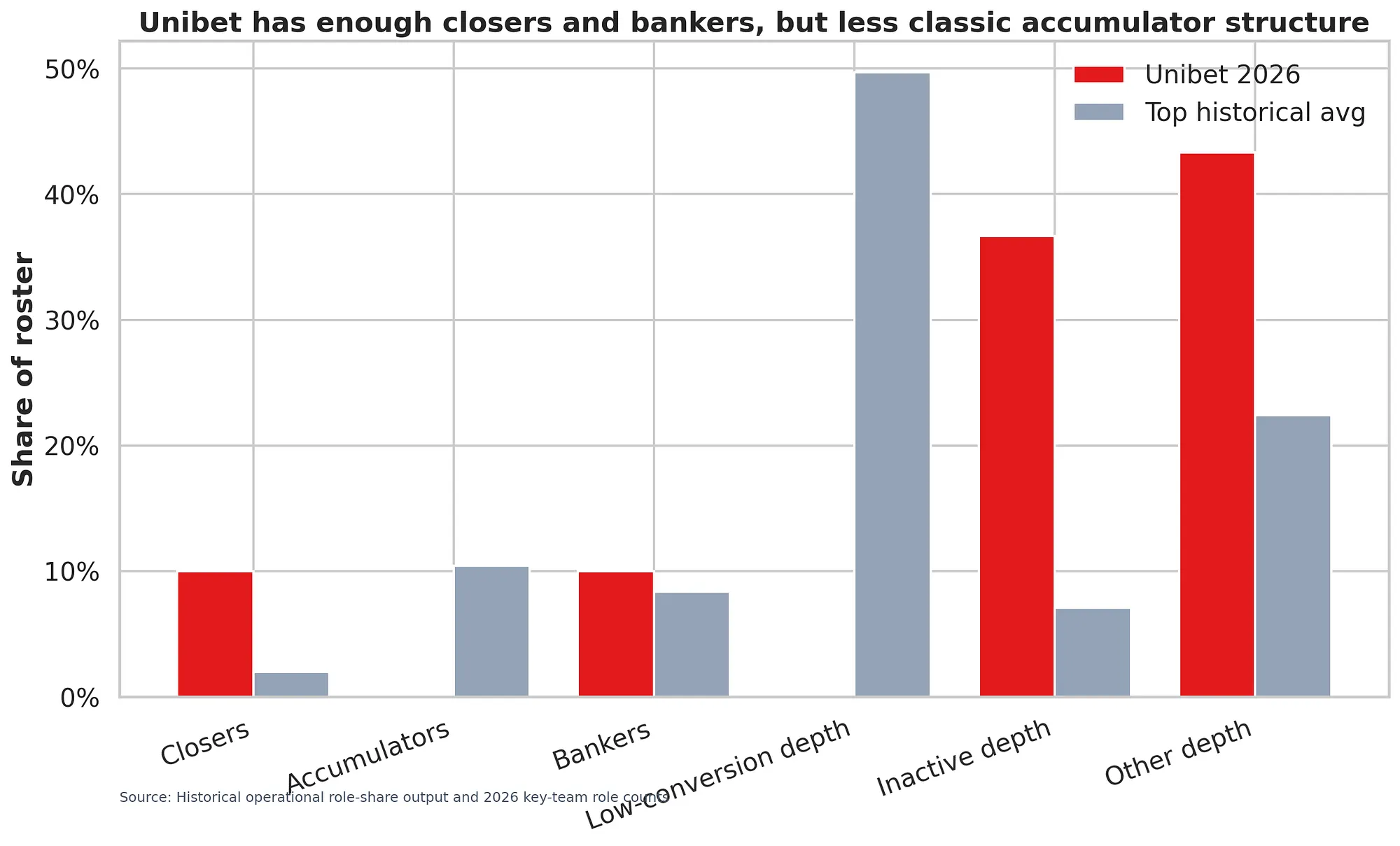
As threatened, here is my Full Write Up on The Rockets so far this season . Some TLDRs and some charts:
-
Trajectory: Unibet is currently tracking above the historical Top-3 ProTeam band. At the early-April checkpoint, Unibet has secured 1,842 points, which significantly exceeds the historical average of 1,412 points for top-performing ProTeams at this stage of the season.
-
Efficiency: Their ‘Accumulator’ riders are delivering exceptionally high value, with the top tier of the roster averaging 12.4 points-per-raceday. This is a 15% improvement over the 2023 historical benchmark for similar rider profiles.
-
Role Mix: Unlike past top teams that often relied on single-discipline dominance, Unibet is showing a more balanced and deeper structure. Their “Mixed Depth” and “Accumulator” categories represent 42% of their total point scoring, compared to the historical top-3 average of 31%.
The season is still very early, and a lot can change before we hit the Grand Tours. However, Unibet’s calendar is stacked enough for their riders to continue filling in their points gap.
I’ve made the entire underlying dataset for this analysis public on GitHub (link in medium), including the Excel workbooks and CSVs, so you can dive into the numbers yourself or use them for your own models.