The ever present Ranger Danger transformed into Ranger damage on my commute into work on Thursday morning. A bloke in an ESV did a hard left hand turn in front of me (I’m in Australia) and had to stop for a pedestrian crossing the road. Unfortunately that left him entirely blocking the separated bike lane I was travelling in and I went straight into his rear tailgate. He, of course, drove off as soon as the pedestrian cleared the crossing.
My commuter is a ‘94 Giant Innova steel flat bar and is largely undamaged, but it appears the front fork has been bent backwards. Is it safe for me to try to straighten them again with a long extension bar or should I pay the $80 for a new one?
For a commuter that’s going to take regular abuse on busy roads, I would personally replace. Not worth the risk.
4 Likes
The lawyer’s response is ‘always replace’.
If it is a small bend on steel fork blades with no sign of kinking, historically it has been considered fine to bend them back into alignment. Any kinks or other tube deformation, replace, no question. If the steerer tube is bent, it is very difficult to get it straight enough to avoid headset issues.
1 Like
I would probably just replace the fork as well. And do carefully inspect the frame. I did something similar. Bent the steel fork back, still tracked straight, but the handling got very twitchy. Put a new fork on and about six months later, the headtube/downtube lug sheered through, partially rusted. Looked like it had cracked in the crash and then took it’s time to finally give way.
1 Like
It’s impossible to give a definitive answer without physically inspecting the fork. If it’s only slightly bent at and/or below the crown I’d happily try to straighten it, but if there are any kinks, creases, or cracks not so much. I agree with Dave Minter that bent steerers are bad news, and are totally unacceptable with needle bearing headsets.
Truing forks isn’t rocket science but one must know what one is doing, and have whatever tools might be needed; framebuilders should have these, (and maybe better, older shops) but newer ones are much less likely to have either the tools or expertise; one cannot true carbon.
1 Like
Best bet is to have a local (if available) framebuilder take a look at the fork. If it’s not too badly off it could be shifted back. That job takes a bit of experience and the right jig. There is a point where it’s just not worth it. For me, personally, it’s the idea of landing on my face and losing teeth.
1 Like
Thanks everyone for your advice and experience. You are all correct - the risk is just not worth it, and the chances of me doing a good job with the tools I have are diminishingly small.
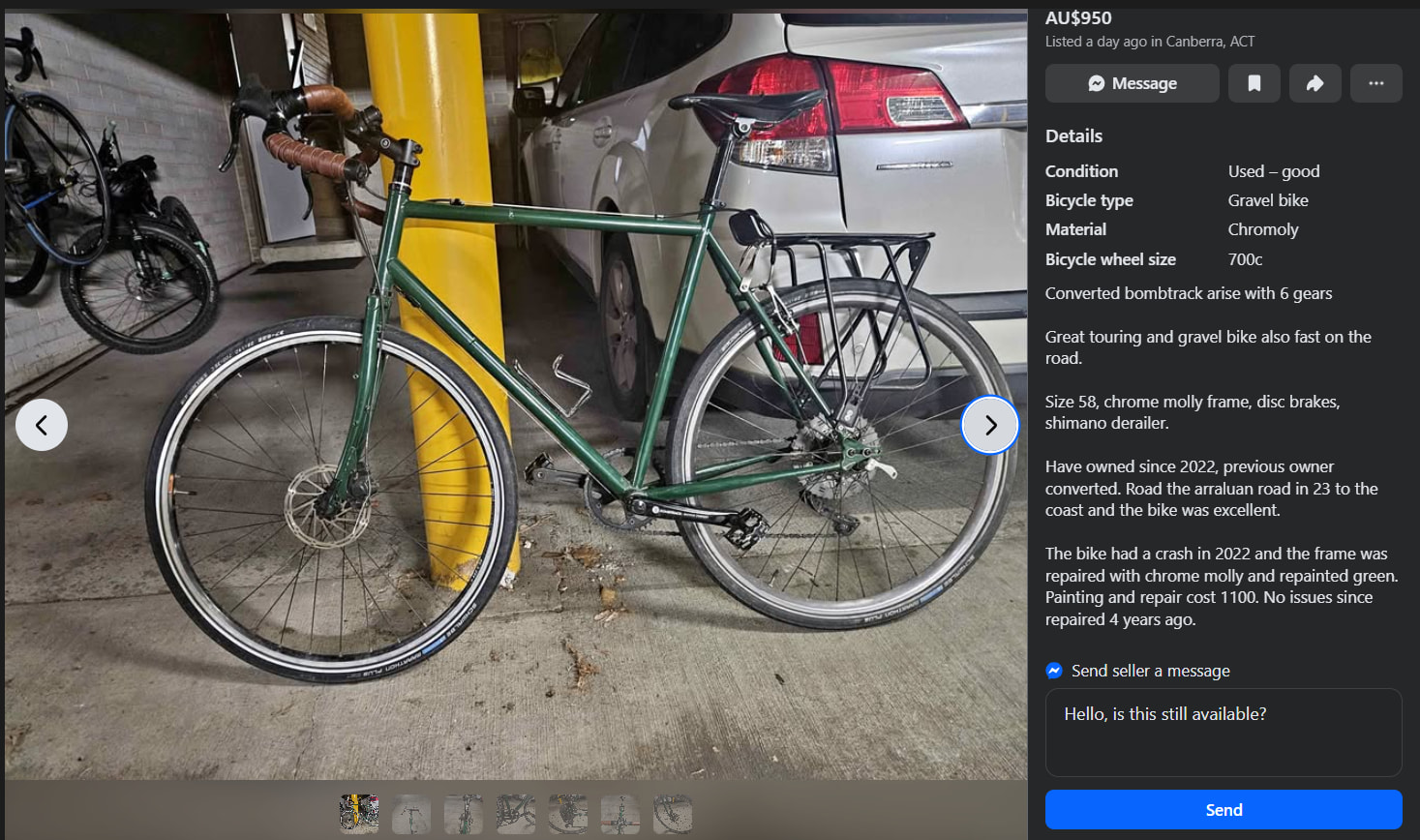
This ad made me think of this thread 
Of course you could just be blissfully unaware, ride your bike for a few years and then sell it as “repaired with chrome molly” and “no issues since repaired 4 years ago”
3 Likes
That’s both hilarious and frightening! I can’t imagine what it would be like to ride. The vendor did miss the opportunity to upsell the custom shortened wheelbase for quicker handling.
1 Like
Took the opportunity to adjust fork rake whilst being repaired to better suit my handling needs
2 Likes
Saw this a lot back in the day. I mostly straightened them only on shitter bikes we’d use for shop purposes. They were never the same and were, it seemed, weaker and prone to cracking. Also, as mentioned, check carefully for any dimples at the top-head-down tube junction. Personally, if you rely on the bike at all, just get new ones.
2 Likes