Absolutely on the standing-climbing-relaxed thing! It can actually be a way to take a short rest on a climb, as you are using your body weight to provide a good proportion of the power (while at higher efforts the body weight on the pedals becomes much less significant as a proportion).
Something I found on NH/VT gravel: Sometimes the steep stuff is so steep that you can’t stand due to traction limits and you have to grind it out sitting. So I’ll often stand on more moderate grades just to use those other muscles and “save” the seated ones for when I really need them.
I find that good practice for relaxed climbing is to find a moderate grade with rolling pitch changes and try to do the whole thing standing, shifting as needed to stay comfortable.
For me the weak point in extended standing seems to be my lower back. Off-the-bike work definitely helps with that.
1 Like
Sorry, but I think you are conflating two things here .. the effort required to produce power, and the resultant power itself.
For power to remain the same with a shorter crank v longer crank, the cadence must increase. Power = torque x cadence. Shortening the crank reduces the torque, so …..
How efficiently the body produces that power is I think what you are getting at otherwise, and it’s fair to say that changing crank length will change that efficiency, giving that spinning requires less muscle strength but applied more frequently.
Which crank length is right for you in terms of efficient power production could only be measured in a lab, measuring things like CO2 production and such like.
I’m not conflating anything. When it comes to humans, in this case, power as measured by a power meter isn’t just a function of the definition of torque in mechanics. It’s also function of biomechanics (range of motion, joint issues, etc). As a result when a human switches from a longer crank to a shorter one, they may see an increase in power without a change in cadence. This is because that change in crank length may decrease power dissipation or make it easier to apply power in certain regions of the pedal stroke.
A person may (absolutely will) apply different levels of torque (and therefore power) in different parts of the pedal stroke, but it’s the full stroke that matters in terms of power measurement.
You could get a power figure from a small part of the pedal stroke if you can get the angular velocity, but it’s meaningless without measuring the rest of the full pedal rotation.
I think I know where you are coming from now though. If you ride at the same speed with two different crank lengths but use the same gearing, you must be pushing more force onto the pedals when riding with the shorter cranks compared with the longer cranks, because power is same, but torque is reduced, so force must be higher.
In reality through, this feels harder, and so when going to shorter cranks people adjust for the higher force needed to overcome the shorter lever by dropping a gear, thus reverting to the previous amount of force on the pedals, which combined with the shorter crank typically allows them to apply the force for longer, and thus the the net result is the a lower overall torque but higher cadence for given power output.
What is best/most efficient is unique to the rider and the riding they do.
There will be a limit to this, where too short results in the angle through which the rider can apply the force reducing again, which I suspect is why we’ve seen some pros go super short but then revert back or land somewhere in between.
Uhm, yep, I know that, but that power measurement can be made at a frequency greater than your cadence.
I can tell you from looking at three months of data after switching to 165’s from 172.5’s (which came after 175’s) that my power readings went up with no significant change in cadence. FWIW, Favero Assioma Duos measure power 200 times per revolution (1.8° per measurement), and that means 200 instantaneous angular speed measurements.
So your power across the full revolution went up, or just certain points in the revolution? Either way, that is interesting, and I certainly now see your point; I was maybe confused by the way you described your point in your previous posts. In essence, you are saying the force you applied to the pedal increased more than enough to balance out the reduce lever length, or you were applying the same force for much longer through the stroke, hence you talking about impingement preventing the body from producing power.
My move to shorter cranks was the result of the long term effects of a hip broken in a bike crash 21 years ago. One big consequence of that was difficulty producing power near the top of my pedal stroke with my right leg. Since the change to 165’s I can hold a given power longer than I could before. I wasted a lot of energy with not so beneficial adaptations after the crash.
To your question, yes, my power went up because I’m now able produce more power in part of pedal stroke.
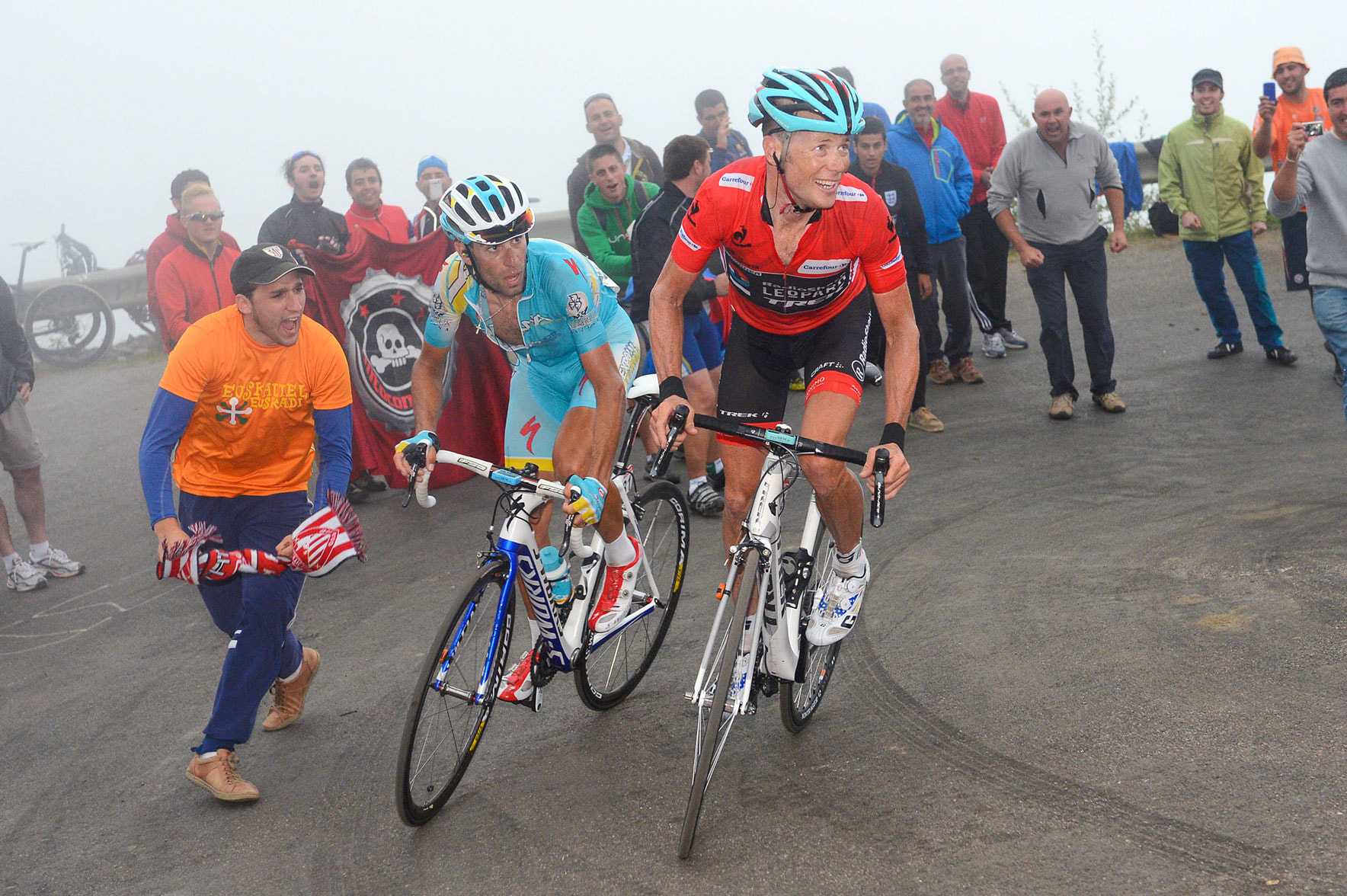
embrace your inner Chis Horner (yeah I know, could mean lots of other things) and dominate standing-climbing on wide bars (pic from Angliru, 2013 Vuelta):
I don’t have any serious recommendations for you (and am reading this thread to think through my own bar choices). I don’t race and mostly run 44 or 46cm bars (I’m 6’5” / 196 cm, though) but will probably put 42cm bars on my go-fast(est) road bike. But I do a higher % of seated climbing, probably in part because of my size.