As the title says, looking for a second opinion. Is this a ring of death? Bike was ridden with a loose headset on gravel for an unknown amount of time.
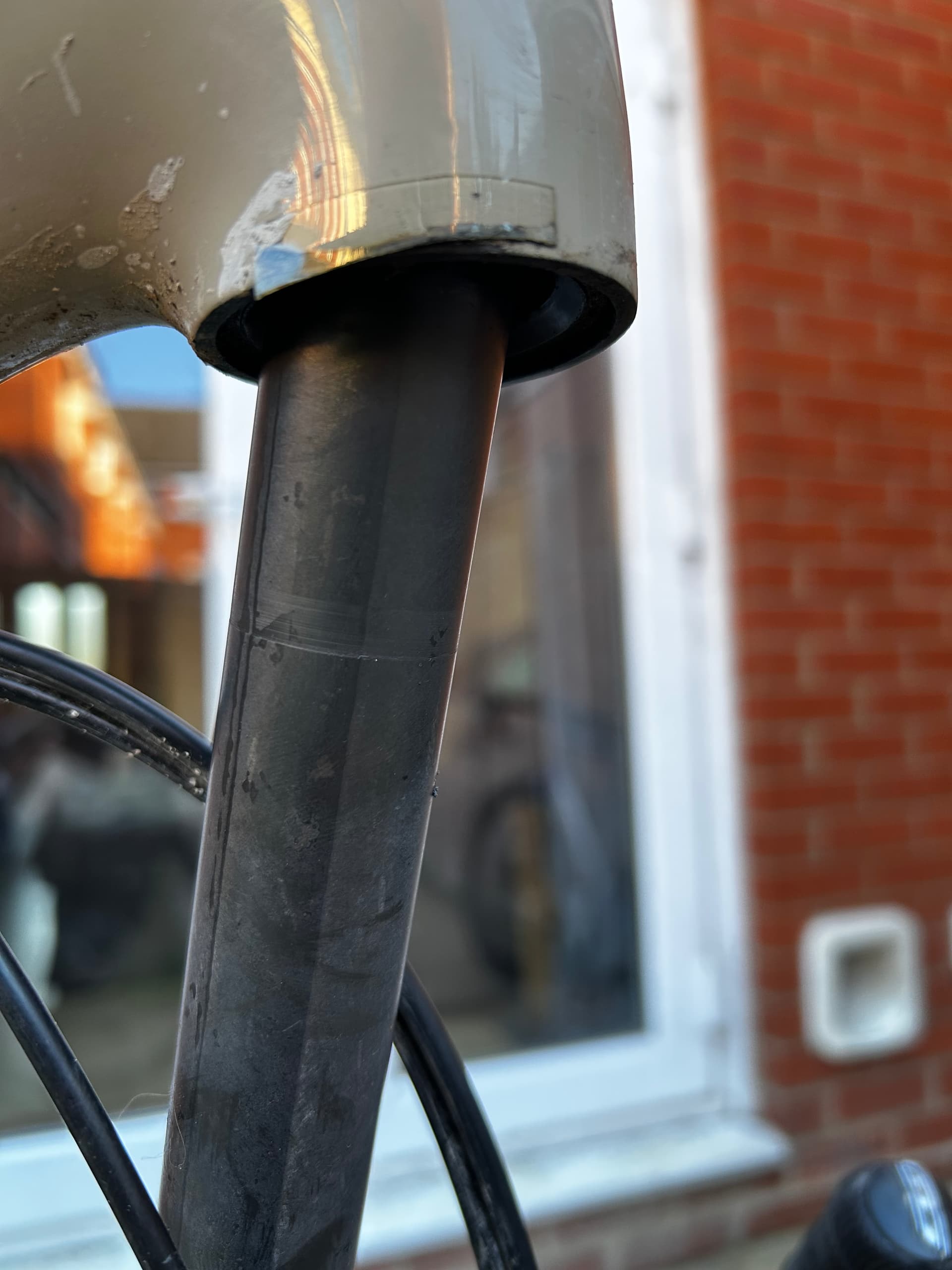
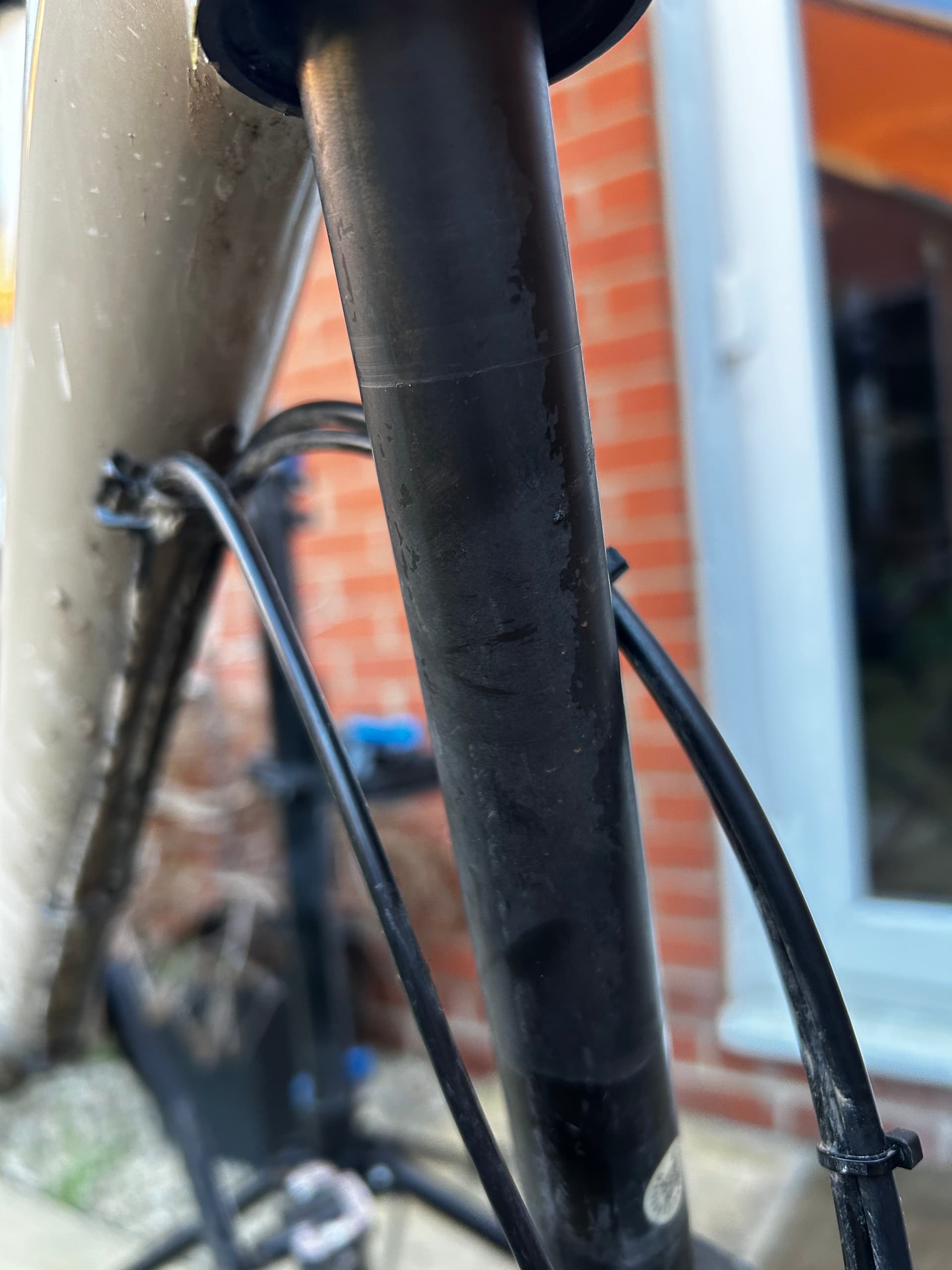
Pretty much any ring around a steerer tube is a ring of death…
It is, and that one looks pretty deep. I’d be inclined to look for a new fork, frankly.
This might be considered a hot take, but…
To me, it looks pretty shallow. IMO, if the wear isn’t even past the first layer, it’s fine. I sand the edges to ensure there is no hard step. This would help the compression ring find its ideal position instead of getting stuck where it once lived.
That said, if the light smoothing takes more than three minutes, that’s a sign that the wear is deeper than what I’d consider safe.
I wouldn’t sand it, but I would make sure it’s fully backed by a compression plug. I would actually be curious on a mechanic or manufacturer take—is an ever so slightly marked steerer tube still basically made safe again when fully / totally backed by a compression plug? I have to think so…
Most opinions on here aren’t going to give you peace of mind. You need to have a carbon repair place look at it.
Given how frequently these threads pop up here and on the previous discord it makes me wonder how many people are cruising around on RoD-ed steerers and not having them break. What percentage of people who own a carbon steerer could describe a RoD? How many of those remaining get their bikes serviced enough and to a high enough quality to have any issues flagged? There have got to be thousands of these riding around…
I had one and replaced my fork. Now I only need to worry about everyone else’s bikes.
I wish there were more info on the impact (no pun intended) of ROD. But even more, I wish our sport didn’t involve such nonsense like a critical part that is so easily damaged. It just shouldn’t be an issue. I guess we consumers will be blamed for chasing grams.
1 Like
As a mechanic I see ROD ossasionally and the stance I take is to always inform the customer and advise, based on depth of the ROD, they either
A) replace the fork based on the depth of the ROD being deep.
B) they have a carbon repair expert assess the fork.
The response from customers is mixed, the majority ask for the bike to be put back together and the bike returned. Do they get the fork inspected or replaced? I suspect not.
Some customers ask for cost of replacement forks, then faced with a potentially high bill, ask for the bike to be finished with the existing fork.
I’ve had 1 or 2 ask us to get the fork inspected for them.
I’ve then had a few others ask us to replace the fork.
Another option a few have taken is to use thebROD as a reason to purchase a new bike and use the affected one as a turbo trainer bike.
In terms of how many people have bikes with unknown ROD, I suspect quite a few. What I do see far too often, I’d estimate 40-50% of the bikes I see, is bikes with loose headset preload and rough headset bearings 
2 Likes
Thanks everyone for the replies. My main question was whether I was correctly identifying this as a ROD as this is a friends bike and I don’t want to give them bad news unnecessarily! It sounds like I have, although I believe it’s in the early stages.
I expect in this case they will replace the fork.
2 Likes