Years ago when I visited Singapore with my bike, I had a fantastic mechanic there - Stephen Ames of Valley Cycles - performed a full service on my bike. When completed, he sent me an extensive checklist on all the items he went through, a checklist that I wish more bike shops would provide to their customers. On the checklist, he had a category for torque check and he went through almost all the fasteners on the bike other than the bottle cages. That has got me thinking. How can the torque on the fasteners be checked? My understanding is that the torque being applied to a rotating fastener is not the same as one that’s static. Can the torque on fasteners be checked without loosening them and then tightening them to the proper torque? Or is it sufficient to set the torque wrench to a target torque and apply torque to the fastener until the torque wrench clicks (for click-type torque wrench) or beeps (for digital torque wrench)?
“The only way you can accurately measure torque is while a bolt is moving,” Boone states.
It takes significantly more torque to move a stationary fastener than a rotating one. For this reason, your torque wrench will only be accurate while you’re smoothly tightening the fastener.
Threaded #55: Things to know when using a torque wrench
I think that if you set the correct torque on the wrench and the bolt moves, it was definitely too loose, but if it doesn’t move and the wrench clicks, you don’t know if it was loose or tight. You have to loosen it and retorque.
We actually do provide a similar checklist for the bikes that come through the shop as well, as a commitment to the stuff we have actually worked on, on the bike, and to highlight issues we think that the owner should be aware of. significant crack on a carbon frame? That goes onto the checklist. Worn pads? Also on the checklist.
It helps us as well, so that owner are able to highlight areas that we might have missed, or simply weren’t aware of, and fix that on the spot (if that’s possible), delay the fix to a later date (if it’s not a safety hazard), or politely request for the client to return at a later date.
Interestingly, we also provide a checklist on fastener torque settings (alongside manufacturer recommended limits). In this case, we undo (and redo) the fasteners to the values listed in the “Set” column, again as a form of commitment to the client. To the cynic, certainly these values could be fudged, and we can only hope that the clients appreciate that that’s something that’s an absolute no-no here.
We also conduct annual surveys to identify pain points that we’ve missed (and/or could improve on). Notably, most clients hardly ever think to look at the invoices we send them (and share with, in a private cloud-based folder).
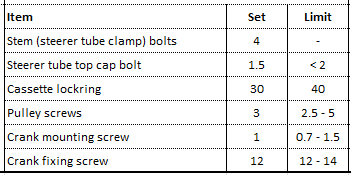
I’m curious: why do you choose to set the cassette lockring to a lower torque than typically printed on the lockring itself? And do you do the same thing when the lockring is used on a Centerlock disk rotor?
It largely depends. In this particular regard, the client had opted for a lightweight (internal tooth) lockring that had a lower stated torque limit of 30Nm. At around 32Nm or so, the teeth were starting to give, and I backed it down to 30Nm instead. You’d be right to say that the stated limit was incorrect though.
I’ve also noticed some (albeit slight) gouging on other lightweight alloy lockrings, including those with 40Nm stated limits. As such, I’ve pretty much settled on 30Nm for cassettes/rotors. Haven’t had any issues with cassettes rotors working themselves loose at those values.
Happy to hear what others think of this though. Would this be irresponsible wrenching?