There are several issues here as they were mentioned already. Older Schwalbe are usually designed to fit narrower rims, while newer Contis designed for wider rims.
Check Road Bike Tire Test: Continental Grand Prix 5000 S TR 30 - doesn’t look like there’s much if any rolling resistance difference with the 28c, with small weight increase. BRR also measures actual unwind width of the tire, so it is very helpful in comparing your old tire to what you are planning on buying width-wise.
I’m running 30mm Pirelli RS on 25 IW rims, and they are super comfortable, but also fast. Measure out to 34mm
On my 23 inner/28 outer wheels they’re 30.4mm - pretty much where they should be. A 28mm GP5000 or GP5000S TR measures at 28.1mm on the same wheels. A 28mm Grand Prix (not the latest version but the GP4000S peer) measures 30.5mm on the same wheels - it’s a tire designed for old-school wheels.
I’ve not tried the GP5000 30mm tires on my Zonda wheels - I should at some point.
For sake of argument, I mounted a pair of Conti GP4000S in a 28mm width on my Zonda wheels and they measured out at 28.1mm - not shocking given they were designed around a narrower internal width rim.
How are you measuring tire width? I had the exact same experience as you, finding GP5000 tires seemed to be a little narrower than expected. Then I realized I was 1. Not measuring when the tire was properly inflated, and 2. Eyeballing it poorly with a ruler instead of calipers.
Question: Does a “28mm” tyre that measures 27mm on one rim and 30mm on a wider one have a different footprint on the road and performance? Or does it only affect the visual width when looking at them?
So, might that shorter, wider contact patch still have a similar area and therefore a similar level of grip and ride quality? Or is shorter and wider better? Also, wouldn’t a tyre spread wider - and therefore carrying more air - feel harder at the same pressure than the same one on a narrower rim?
Theoretically it should have the same area, but with the tire on a wider rim, I think the casing stiffness will vary more as you move away from the center of the patch. So how that affects contact patch size might vary a bit. I in general , wider tires will have a bit more grip than narrow tires.
As for ride quality, the same tire on a rim with larger internal width at the same pressure will have a higher casing tension, and that means it will ride a bit more harsh. Lowering the pressure to get a similar casing tension to the tire on a narrower rim will get about the same ride quality but a bigger contact patch.
What the actual difference will be depends on the tire in question.
in theory (and practice, in theory - ha) for a given pressure, the downward force of a tyre contact patch is proportional to its area. as the force is the same (rider, bike over rear wheel) - so must be the contact patch area. that probably doesn’t hold precisely true as I’d kind of guess (could be wrong here, just guessing) that there is some interaction with the sidewall tension that supplements the force applied downwards on the contact patch by air pressure alone. but basically F = Px A so if you hold F and P constant, so is Area.
This is coming from my understanding of high performance car tires, like the kind one would use driving a car on a race track.
This is for the same tire measuring wide and narrow. My understanding is comparing a 25 vs 30 mm tire has been well covered with a general consensus.
As deflection is a product of system mass and tire pressure, the contact patch would be the same size for the same tire at the same pressure. As stated earlier, the wider measuring tire contact patch would be wider side to side and narrower front to back than a narrower tire. Generally this means more lateral grip (faster cornering before slipping) as well as reduced rolling resistance as the tire carcass deflects less, and/or the angle of attack and release of the carcass as it rolls over the ground. I my be less than correct about the last part.
I would think that at wide and narrow tires would feel the same at the same pressure. I not sure the increase in air volume of the wider tire would make any measurable difference.
Of course, I could be more full of stuff than a Christmas Turkey. Everyone fire away.
If we consider a bike tire to be a cylinder and the hoop stress is 𝜎=P*r/t, where P is pressure, r is the radius of the tire, and t is the thickness. Hoop stress varies directly with tire radius and also with pressure, so if we keep pressure constant and double the radius, the hoop stress doubles. If hoop stress goes up, tension in the casing goes up.
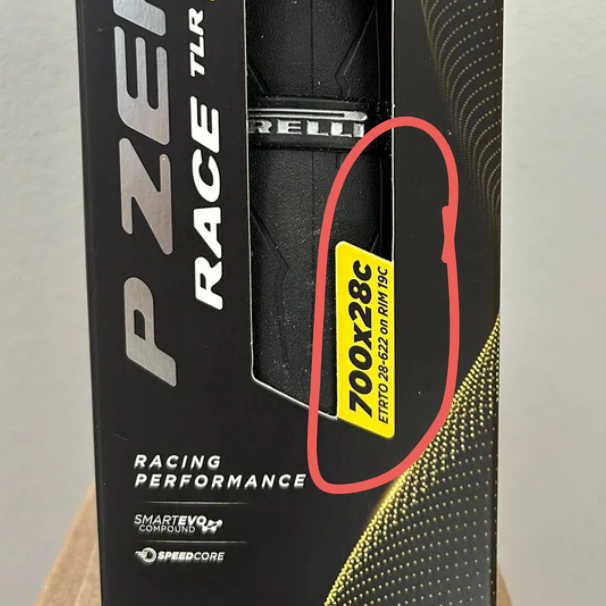
Yeah, it’s annoying that Continental only provide two examples (25 and 30mm each on different sized “measuring rims.” I noticed yesterday that Pirelli lists their measuring rim width at which their tyres measure the listed width on their packaging so that you know what you’re getting at the point of sale. I wish Continental would do the same.
That’s just the rim size ETRTO specifies for measuring tire width of a 28mm tire. Everyone uses that same spec, ie the ETRTO spec. It’s also worth noting that the ETRTO spec for a 28mm tire tested on a 19mm rim is 28 ± 2mm. If we use ETRTO published estimates for tire width on rims wider than spec, approximately 2mm increase in tire width for every 4mm increase in rim internal width (or more rationally, a 0.5mm increase in tire width for every 1 mm increase in rim internal width) the Conti 28’s that you put on the Maker wheels with 19.5mm internal widths fall within the ETRTO tolerance range.
With that said, such estimates are just that, estimates. Tire widths (measured flat from bead to bead) are going to vary a bit for a given size, and internal rim widths are going to vary a bit with respect to their stated internal width.
IMHO, a tire’s inflated width being off by a millimeter isn’t that big of a deal. It’s not something you’re gonna notice on the bike.
There is so much more to this than we’re often led to believe! The Geeks were talking about this recently and how the rule of 105 has now been disprove. There’s still a fair bit more to be understood, it seems.
Update: I’ve got some 30s, and they measure 29.2mm. That’s as big as I can go, so I’m happy. I’ve only got a couple of millimetres to play with under the rear brake bridge. Thanks for all the knowledge, everyone!
That’s true. The Rule of 105 may have been valid when aero rims just had v-shaped cross-sections for which flow separation happened several orders of magnitude more quickly than dollar separation happened from a cyclist’s wallet in a bike shop.
It’d be interesting to hear from a polymer engineer, especially one who’s worked at a tire company, about tire size variance and the factors that influence it. I’d guess that car/truck tires have smaller variances or are less sensitive to variances given their width and heavy construction (compared to bike tires).
Actually, I think it would be pretty damned cool if EC could do an interview with an engineer from a tire company that makes both car/truck/motorcycle tires and bike tires to get some insight into why bike tire fitment can vary so much.
True you may not notice, but in some situations, it is fit capacity that is limiting and hence knowing ultimate dimensions influence usability. Case in point, my previous rim-brake 2016 Cervelo R5 with Hed Ardennes black wheels (21 mm internal rim width) could only fit “23 mm” (labeled) Vittoria Corsa tyres due to chainstay rub …
 I noticed yesterday that Pirelli lists their measuring rim width at which their tyres measure the listed width on their packaging so that you know what you’re getting at the point of sale. I wish Continental would do the same.