Hi everyone,
This might be too recent of a release but let me try. I want to get Zeno couplers for my road and gravel bikes to travel in a small bag.
I already got one pair of the hoses they offer with the couplers already on it. The disadvantage is that I’ll have to pull the old hoses out.
now I saw that they also offer a DIY kit that allows you to attach the old hose to the coupler in the same way you’d attach a lever or caliper, I.e. with olive and nut: https://www.youtube.com/watch?v=nCeEAslY3zw
has anyone tried these? I think for the gravel bike it would save me a lot of time and effort without the aero and looks penalty being too much of a concern. I’m just worried that it could be less reliable than the pre-pressed hoses.
Surely a Zeno coupler would never reach the other end?
11 Likes
Not sure I follow or I’ve explained it well.
Zeno offers three versions:
- The shop version - you need a special tool to clamp it and you can use your existing hoses. I can’t use that because they seem to sell that only to shops
- Preclamped hoses - that seems to be the safest choice, but I need to replace the old hose which I’m trying to avoid
- DIY version where you can connect to an existing hose by screwing the pin and sockets on to the hose with an olive and nut.
I’m trying to see for option 3 if anyone has tried before.
Sorry, it was a lame joke. I just thought it paradoxical that anyone would name a connector after Zeno of Elea: https://greekreporter.com/2026/02/11/strange-paradoxes-puzzles-zeno-elea/
3 Likes
Ahh should have caught that - thank you for sharing
I didn’t realise Zeno was responsible for that “never get there” paradox, but crucially the couplers have a fixed, non-zero length, so it does not apply here. (I’m also interested in these for a gravel bike, but have never seen any, and probably won’t unless I order some.)
I have them on my bike because I wanted to test how much they improve servicability on integrated cockpits. I am not fully convinced, at least in current form and for use inside a frame. It takes significant force to connect and disconnect them, and they are quite slippery. So I need two pliers and quite a few attemps to do the task. Also not quite sure about the claimed dry connect/disconnect, I certainly have a few drops of mineral oil flying around when I finally manage to disconnect. If they sit outside on a travel/split bike, which was the original application, I am sure they will work much better.
Thank you for the insight - agree - I don’t think it would work well within the frame, just by seeing how little space the headset area typically has. For my bikes the hoses route under the stem so I do have space.
Did you get the regular version or the bigger DIY version? I suspect you have the regular because the DIY version that takes an olive to connect seems quite bulky.
1 Like
I have the crimped version. It definately helps if there is enough slack in the brake line. If it is a short section between the headset and where it it makes the bend to the handlebar, twisting it (as you need to disconnect) can become quite hard.
1 Like
I’m looking at the Roval Rapide one piece bars for my Tarmac. Those bars aren’t 100% internal, the hoses go underneath the outside of the stem and into the headset. Are yours routed fully internally?
I’ve put the “DIY” version of Zeno couplers on several bikes, in mineral oil and DOT versions. I’m a big fan. I found it straightforward to install them onto regular brake hose, although it helps [edit: it’s really necessary] to have a flat/thin 8mm box wrench along with a regular 10mm box or adjustable wrench to make everything tight.
I’ve only installed on 5mm hoses; idk if they work with 5.5mm hoses, which some brakesets use.
I’ve also found it straightforward to open and reconnect the couplers. There is a small fiddly clip to keep them connected, and I recommend buying an extra of those, and its little rubber leash, because the couplers are useless without the clip. Connecting them is a two-hand job, but I’ve never needed tools, and I’ve never made a mess.
I’ve only installed on external hoses, to make it easier to pack a bike for travel or to switch between drop and flat bars. I’ll let others comment about use for internally-routed hoses (which I avoid).
Thank you for sharing- I’ll give it a try. I believe you have the older version that comes with the clip. The new one is smaller and doesn’t have that, though it is a bit hard to separate (and needs space, so not sure it would work well for fully integrated bars.
Yes, they are fully internal on my bars. Might be easier on the Specialized cockpit.
I’ve got them on my bike. The cockpit is externally routed, hoses entering through the headset cover (which is not ideal, as it exposes the bearings). They’re a great idea, but even in this setup, they’re hard to work with, as it takes a lot of force to open/close the connectors, and you don’t have a lot of space to work with.
I’ve got an idea for a plier-type tool to open and close them, but so far it’s just an idea.
2 Likes
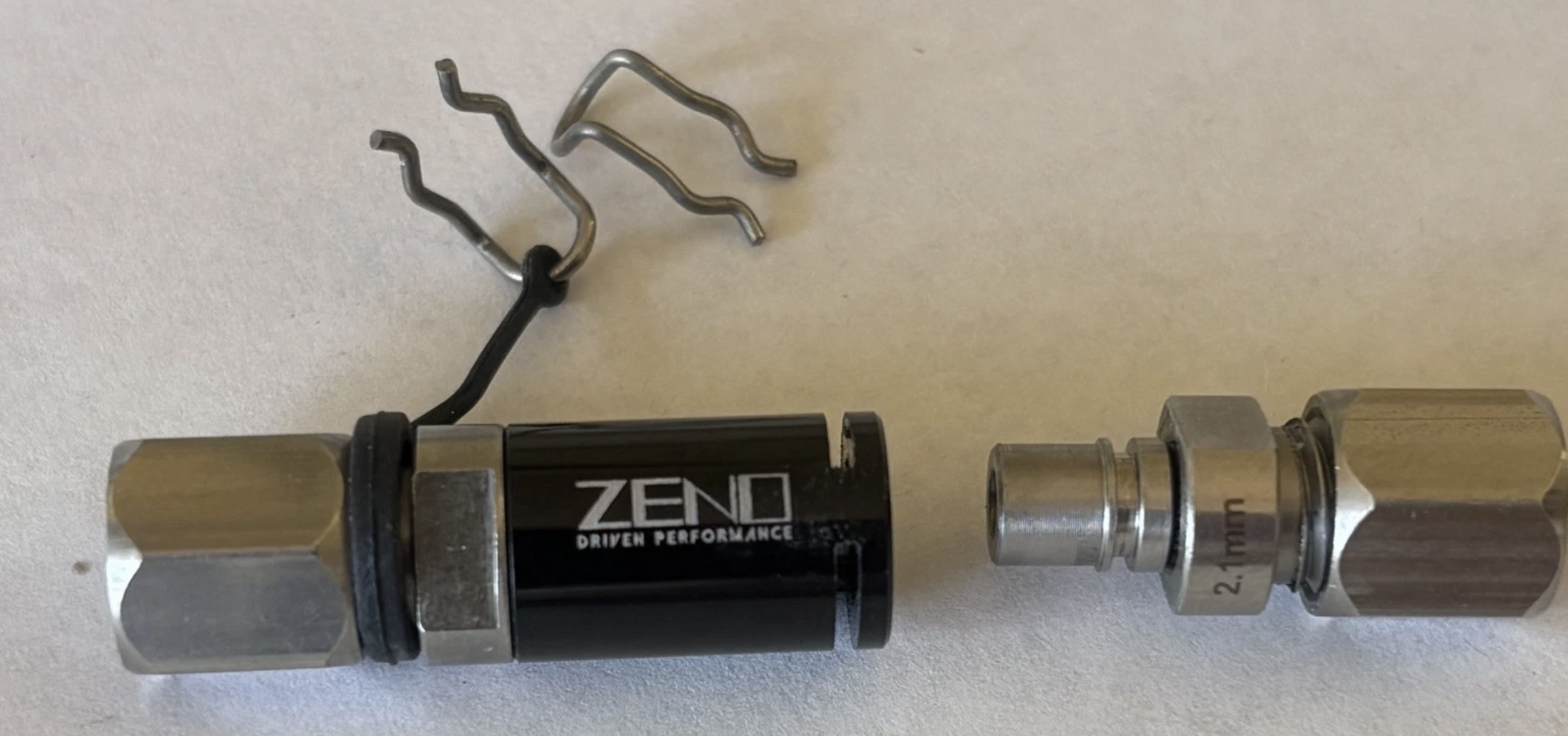
I looked at the video linked in the original post at the top, from 6 years ago. Those are definitely not what’s available now. What I have uses clips, and may also not be the most current version:
I know there is a new slim/low-profile version that does not use clips, but I think that’s only available preinstalled onto hose. Which is fine for many cases, mainly unless one needs a banjo fitting at the other end of the hose.
Interesting they do have a banjo fitting available. Q-Connector Hose adaptor from M8* P0.75 to Banjo – zenocycle. Not sure its advantage for packing a bike but nice to know.
This is the DIY version: https://www.youtube.com/watch?v=HGhB3Gk8j0E
It connects to the existing hose like the hose would connect to the caliper or lever, so you don’t need to add a new hose, but it’s more bulky. I just ordered it, will give it a try.
I share my experience with hose couplers if anyone’s interested.
I have not tried Zeno’s offering but I do run a similar hose coupler from TRP on the front brake of my gravel bike (Rival Xplr) as an experiment and so far I’m happier then I though I’d be with the result.
I have both a rigid fork with a semi integrated hose routing and a Rockshox Rudy suspension fork and I was looking after a solution that would allow me to:
A) quickly and easily swap forks, even possibly “in the field” if a last minute change is due.
B) not having to trim the hose and toss the olive and insert pin every time I have to pass the hose thru the rigid fork’s leg, until a new hose is due. Costly.
I bought a second Rival caliper + hose on sale, so both forks have their own caliper and hoses+rivnut installed so that all I have to do is screwing out and screwing in the hose of each fork’s everytime I switch.
I also have a seringe half-full of Dot oil and do a very quick mini bleed a the brake lever just to be sure.
I think the operation takes 15 minutes top. Both calipers are already pre-aligned to my best wheels
A few data points to add to the conversation, having run the Zeno’s for a couple of years on my internally routed travel bike:
- I used the pre-fitted couplers as I have to thread it through the headset and the DIY is too bulky for that
- I have an un-used DIY fitting and it looks robust, nicely it doesn’t use an olive like shimano so is reusable
- using it for internal routing has been perfect, there’s a coupler in the down-tube right where the frame coupling is and a second one under the bartape that I can peel back and disconnect
- I did try a couple of tool solutions and ended up using stainless wire loops attached to either side and can then just use my pack pliers to pull them together so no extra tool required. That said I’ll usually just do it by hand as it’s not to hard once you get used to it
- I’m not sure how many times I’ve disconnected the rear (the front is only used when I drop the forks which is less often) but it would but 15+ and I’m yet to need to bleed them
- I’ll be interested to see how the Gen2 tool-less ones work; Gen 1 can be fiddly but does the job
1 Like
I am currently testing this product. I have some travel coming up in the next few weeks and will then hopefully share my thoughts after that. I have already installed the pre-made V2 hoses and the Shop-type crimp couplers. I was also sent a couple of the DIY couplers.
The only real downside to the DIY couplers is in the increased outer diameter and bulk. Where the crimp-type offer a diameter marginally larger than the hose, the DIY version is more like a bulky hose nut.
5 Likes