I can make that exact same argument about people paying the huge entry fees for races from big organizers like Lifetime or Ironman.
1 Like
To be a professional musician in today’s world is a far cry from what being a professional musician was in the pre-music streaming era.
Where in the past, recording artists could rely on record sales and royalties to provide the lion’s share of their income, now most of these artists, with the notable exception of the top 1% or thereabouts, must rely upon income from shows/concerts and merchandise sales to survive. This is a lot harder than it may seem, particularly when these folks are on tour and away from home and family for months on end.
So please don’t get too upset when you’re asked to pay more to see your favorite artists perform. You’re likely getting their entire discography for almost nothing.
2 Likes
I compare this to the cost of the local cross country (running) league I started to do last year. £12 pre entry for the entire season of six 5 mile races. So for a fairly fit middle aged lump like me, around the same 40 or so minutes of a veteran cross race. Working out at £2 per race.
I haven’t raced cross once this season through injury, and I do miss it. But when it comes to comparing the costs … I mean is it any wonder grass roots stuff is dying on its arse? Road and TT in much the same boat I believe.
1 Like
“Why would I pay $X to ride public roads”
I’m not paying for a route, I’m paying because someone managed to put together hundreds to thousands of like minded individuals on a single day for me to go enjoy a day on the bike with that I may not have otherwise had the chance to. I’m paying for an experience, and if that’s what it costs, so be it. I want them to be able to feel that organizing and hosting the event was worthwhile so I have the opportunity to do so again in the future.
7 Likes
If the roads are closed especially for the whole route, that’s worth something.
There’s about 1 closed road sportive in the UK as far as I know. Given the roads are going to be open to cars, there is not much value to me in riding a route with thousands of other cyclists, many of whom are unsafe, and putting up with congestion in cafes / toilets / trains. Etc. vs. Just riding a route myself with friends on a day with good weather.
4 Likes
You forgot my PAS kit.
It’s not about the top end, it’s about bringing others into the sport/pastime.
There are 2 major factors in the cost increases for on-road cycling events:
- Insurance.
- Traffic management.
Insurance costs are best mitigated by the UCI affiliated cycling membership model - pay once annually. Instead, cyclists bitch and moan about the cost - then pay repeatedly at each non-affiliated event they sign up for. We can be stupid.
Traffic management is a tougher challenge. As a (former) bureaucrat, I note others have missed what I’d see as the key problem here - excessive red tape and rent seeking behaviour.
I’ve organised state level road races and experienced the scam that is the traffic management industry. The industry influences the standards / code that they are then obligated to follow in allocating excessive numbers of staff to redundant roles. I’ve witnessed it repeatedly - they turn up in droves and you can see half of them standing around with nothing to do.
If you question them (and I know we have in negotiating their procurement) they just tap on the standards that their industry pushed and say ‘we’ve gotta follow it’. It’s classic rent seeking behaviour and they have it stitched up.
The truth is they aren’t targeting cycling events - rather road managers, who are typically govts who just pay the bill without questioning it - cost it’s not their money they’re spending.
I don’t know what cycling event organisers can do about this - that is a tough problem to solve. The underlying cause is a greedy but motivated traffic management industry who have comprehensively outmanoeuvred sleepy govts who prefer to just pay the bill, whatever it is.
Cycling event organisers have near-zero bargaining power when we are bidding against govts willing to pay whatever they ask cos they aren’t bothered about the cost.
5 Likes
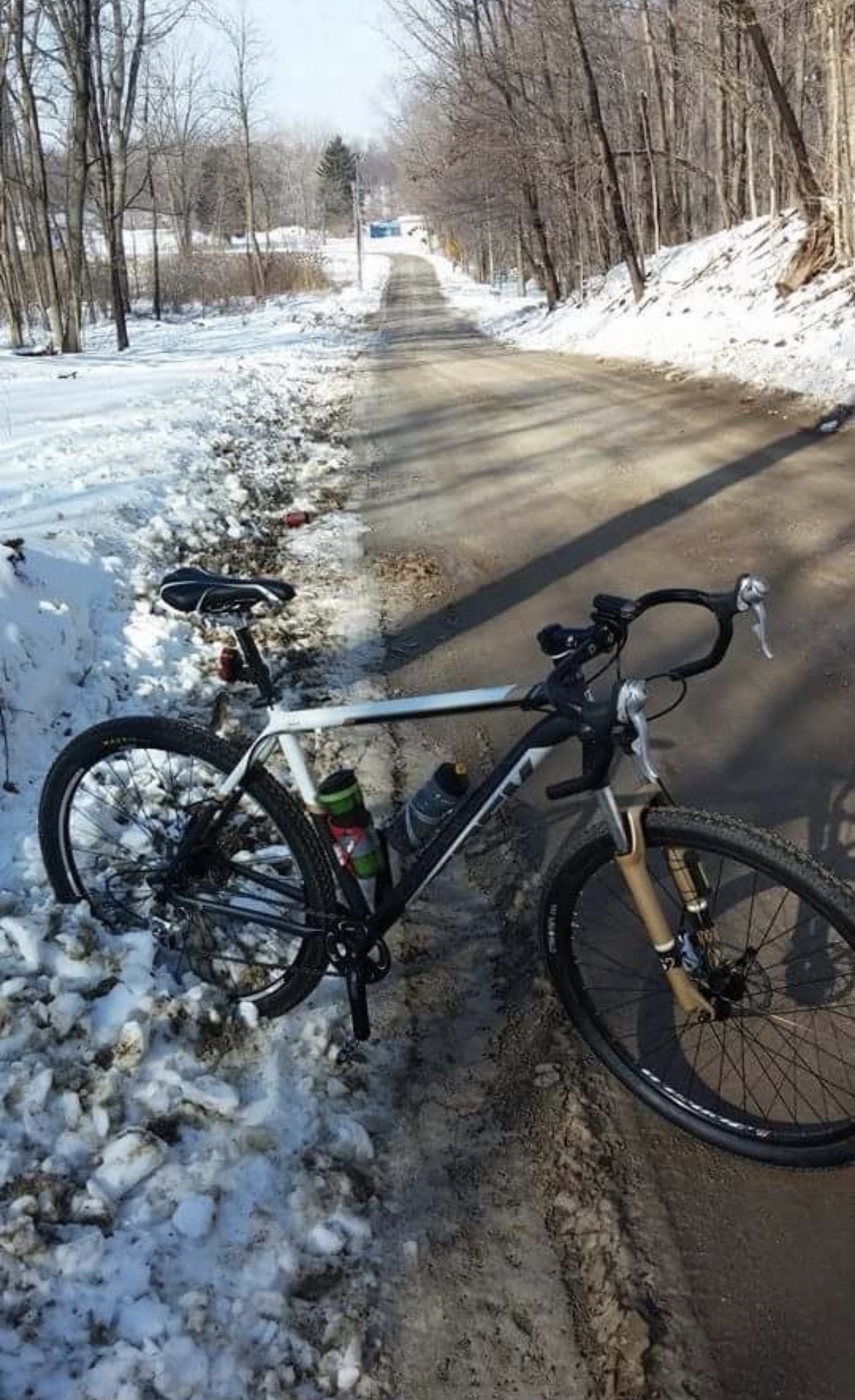
Ha! I did that event in 2013/2014 and it was def gravel before gravel was grãvël. No way I would have paid more than $50 for an event like that at that time. Had to confirm my participation years via the results. Cool they still have all of them in the site. I did the 36 mi versions. This was the bike I built for one year, single speed 29er, converted to 1x7 old Shimano RSX, and I did switch to rigid fork before the event, I think this is just the only pic I have and surprised I even found it 
2 Likes
Love it. There were many Frankenbikes, as I recall. I will also be overworked middle aged dad-ing my way into the 36 this year. I think I used my 'cross bike last time, around the same time as when you last rode it? Which basically worked fine, apart from the minor problem of no way in hell did I have the core strength or endurance to hold that position comfortably for the length of the event. So this year I’m taking a whatever you want to call it rigid road bike- shaped object with 650bs, 2,1" tires and appropriate stack and reach for long non-race rides (and ironically probably coming into it with better core strength). There will be a race up there somewhere.
1 Like
I remember to good old days of gravel, doing Almonzo in 2014/15. Entry fee was the cost of mailing a post card in for registration!
Our local MTB series is still a fairly good deal. ~$35 per race.
1 Like
Come checkout the hollo gravel classic in August. Postcard registration and free.
Thanks for the invite, but I don’t think I am fitting that into my race schedule. The MN MTB series has Mankato the week before and Tioga the week after. A races are Cheq 40 and CX nats.
Indeed. This is why I stopped doing events in the US a few years ago. US fees reached $250 for example. vs. €25-30 for the Vencoise fondo (and they still feed you). You do have to have a French license, but mine is €25 a year through my club, and it includes insurance.
2 Likes
What I don’t understand* is that if I want to go see one of the 1% then that’s where the huge ticket costs (3 figures) are despite the fact that those artists are probably popular enough to earn from streaming, whereas most of the smaller artists I go and see whose sales and streaming revenues are negligible are still £15-25 a ticket.
*well, I probably do understand it, they are just using supply and demand to make their money, which is fair enough.
1 Like
This has been echoed throughout almost all of the comments—but I really can’t even contemplate being a race promoter / organizer in the US. Sounds completely miserable and seems to most often be a money losing proposition. In light of that, even when I think an entry price is too rich, or perhaps even that it doesn’t compare favorably to its competition, I just revert back to being thankful that the event even exists exists in the first place. Event #s across every disciple save gravel are meaningfully down since I started cycling in the early 2010s and that’s not the trend I want to see.
4 Likes
Just paid $100 for a gravel race in my area on local roads with ZERO traffic control of any kind, and the organizers didn’t even mark the turns! Actually made a couple of wrong choices at certain points, but never got much off track so the time impact was relatively minimal. Looking at future races run by a different group where the entry fees are $40 & $60, depending on whether you want a post-race meal. My performance was nothing to write home about, but I loved the experience, and am looking to do more in the future.
There’s a different factor that likely plays a role here as well.
We all know scale makes most things cheaper per-unit. Like, putting on an event with 5,000 riders likely will not cost 5x putting on the same event for 1,000 riders.
But I’m not sure it’s as well understood that club memberships/involvements have been declining for decades, at least in the U.S. This is a pre-internet phenomenon (Bowling Alone was published in 2000) although the trend has continued. Many cycling clubs are experiencing significant membership declines, which makes two counts of it being harder to put on events (lower demand, but also fewer club resources including volunteers).
Cycling declines in the US also have a more recent component, as the started-biking-becaise-Lance crowd begins to age out.
Fresno Cycling Club, of which I was a member when I lived there, is beginning to have difficulty putting on their Climb to Kaiser event, which along with this thread got me thinking about the issue based on my sociology training.
1 Like
*From Europe
Prices are rising over here too, but we are (yet) nowhere near the USA range.
2 examples for the amateur road scene:
Tour of Flanders = €100 x 240km of probably the better organized and accessible granfondo you can ride: closed roads, 4-star feed zones, stewards at every crossroads, thoroughly marked course, finisher medals (handed at registration  ) hot showers until late at night and wonderful Belgian beer.
Stradebianche = €120 x 140km of incredible scenic roads of all kinds, average organisation, few undisciplined locals that drive tractors on the most technical parts of the course, open roads after 2 hours and good luck ya’ll, 3-star feed zones, stewards at all important crossroads, if you finish past the 6 hours (more than half the participants) you will get no medal, a partially disassembled finish line, people from Siena invading the fenced track, some of the barriers will be pushed across the course … but there’s no other finish like it (Piazza al Campo) and race package includes a jersey and a gilet by Sportful.
All in all they are two great events where you get to also watch the WT heavies: after the fondo in Flanders and before the fondo in Siena. It’s what you get in return for the entry fee: a) in Flanders it’s great it really feels like a true bike fest participated by all Belgians, riders and bystanders alike and the entry money feels well spent (16.000 participants), b) in Siena it’s getting worse every year (I did 5 editions), it feels like something imposed on the locals who would rather not have it. Prices have gone up, but you seem to get less in return and the organisation has slowly become subpar.
Other top events in Europe, though way more expensive (travel, minimum stay accomodation, lottery …) : Maratona dles Dolomites, Mont Ventoux/ Marmotte, Etape du Tour, Mallorca312, Oetztaler.
All in all, rider security seems to be “guaranteed “ only on top level (top price) events, anything below you’ll have to sign a waiver from the organizers …
2 Likes
I wish. Unfortunately, in WNC the events usually have some traffic control in the first few miles for the first hour or so of the ride when there are a lot of cyclists herding together. After this though, very little traffic control if any. Yes, I agree with community, etc., but I question whether this is worth the price of entry. I used to do a lot of the GFNS events, but they have become way too expensive. “But you get a jersey!” I have a drawer full of GFNS jerseys I’ve never worn. No “no jersey” option, either.
This is so true. So many of the costs incurred by event organisers are invisible to participants but really do add up.
And I completely get the point about different organisational models setting vastly different pricing expectations.
I ran a club road race in the UK for a few years and the aim was always to break even or accept a small loss, which was easily absorbed by modest but prudent club financial management.
The reality was that this break even point was a total fallacy - it didn’t account for a huge chunk of volunteer time, inflation-defying inertia, community benevolence and avoided costs baked in by using the same course and facilities - year-in, year-out - for 20+ years.
Covid disrupted all of that. Many costs were updated to modern realities and reviving community acceptance is a stretch too far for a volunteer organiser already putting in 100s of hours with zero compensation.
That £30 entry fee for an admittedly basic, bare bones road race, run out of a village hall, was remarkable with hindsight. Let alone a well-run, branded/marketed, premium-end event with bells and whistles.
5 Likes