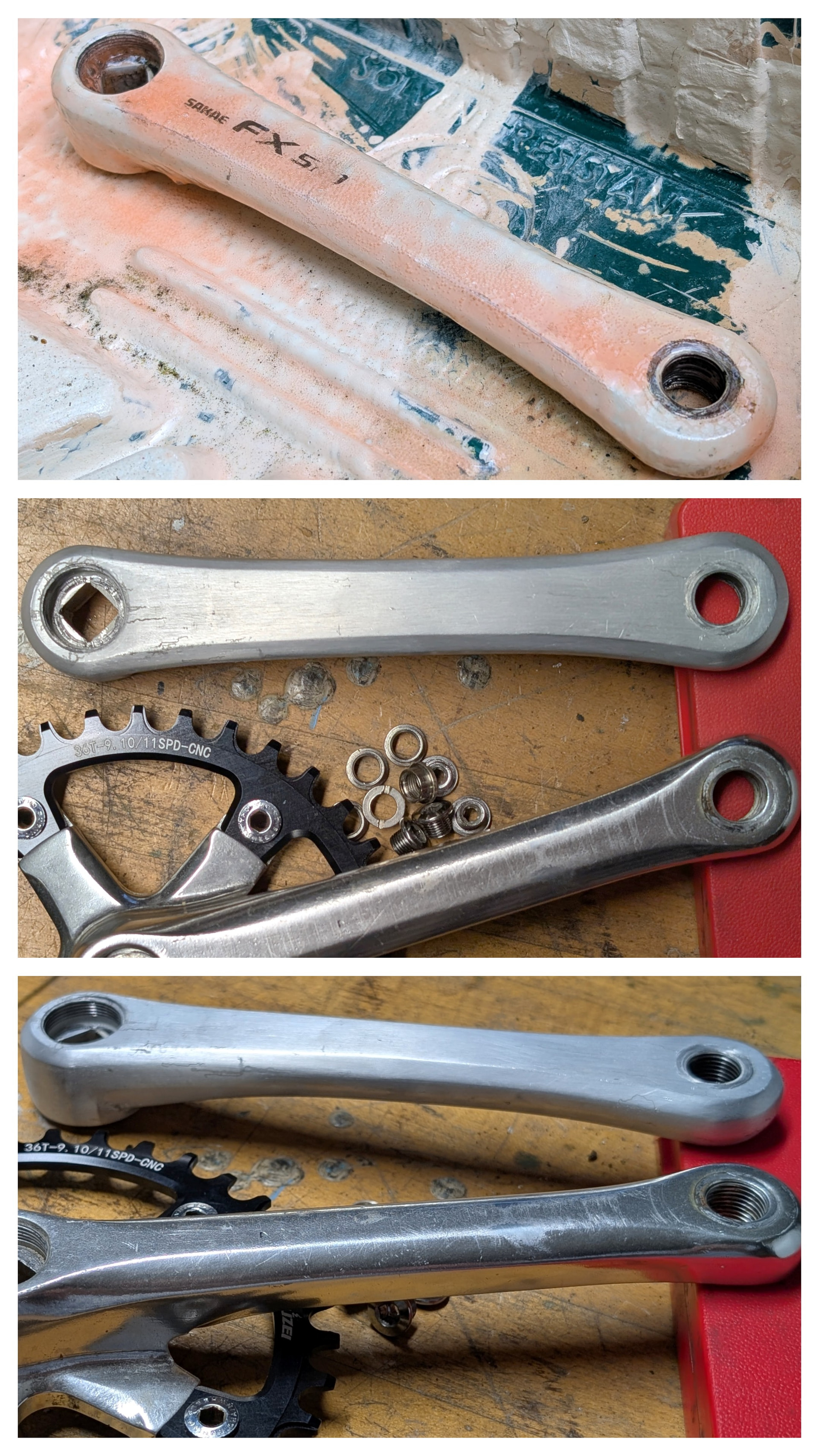
I’m putting 165mm cranks on my wife’s commute bike, using a mismatched pair with white-painted left crankarm. I removed that paint with CitriStrip, and it ain’t nearly as shiny as the anodized drive-side crankarm, but it’s silver which is fine.
Is there any real durability downside to leaving it bare? Official recommendations seen overly conservative to avoid corrosion. My general understanding is that bare aluminum immediately oxidizes (which is why it’s not shiny, compared to the clear-anodized drive-side crankarm it’s being paired with) and aluminum oxide doesn’t propagate under the initial outer layer as does iron oxide (rust).
This bike will be used for winter commuting, but in the S.F. Bay Area that just means rain, but no salt. This is a fairly beefy crankarm, too.
I’ve used plenty of crankarms where heel-rub removed the anodizing on parts of the outer edge of the arm, and never worried about those.
I’m not gonna worry about getting it anodized, but could rattle-can some clear-coat or polish it with Simichrome or California-legal equivalent. It just seems unlikely that either of these will matter for durability’s sake.
I have two aluminium frames I’ve stripped myself and left bare without any issues. One is on my trainer, the other is my track bike. No issues so far, years later for the track bike.
I can’t see how you would have any issues that you wouldn’t be able to see coming. Just give it a wipe over every now and then to keep it looking fresh.
Thanks. That fits with my perception here. And obviously a solid alumminum crankarm is waaaay thicker than frame tubing.
I bought some aluminum polish, more so the looks will be closer to the DS crankarm, but that will be it.
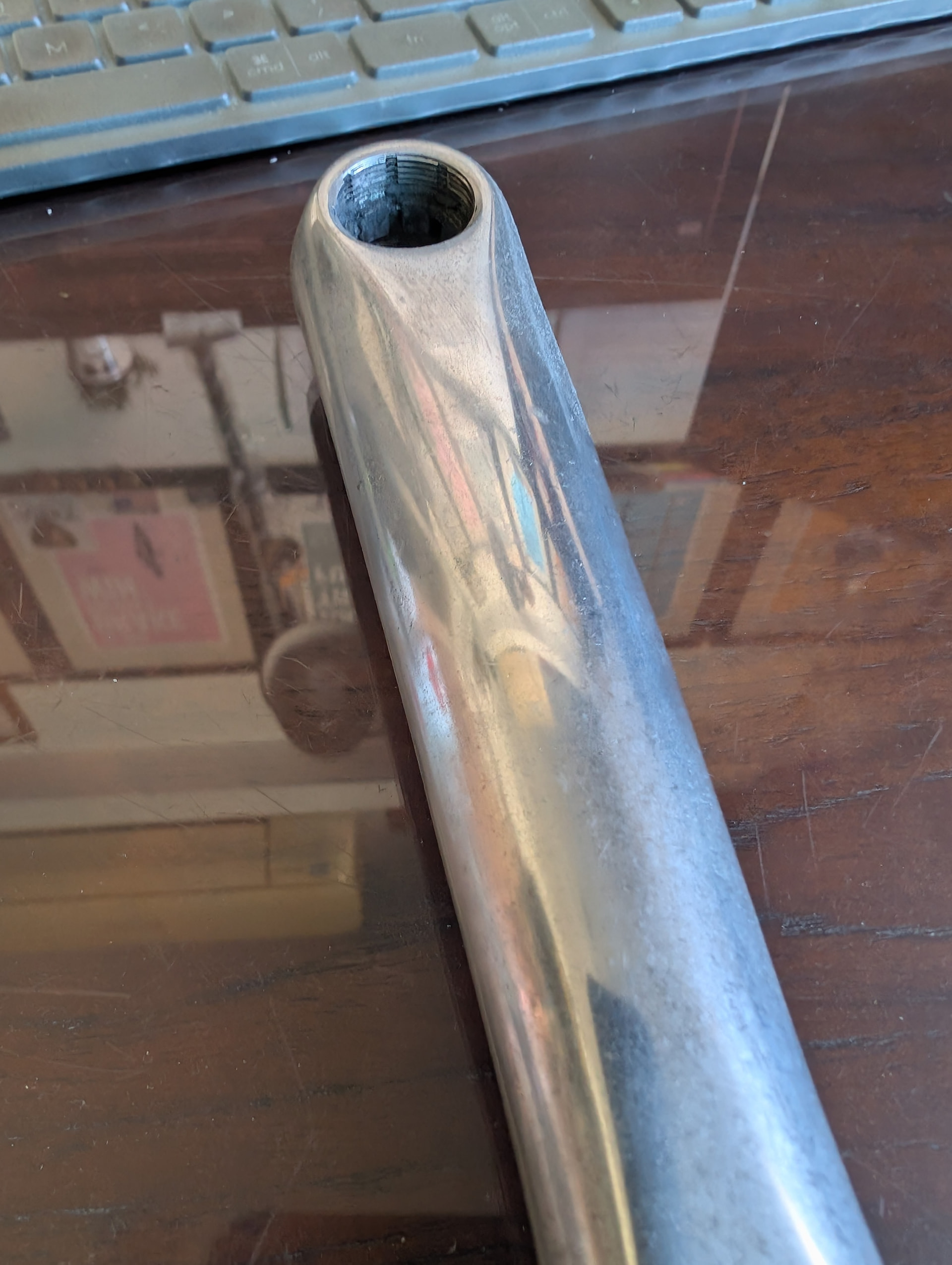
This is an NDS crank arm (of unknown provenance, except that it’s a Shimano Octalink) that I cleaned up and polished, about 2.5 years ago. I use it on my commuter regularly, but it still looks to be in a pretty acceptable condition, albeit some oxidation. I’m pretty certain that a little buffing and polishing would bring things up quite nicely.
I wouldn’t worry about the oxidation, other than the aesthetic impact.
I have octalink D/A 180mm cranks on my gravel bike, the chain line works for one by with wider rear spacing. I removed all the anodizing over a decade ago and never polished them, and they have been fine. I guess that should have been exhibit a in this thread. I may polish them now that I bought the aluminum stuff to do so.
I may go to that degree on some part(s) at some point, and when that time comes I’ll look at your rundown (I saved the text). But this will be much more cursory.
I’ve used oven cleaner to strip anodising back (that gets the black off, if it’s a black crank, but should be pretty good at cleaning up a silver crank too) and then Mother’s Mag and Aluminium Polish every so often to get things back to shiny silver when it dulls. I’ve been very happy with the results, and no obvious downsides in terms of durability that I’ve encountered (yet).
Thanks! I ordered Mother’s Mag earlier today. I’m hoping to use it on things like this (with a pretty low aesthetic bar) and also on stuff that I’ll buff more nicely.
You have nothing to worry about, raw aluminium will last a very long time as long as it isn’t exposed to extremes of pH.
The only reason we don’t have centuries old aluminium structures to demonstrate how well it endures is that until about 1885 aluminium was impossibly expensive to make: at one point it cost more than gold. This is because aluminium is basically solidified electricity and it wasn’t until electric power became widely available that practical refining methods were developed.
On the other hand raw aluminium exposed to the elements will form a chalky looking surface layer that may not be to your taste. If you want to get rid of this it is possible to anodise it using commonly available materials but the process is a bit tricky, IMO the better option is to use the less common but much easier PAA process and overcoat with something like epoxy.