Don't credit disc brakes for allowing wider road tires

Note: this isn’t a save-the-rim-brake post or attempt to get people to rethink what brakes they use. Just one point in understanding bicycle tech trend history.

I frequently read things like "road bikes moving to disc brakes allowed the trend toward wider tires" - which always strikes me as a major over-attribution.

By locating the braking near the hub, disc brakes allow flexibility on rim diameter that’s not available (or at least way trickier) with rim brakes. Disc brakes also simplify issues faced by rim brakes (whether canti/v or caliper) around very wide tires or significant difference between tire width and rim width.

But while the road-racing market largely used short-reach rim brakes (typically with pad adjustment from 39-49mm below the brake bolt) from ~1980 until shifting to disc brakes, longer-reach rim brakes had been around for decades and worked well, if racing had shifted toward wider tires. Here’s the brakes that would have been used if racing had shifted toward wider tires in the following years:

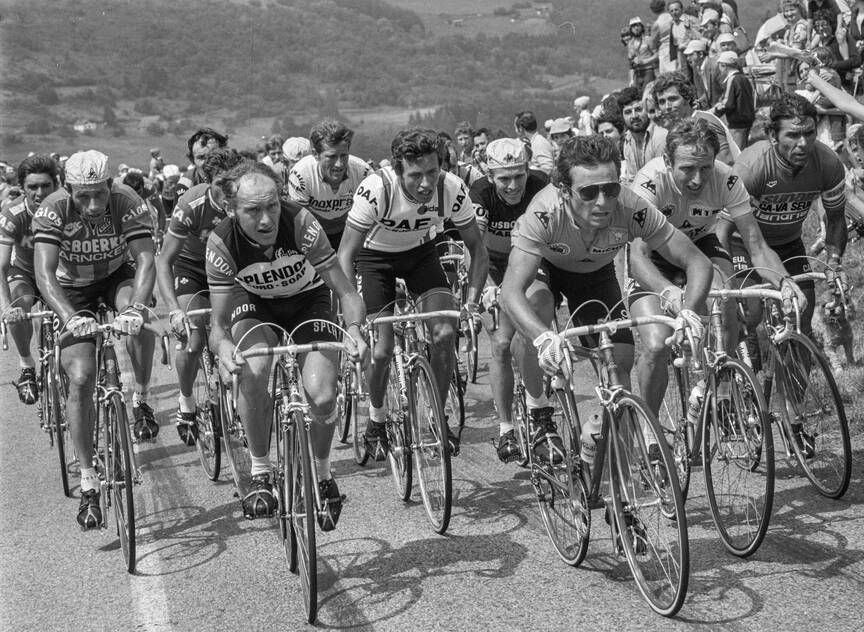
1980 - the shift toward short-reach brakes (and frames designed around them) simply wouldn’t have finalized, and “standard” reach sidepull brakes would have continued to be used. Racers could have switched to centerpull brakes (which had less arm flex by locating the pivot between the brake bolt and the pad attachment) if they wanted more braking power

In the 1980 Tour, the balding guy has centerpull brakes on his Colnago
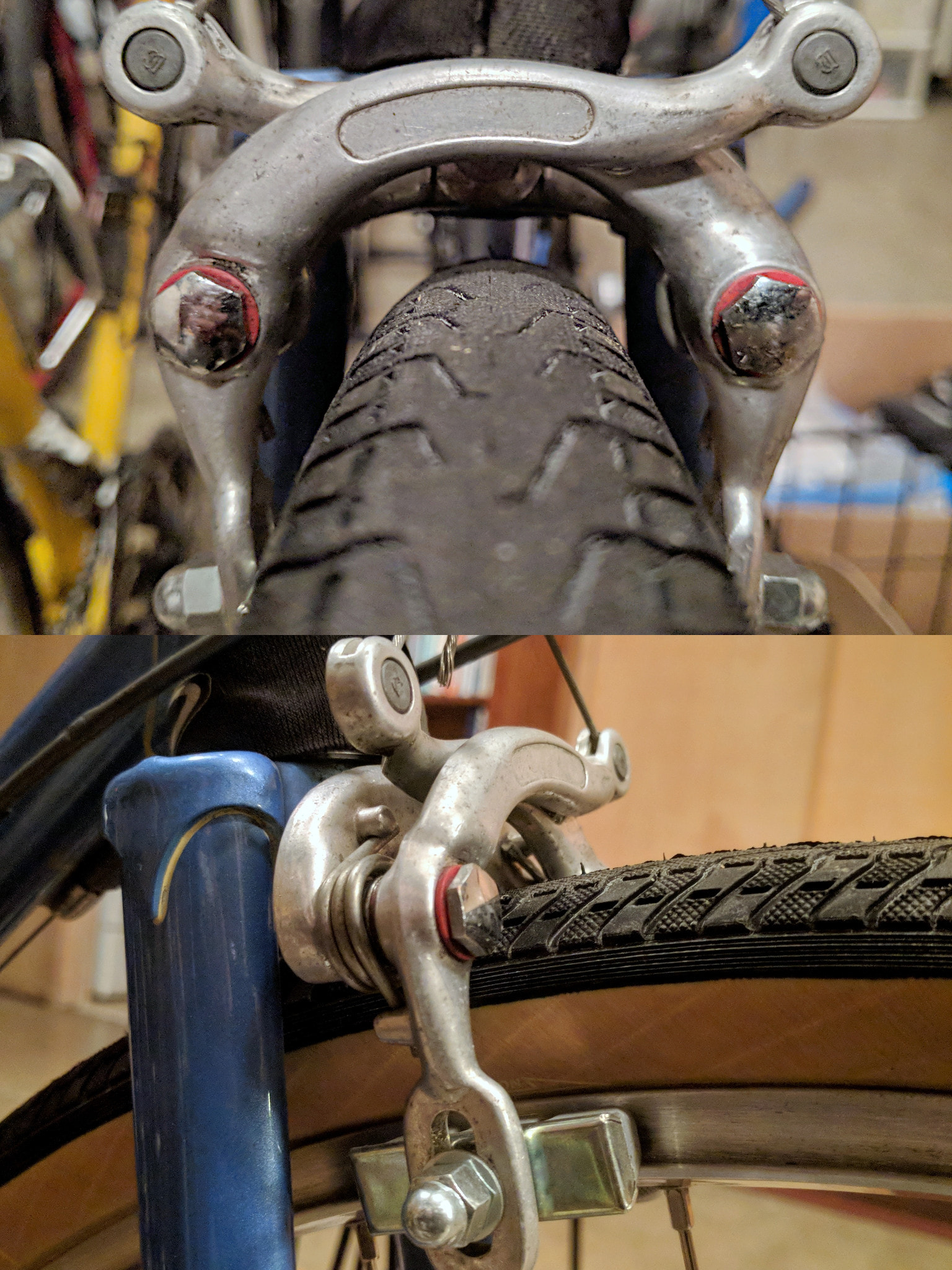

mid-reach Dia-Compe centerpull from the 1970s has tons of clearance over a 38mm tire

2000 - mid-reach dual-pivot sidepulls arrived a few years after Shimano first introduced the design in short-reach rim brakes. Shimano introduced the 6500-level BR-R600 (47-57mm reach) dual pivot in the late 90s. And if racing had wanted brake reach earlier, Shimano would have introduced a medium-reach dual pivot earlier.
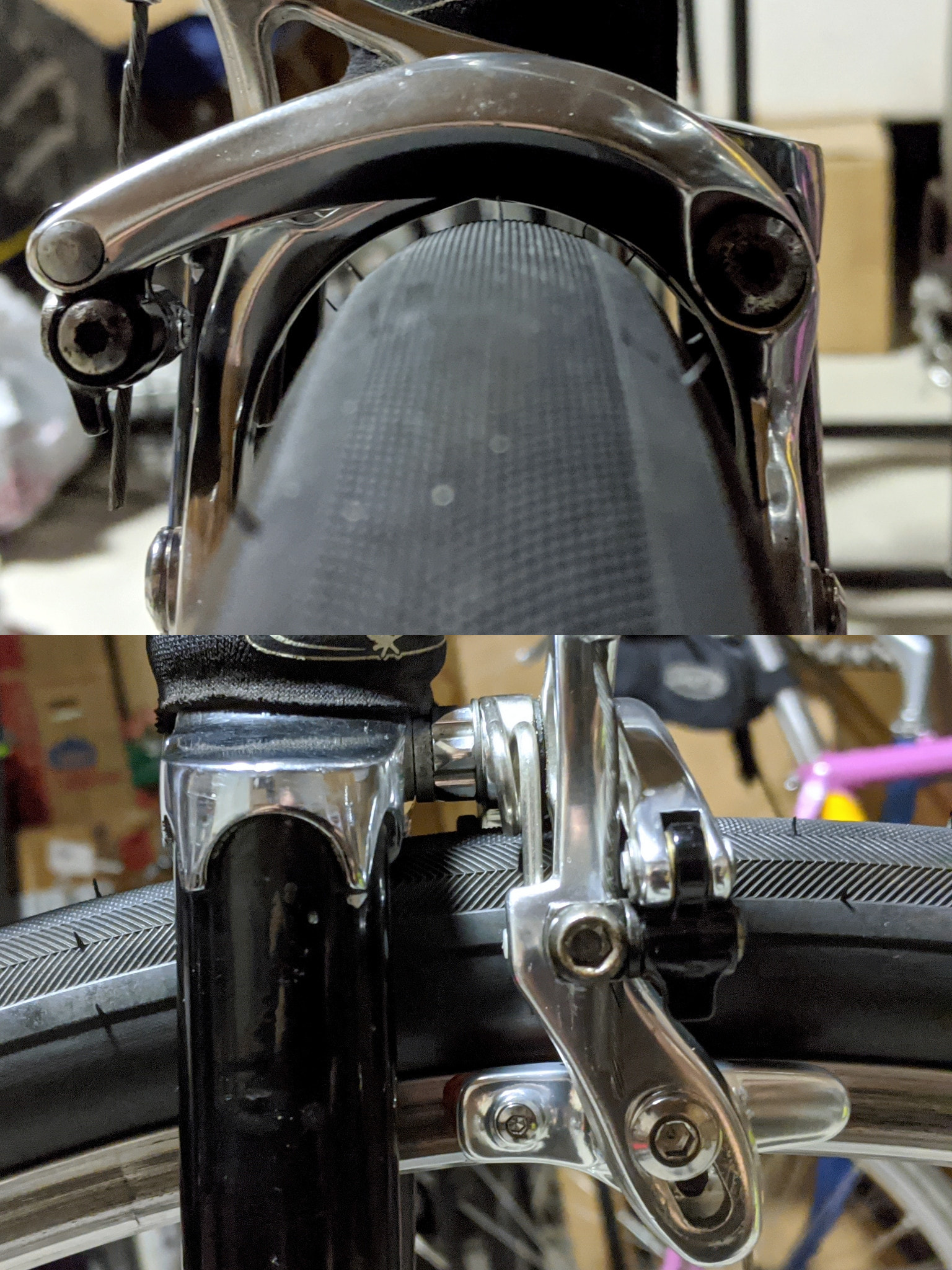

Tektro mid-reach dual pivot clearing a 38mm tire even on frame with less clearance, with brake pad near top of adjustment slot

2015 - there were a bunch of mid-reach dual-pivot brakes on the market (from Shimano, Tektro, TRP, and Velo Orange), before disc brakes had made any inroads into the road bike market. (Tektro also had been making the long-reach R55X for a decade, originally introduced as a collaboration with Rivendell, although with 55-73mm reach and wider opening designed to clear fenders, its braking power wasn’t as good as the mid-reach designs.) Paul also made a modernized dual-pivot brake, and original-design dual pivots were still available at least from Dia-Compe. A couple overviews from that time:

This was still very much in the rim-brake era of road bikes, even at the high end. This photo from fall 2016 was missing the two fastest guys and their deep-section carbon rims, but they were on rim brakes as well.

There was a slight timing issue in the road market because Shimano’s repeated altering of brake-cable-pull requirements across 10- and 11-speed groups meant that none of the available mid-reach brakes were optimally compatible with 11-speed STI levers. I think SRAM was somewhat similar (though not as significantly different as 11-speed Shimano). Campagnolo had kept their cable-pull more similar across generations, but they were already becoming a lesser player.

Had the shift to wider tires hit a year or two earlier than it did, mid-reach rim brakes would have shortly been tailored to compatibility with current 11-speed brifters. But disc brakes took over road bikes within a product cycle, signaling the demise of mechanical braking as well as rim-braking across most of the road bike market.
13 Likes

I had a set of those Tektro long-reach brakes and they were Not Good.

I think that fatter tires is part of the answer to “why did disc brakes take off?” I think carbon rims is the other part. Obviously carbon rims have been used with rim brakes, but you need special pads, and braking is still not great. Early carbon rims were often just carbon fairings on aluminum rims, or had aluminum brake tracks, but once carbon manufacturers got the point of making full carbon rims, there was clearly a need for different brake technology.

9 Likes

Understood, those may be at the edge of scalability for the dual-pivot design, especially with Rivendell specifying wider curve for good fender clearance. My wife is happy with their performance on her rando bike, but that’s with salmon pads, pads are closer to the top of the slot which means stoppier on the mechanical advantage front, and on 650b wheels whose smaller circle means slightly higher braking force compared to 700c.

But to your point, medium-reach are stronger.

Again, I’m not arguing that discs weren’t an improvement. Just that discs weren’t the cause of road/racing shifting toward wider tires. That capability fully existed already.

Medium-reach rim brakes that worked well existed from at least 5 manufacturers a whole product cycle before disc started making inroads into the road cycling market, and if road racing had moved toward wider tires in 1980 or 2000, quality-for-the-time brakes with good reach existed then as well.

2 Likes

I’ve always thought the bike industry almost completely missed 3-5yrs (or more) of profit-making before moving to disc brakes. Designing bikes around direct-mount brakes would have enforced moves in that direction on new bikes and/or frames. The brakes were more powerful and had the bonus of enabling wider tyres despite retaining rim brakes to boot.

SRAM, Shimano, Campagnolo, eeBrakes/Cane Creek, and Bontrager were all in on the act, and many frames started to appear - even including some custom builders like Gaulzetti & Bishop - but then the disc brake regime gathered too much pace for it to reach maturity.

3 Likes

Agree. I actually really feel bad for vee-brakes. They were so much better than the low-end shitty heavy discs that came after them.

1 Like

I was able to lock up my front wheel fairly easily on my rim-brake gravel bike. The bigger downside for me was that I didn’t like the hood shape for either the Tektro or Dia Compe long-pull-specific drop bar levers, along with being outside the brifter realm.

I hadn’t mentioned cantilever & v-brakes because they were always well outside of road racing. But I agree that many hybrids made more sense to keep v-brakes around. But even lower-end consumers want newer stuff - think of all the cheap mountain bikes from the 1990s that were made worse by having a s***ty suspension fork. But that feature was repeatedly voted for with customer money.

2 Likes

I’m a fair-weather road rider, and would happily ride with good mechanical rim brakes if they’d take a 32-34mm tire. I have no issues with rim brake performance in dry conditions(R8000s, aluminum rims). The only thing I don’t like about my current(old) rim-brake road bike is that the frame limits it to a 25mm tire.

3 Likes

Yeah, not much you can do about the axle-to-brake-bolt dimension on your frame. Plenty of road-sport or late-rim-brake endurance-road frames probably available inexpensively on used market these days.

1 Like

Carbon rims and disc brakes were basically a feedback loop, with each facilitating the other. And since disc forks necessarily have to be stiffer to stop unwanted steering under braking, wider tyres help prevent bikes getting too uncomfortable; wider tyres have other benefits too. Plus discs, being newer/more hyped, must of course be better/more desirable/have more pose value. Sigh.

If Shimano hadn’t changed their brake levers from 7900 onwards, or if they had updated their 57mm reach brakes when that happened, then discs would have less reason to exist, but at the top level of the sport carbon rims are what killed rim brakes.

As for centre pulls being more powerful, I don’t believe it. Maybe compared to some of the crappier single pivot sidepulls, but not compared to dual pivots IME. Centrepulls - and the levers supplied with them - varied immensely, but IME they were all either horribly spongy (Dia Compe, etc), or had huge lever reach and little power (Mafac, Universal).

In any case, we’re stuck with how things are, for better or worse, and I’d include proprietary seatposts and steerers, one piece barstems, ISPs, and integrated cabling in that list, and intend to avoid all of them where possible.

6 Likes

Agreed, carbon rims was the feedback loop for discs to take over.
Whereas disc takeover and the shift to wider tires were both independent of each other.

I’m similarly bummed by stuff in your final paragraph, but none of that is stopping people who don’t like those things from finding bikes they like. It just means the industry is successfully selling more-PITA, likely-less-durable (or at least less-replaceable) things to most of the market, which makes those bikes less likely to be viable with whatever is being sold new 20 years from now.

2 Likes

Yeah, I meant that the centerpull design is fundamentally stronger against brake-arm flex than a single-pivot sidepull, for a given amount of brakearm material. Maybe it ends up being a wash if we’re saying “for a given amount of weight” since the centerpull design is more complicated and has more stuff in it.

That said, my experience with baseline Dia-Compe centerpulls from the 1970s is all positive, assuming good brake pads. That’s what I have on my commute bike in hilly Berkeley, often with a child seat or child trailer. But this is all using relatively modern aero brake levers, or flat-bar levers. I trust them over the best mid-reach single-pivot sidepulls I’ve tried from that era. And for commuting use, dual pivots (apart from the long-reach Tektro 559) have worse fender clearance.

Most folks who use Mafac centerpulls seem pleased with the stopping power as well, although this again assumes modern pads (you can get Salmon pads specifically for the Mafacs). There are some weird things like Dia-Compe 750 long-reach centerpull brakes not changing any other mechanical advantage aspects compared to the mid-reach 610 centerpulls, so the longer-reach is both more flexy and worse on the MA front.

1 Like

I am always on the hunt for a good mid reach brake road frame. I have a set of TRP RG957 brakes and a Campagnolo Chorus 11 speed group to go with it. Want to make a low maintenance “all road” bike with 35-38mm tires.

1 Like

That’s a nice setup. You looking for a steel road-sport frame (Soma ES, Salsa Casserole, Black Mountain) or something blingier?

Or use early-80s sport-touring frames (originally built for 27" / 630mm wheels), if you’re okay with horizontal dropouts.

1 Like

Shimano did change their road cable pull with their ten speed 7900 group. It did not start with their move to 11sp.

Yup, you and Stephen and I are all in agreement. The 11-speed groups just had the most change in cable-pull (plus variable cable-pull rate at the lever).

Soma ES, Genesis had a model, All City Mr.Pink (but I think it “only” had 32mm stated clearance.) I looked into the run of bikes Black Mountain did for Blue Lug, but I was late to the party and there aren’t any of the larger sizes in stock.

I had dreams of building my own frame, but there is never enough time. My gravel bike is a custom Waltly, so that is an option. But I think I would prefer a steel bike.

Basic Cycle Co makes a that basically checks all my boxes, but I don’t really love their color palette.

The ideal bike would look like a Fairlight Strael, but with rim brakes.

1 Like

My city bike is a 27" conversion to 700c.has long reach brakes and Fits 32mm with fenders easily. It works well but is not high performing haha

1 Like

There were no extra changes in cable pull past the 7900 generation. And there were no variable leverage mechanisms such as Servo Wave in their road levers

I have a set of Weinmann center-pulls on one of my bikes with some Kool Stop pads and they’re great.

I also have an 80s ATB with a set of the wide stance Shimano cantis fitted and those things will absolutely crush a rim into submission once you have them set up right.

1 Like

Being a pedant myself, I love when I feel part of a community. Fair enough, it was a nexus of small technology shifts to converge into a game changer. Wide tires prevalence doesn’t exist solely beacuse of discs, but they had a huge part, as did carbon wheel construction.

Aluminum wheels are light when they’re narrow. Rim brakes are powerful when they’re short, and rims (especially carbon) brake really well… when it’s dry.

Put all three of those together - wet rim, less powerful long reach brakes and wide heavy rims and you’ll be left wanting. So it was all three. Not to mention the carbon cost of the wearing brake surface.

With wide, deep carbon rims not needing a braking surface, being very light and stiff and having disc rotors, you’ve solved all the problems, and wide tires just became an obvious next step. Discs were a huge part of the puzzle.

*said by a person who still rides carbon wheels and rim brakes on his road bike.

4 Likes