I have an old mountain bike with Hope Tech X2 brakes on it.
I don’t ride the bike often anymore, but last Sunday I took it on a seriously challenging ride with a lot of steep, technical stuff in it.
After a while my rear brake was becoming noisier and noisier, and while I first thought the brake pads were done, it was the rear rotor.
I have a Hope 160 mm floating disc rotor on this bike, and the rivets are loose so there is play on the rotor when braking. Thickness of the rotor is +/- 1.5 mm, so it is time to replace the thing.
A new, identical rotor from Hope would cost me € 60.
The slightly cheaper, non-floating version costs € 45.
Then I see that a Shimano Deore disc rotor costs only € 12,5.
So I am wondering, where is the price difference?
For a front disc rotor I wouldn’t hesitate to just pay for the Hope, but as it is an old bike that isn’t ridden a lot anymore, and it is the rear rotor and not the front one, I am tempted to save myself some cash here.
I lack the inside knowledge on Hope’s products, but I’ll take a stab to say that the lower cost of the Shimano Deore item could be attributed to;
Lower cost materials - Shimano is known for its use of stainless steel for its rotors. For its cheaper models, it’s likely that martensitic stainless steel is used instead of the austenitic variety, for cost savings. However, this would mean that the rotors would eventually rust if not used regularly, where the frequent braking/abrasion would mean reduced oxidation on the surface of the rotor.
Simpler design of Shimano’s most basic rotors, where the latter is mostly stamped, rather than precision machined.
These rotors would also likely be produced in regions where manpower costs would be markedly cheaper than in the UK.
Anecdotally, I get clients coming in now and then to have their rotors “refreshed” due to glazing, poor maintenance habits resulting in the debris scoring the rotor, etc. It takes forever to sand down the surface of Shimano’s higher-end rotors, RT/MT900, RT/MT800, etc, unlike some of the lighter weight, weight-weenie options out there, so durability is correspondingly improved in Shimano’s higher end options.
IMO fancy disc rotors (floating, oddly shaped, etc) are just a way to bring customization but won’t bring any tangible benefits except for a few caveats:
Some very cheap Shimano rotors are to be used with resin pads only –> they have no bite and must be avoided
If you are tall and do long downhills then increasing rotor thickness is a great way to resist overheating and retain power (Sram HS2 are perfectly fine, Trp has also some cheap models )
Going up a size is the cheapest way to increase brake performance and resist heat, most mtb bike can handle a 180mm rear rotor. I run 180 rear 200 front on all my bikes except my E-enduro bike (220/200). I weight 70kg
Shimano Ice-tec floating rotors are susceptible of warping.
Best of luck on your research and have fun on the trails !
I recently swapped from Shimano Ice Tech rotors to Intend “Skinny” rotors, which are actually not that skinny — at 2.05 mm compared to 1.75 mm for Shimano, if I remember correctly. This was a game changer. The heat dissipation works wonders and is said to save a lot of material in the long run, both for pads and rotors. There are other options with similar thicknesses. What I mean to say is: I would get the thickest ones you can fit into the calipers.
The Shimano rotors labeled “Resin Pad Only” are garbage. They aren’t heat treated. They can’t take extended braking with any pad material. They’re really for use in urban settings and bike paths, where braking strain is low.
Other Shimano rotors are fine.
The best thing about Hope floating rotors is that you can get the center section in different colors. The worst part is that they sometimes make noise, and also they don’t fit every brake. The rivets will contact the calipers of certain brakes. Clearly that’s not an issue for you though.
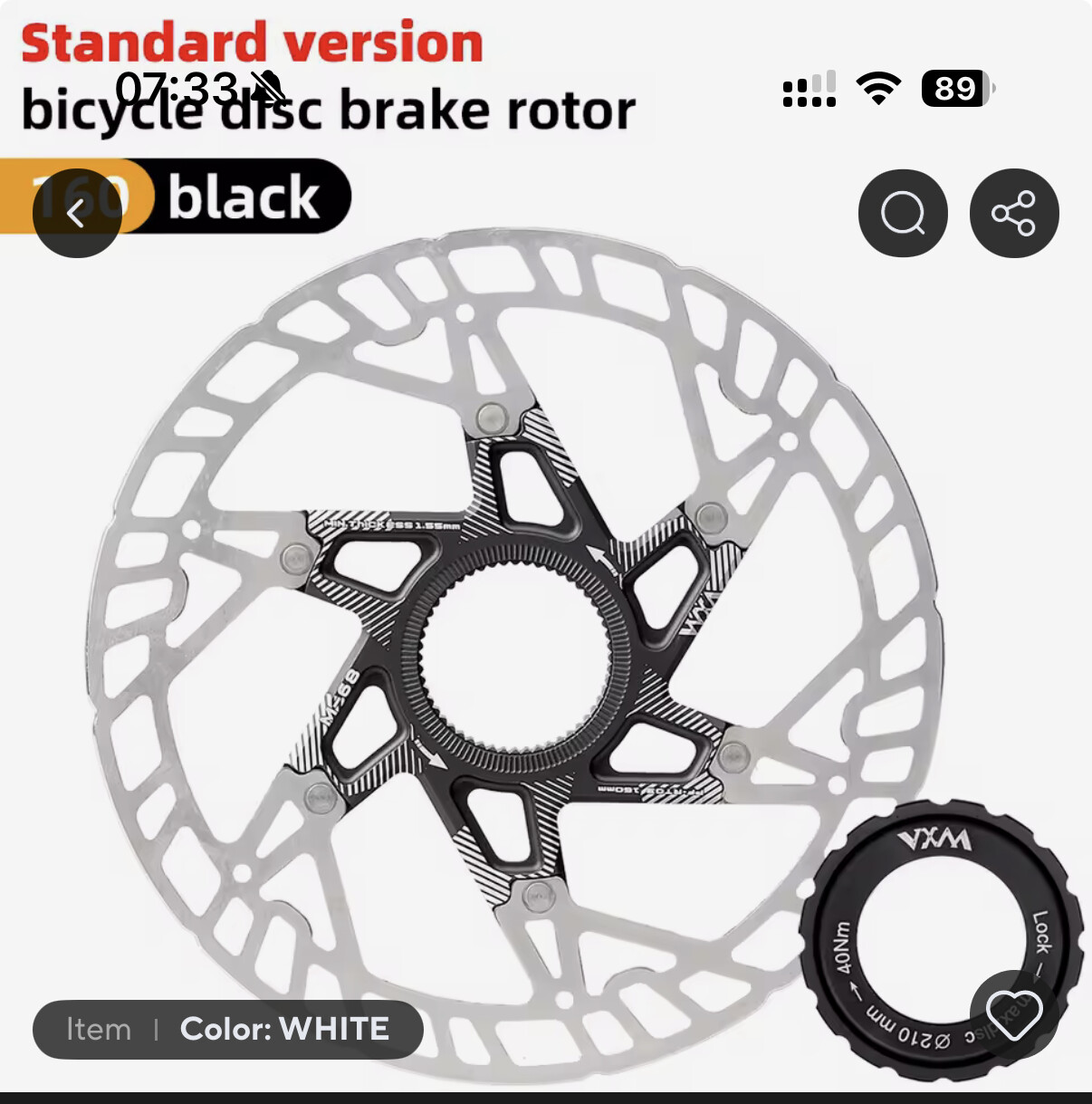
I don’t like to be “that guy” but I’ve been testing out some VXM rotors from AliExpress on my gravel bike and been quite happy with them. I’ve had a lot of issues finding a brake setup with my Hope RX4+ calipers that isn’t noisy and doesn’t glaze pads on very long descents. They are well made and seem to be lasting better than the Swiss stop discs I had before. I am attaching an image of them as AliExpress links never seem to last. They also come with lock rings!
There are definitely differences between rotors and not all are obvious all of the time.
In my experience, ICE Tech rotors are significantly better than cheaper non-ICE Tech rotors.
Things like ICE Tech’s sandwich construction or producing floating rotors makes them genuinely more expensive to manufacture and better.
These features make rotors better when you push them. Which it sounds like you do.
Personally, I’d make that decision based on how I ride a bike, not how old it is. If you push your bike when you ride it, you should have good brakes on it, it is that simple IMHO.
I have recently upgraded my hardtail with a Rotor 2InPower crank even though the frame is from 2014, the groupset and fork from 2018 and brakes, stem and handlebar from 2022. The frame looks a bit ratty, but everything works great and it is < 10 kg without a saddle bag.