Here is a tailored version for the Escape Collective Discord/forum community under the “Projects and Makers” tech section. The crowd here is notoriously analytical, deeply appreciative of mechanical nuances, and highly dialed into optimal component choices.
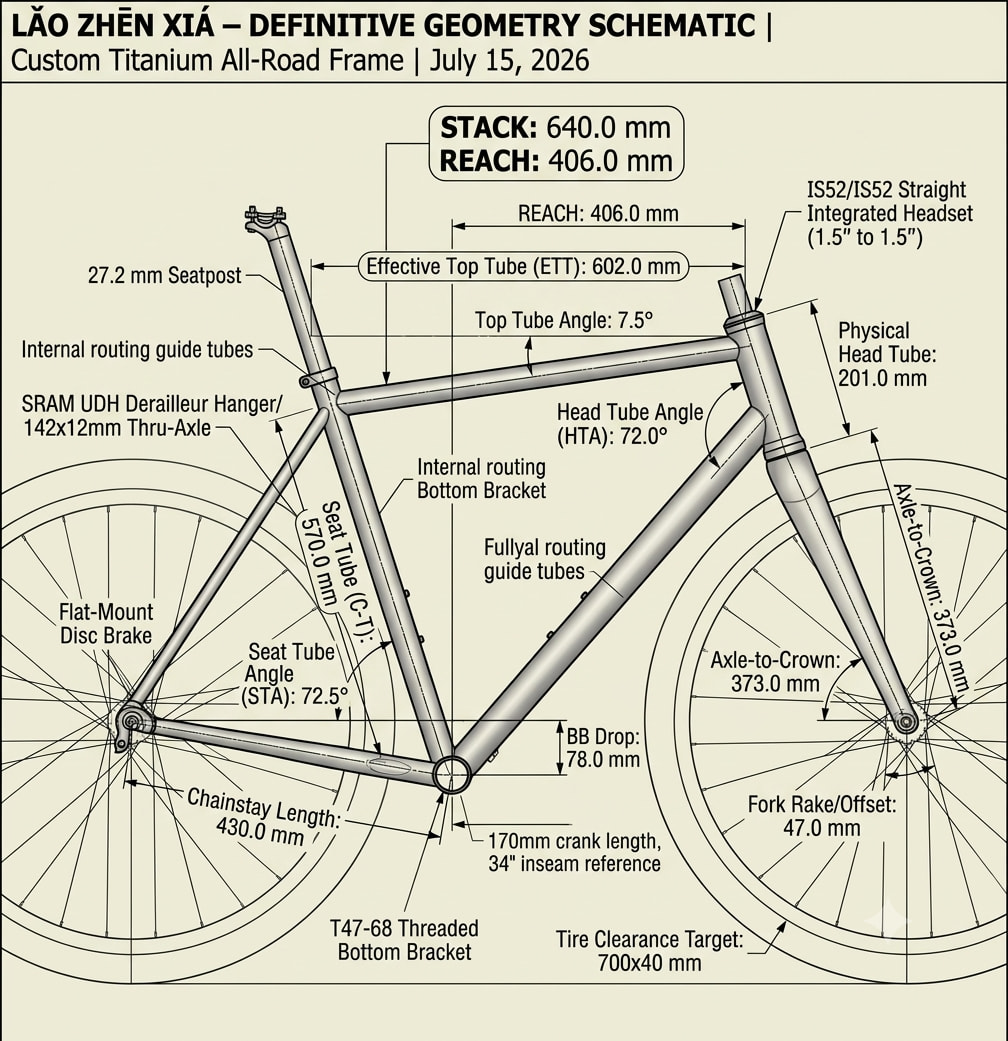
I’m currently mapping out the geometry and component specifications for a custom titanium 1x all-road/gravel frame that I plan to order from a custom builder (likely XACD) next year. Before I officially open the CAD blueprint process with the factory, I want to make sure my numbers are completely dialed and that I won’t run into any classic clearance or manufacturing pitfalls.
The goal is a fast, clean, integrated 1x build built around a traditional, level top tube silhouette.
My Fit & Main Component Specifications:
Saddle Height: 787mm (BB center to top of saddle)
Saddle Setback: -102mm
Handlebar Reach: 585mm
Cockpit: Integrated carbon handlebar/stem (100mm length / 420mm width) with full internal routing through an IS52 headset system.
Drivetrain: 1x setup running a Pass Quest 48T 110BCD chainring on a Magene P505 spider power meter (24mm spindle).
Seatpost: 27.2mm diameter carbon seatpost with a 20-25mm setback/offset.
The Design Logic:
With a 600mm seat tube, I’ll have roughly 142mm of exposed seatpost to the saddle rails. I want to keep the classic, traditional look of a level top tube, and ~140mm of exposure gives me exactly enough exposed 27.2mm carbon shaft to flex and damp high-frequency road vibrations. Because my fit requires a deep -102mm setback, combining the slack 72.5° STA with a 20-25mm offset post keeps the saddle rails safely centered in the clamp.
Questions for the Tech Brain Trust:
The 48T Chainring vs. 40mm Tire Dilemma: A 48T ring is massive for a gravel frame. On 24mm internal rims, 40mm tires are going to stretch out closer to 41-42mm. For those who have navigated custom Ti yokes/stays, what specific chainstay manipulation or dimpling instructions should I write into the order notes to ensure the chainring doesn’t chew into the titanium stay while maintaining tire clearance?
IS52 Integrated Head Tube Details: I want fully internal cable routing. When drawing up the integrated IS52 head tube with the builder, what should I double-check regarding internal bearing seats, transition spacers, and turning radius limits to make sure it plays nice with standard integrated carbon bars?
Front-Center & Stability: Given the slack 72.5° STA and my rearward weight bias, how should I approach the front triangle geometry (head tube angle/fork rake) to keep the bike tracking straight and stable on high-speed loose gravel descents?
I’d love to hear your thoughts on the numbers. Let me know if you see any red flags or hidden compatibility issues before I start the CAD iterations!
That was an error! I meant for it to be a 400mm gravel fork at this point. I also want to make this frame compatible for 2x as well, so I’m going to to ask for a forward BB seat tube offset. Also, will need to have a 3d-titanium yoke.
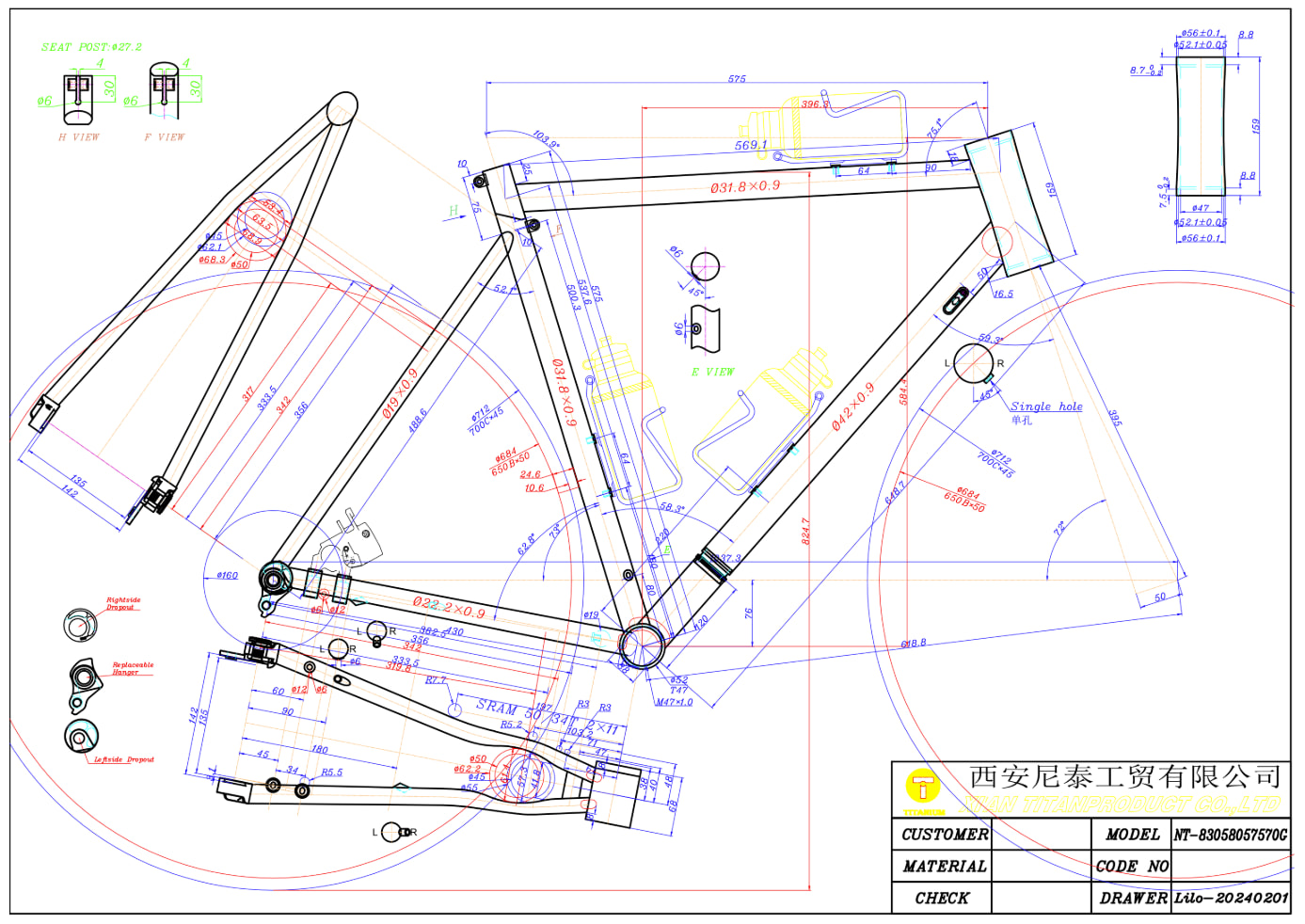
Wihout diving too deep into the numbers it looks pretty similar to a custom Ti breakaway frame i can made by Titan bikes a couple of years ago. Here’s the drawing, it’s a lot to take in but key points:
I got 45mm clearance on a 68mm BB without 3d printed yokes no problems.
It has a fully integrated headset, that was very simple for them
I’m running 2x, plenty of clearance.
A lot of the questions and design elements I left to the manufacturer to figure out and they did fine. I’m an engineer and could have done it but they know this stuff inside out so just give them the outcome you want and let them iterate with you to solve it. They got the first CAD diagrams back in 2 days and were 90% right, with a couple of minor tweaks from there before we could start
Think carefully about exactly what fork, bars, and cable routing bits you’re going to use. Also the fork A-C and rake will affect steering geometry and toe clearance - or lack thereof.
It’s IMO doubtful that 48T and 42-ish mm tyres will need a yoke, but if the maker suggests this look carefully at the width across the outside of the chainstays where the ends of the cranks will be (typically ~190mm behind the BB centre) to be certain this is okay(!!!). I had to request this number (which was missing from the drawing), and then change the RH chainstay to enable te cranks to turn.
Also, if you might run 2x:
Remember to allow room for the inner chainwheel
Be careful about the included angle between the seat tube and chainstays, especially with such a slack STA and large BB Drop. This is especially crucial if you might run a small outer ring and a large cassette. If the angle is too acute, there can be two problems: a) the FD cage might not clear the chainstay, and b) the chain might hit the top of the cage in some gears - I had that problem with a 72° STA, 75mm drop and 435mm chainstays; very annoying. It would be better IME if the CS to STA angle was nearer the less acute end of the range, and this is IIRC 63-66° for i.e. GRX - 62° is definitely not good. Other FDs are likely to vary slightly, so check the specs. Yes, there are angle shims, and FD mounts can be filed, but it’s better not to have to fiddle about.
Also, that amount of setback is not anywhere near what’s happening with current fitting trends and, FWIW, my setback ended up being reduced from ~105mm to 65mm by Steve Hogg, who was known for favouring slack STAs, and this was well prior to “progressive fit” aka “meme fit”.
It’s important that you understand and check EVERY dimension on the drawing as they’ll make exactly what is there; do not expect the builder to read your mind! (I’d attach my old frame drawing but don’t know how to do this.)
PS: I have no idea what “handlebar reach” is, but you should consider reach/effective top tube length, plus head angle, fork offset and front centre carefully; these all interact and need to work together. It’s possible to adjust things with stem length to some degree, but not always, and especially not with integrated bars.
Thanks Danny, super helpful to see that drawing! Awesome that Titan handled the 2x clearance and internal routing so smoothly.
You’re spot on about letting the builder do what they do best. That’s pretty much my exact plan—give them my hard boundaries (40mm tires, T47-68 BB, integrated ACR setup, and my fit numbers) and let them iterate the actual CAD drawing.
Really appreciate you sharing the setup, gives me a lot of confidence going into it!
For the chainring and tire clearance you’ll want to spec the maximum tire width used. If your tire will truly be 42mm wide. Use that number.
Then spec the clearance around the tire. For road bikes it’s typically 4mm and off-road bikes it’s 6mm.
If you want to run 2x and 1x drivetrains then you’ll have to tell them which cranks and chainrings to design clearance for and/or provide drawings from the manufacturer.
After they know those constraints they’ll be able to tell you if a yoke is needed.
Head tube
The headset specs are already defined by set standards so I don’t think you’ll need to do more than tell them you want to go with IS52 top and bottom. But it never hurts to provide the specs and tolerances anyways.
Fully internal cable routing generally means drilling an oversized vent hole where the down tube connects with the head tube. Pretty simple. You may want to spec the hole size. Enve has guidelines.
Stability
Stability improves with a longer wheelbase. Since you sit so far back behind the BB, I’d lengthen the chainstays. That’ll move more weight to the front wheel for better traction. Otherwise, the rear weight bias will potentially make the front wheel feel vague or too light. But handling is subjective. There’s no right answer here.
Internal guide tubes
If you’re planning to run a wireless drivetrain then you only need to deal with the rear brake line. For a full internal route the hose runs along the outside of the steerer tube and then pokes into the down tube through the enlarged vent hole. Then it pokes into the BB shell, snakes around the crank axle and into the vent hole in the chainstay before poking out of the chainstay near the brake caliper. I don’t think there’s a practical way to make this run inside a guide tube. But maybe the manufacturer has done it before. I think it’s more common for the hose to run free inside the down tube. To prevent rattles you add a foam sleeve to the hose.
You’ll probably want to spec the distance between the caliper location and chainstay port. Shimano and Sram have guidelines for this distance.
Fork
What fork are you planning to use? I doubt you’re getting something custom made. Make sure to provide the right offset and fork length for the fork you plan to use. There’s a difference between fork length and axle-to-crown measurements. Make sure you’re providing the right number.
For clearances, I’m capping at 700x40mm and running 1x 46-48t chainring and also adaptable to a standard 2x road crankset (Magene P515). I’ll hand those exact component drawings to the builder so they can decide whether a 3D yoke or standard stays fit best.
Head tube will be a standard IS52 top/bottom to run the Vision Metron 5D ACR internal routing clean into the downtube with a foam sleeve.
Also good note on chainstay length—planning around 430–435mm stays to keep high-speed gravel stability without losing front-wheel traction, paired with a standard 395–400mm A2C fork. Appreciate the advice!
Generally, you either design everything (CS bends, dimples, and 3D Yoke), or you let the manufacturer do what they are capable of given the tooling and techniques they have. I would ask something like “What is the shortest chainstay you can fit 700x40 and 48t 47mm chainline” and go from there.
I would look at headset documentation to determine the headtube bearing seat dimensions. There is some variation in the IS52 standard, specifically with the lower bearing depth (7mm vs 7.5mm deep). Ritchey posts some documentation:
The front center is going to be a byproduct of the trail that you want and your handlebar X-Y position. You set the HTA to get your trail, you move your bars into the right position, and your FC is what it is. If you really wanted to tune FC, you would go up or down in fork offset in order to change the HTA (to keep the trail at your target length). Trail is up to you; base it on something that you have ridden.
If you are trying to finesse the trail and tire/drivetrain clearance, you need accurate tire measurements. A Vittoria Terreno 700x40 T50 Pro on a 25i rim has an OD of 705mm, a Knob Diameter of 690, and a knob and casing width of 40mm.
The front center is going to be a byproduct of the trail that you want and your handlebar X-Y position. You set the HTA to get your trail, you move your bars into the right position, and your FC is what it is. If you really wanted to tune FC, you would go up or down in fork offset in order to change the HTA (to keep the trail at your target length). Trail is up to you; base it on something that you have ridden.
Mmm, personally I would also design for fit first, but not in an absolute sense. With spacers, a different stem or a different handlebar (reach) you normally have enough adjustment window to compensate for a change in head angle.
So, when it comes to handling, I would personally tune around trail and front center, and try to get a working combination of fork offset and head angle to achieve that. Provided that you stay within that window that allows getting your fit right by selecting the right stem and handlebar combo.
When designing my Waltly gravel bike around 27.5/2.6” tires, I found this stack/reach calculator incredibly useful:
It enabled me to input the geometry of two bikes whose fit I loved and use that as my reference point. I think the ability to dial in trail and the weight balance between front and rear is particularly useful.
I went with 460mm chainstays and have no regrets. I believe chainstays should be proportional to seat height and setback. With your setback, a bit longer stays will enable you to run a 2x more easily and not risk pushing your center of gravity behind the rear axle on climbs.
Second that; it feels like chasing shorter chain-stays has become this marketing hype but really doesn’t add much/any value. I went for 430mm on mine to get the clearance and not a regret in the world. Particularly given the size of your frame and the ST angle a longer chainstary will help weight distribution as well as clearance (you could easily go for 45mm for a bit of futureproofing) with no downside.
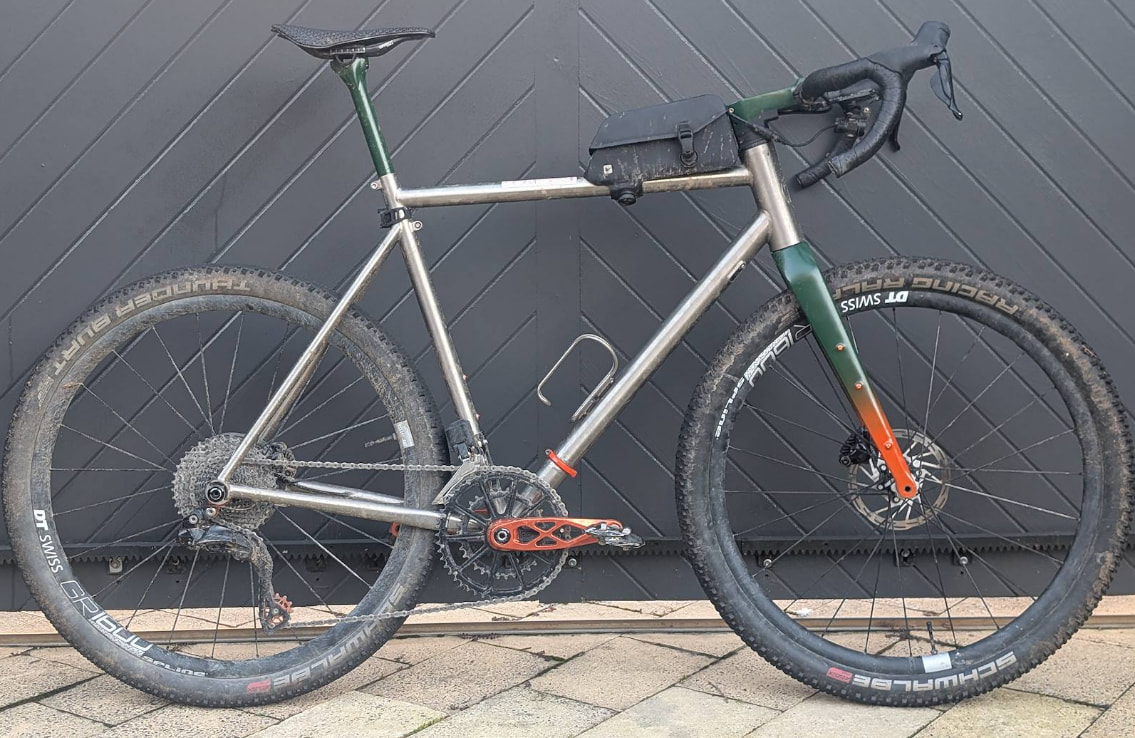
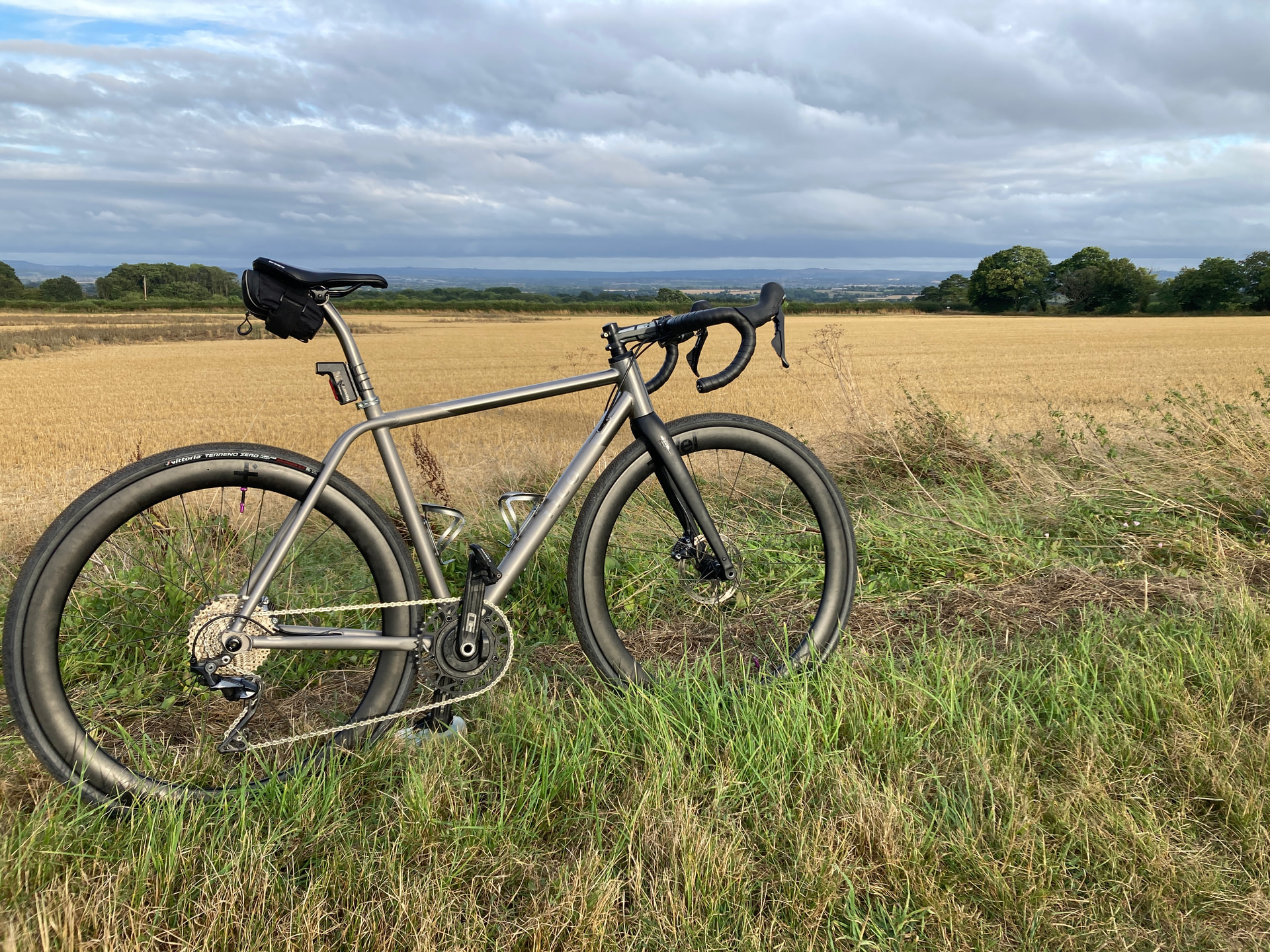
I finally got around to getting a pic of my Titan frame for what it’s worth
Enjoy the process as much as the outcome. At some point you need to bite the bullet and commit to the drawings, then you can tweak from there, ask the manufacturer questions etc
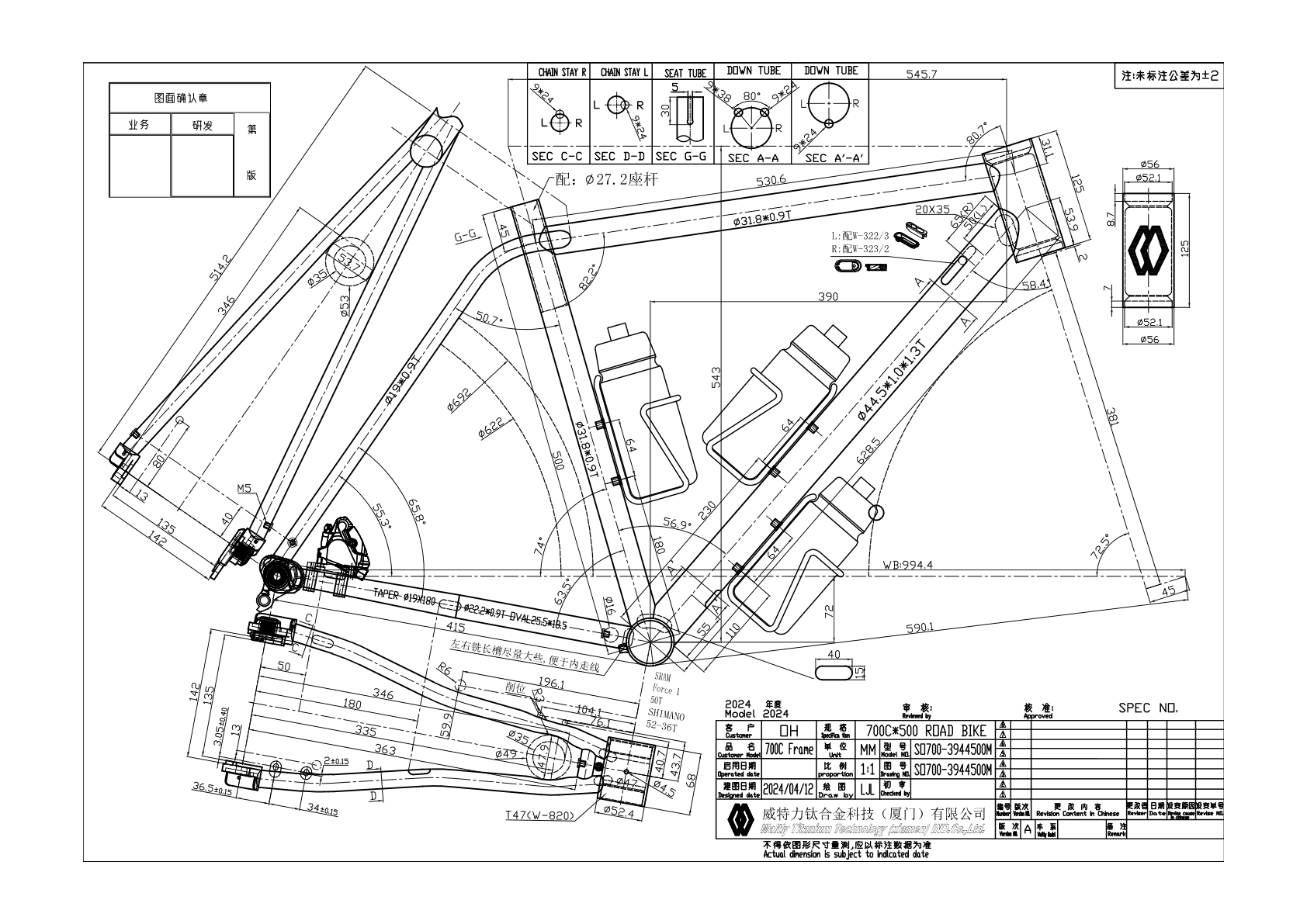
I designed my all road ti bike, built by Waltly, a few years ago and had fun comparing geometry with previous bikes I’ve owned then found a fork that met my requirements.
I found a fork I liked then tweaked the frame gemeotry to work with that fork.
Waltly were great for me, I just said:
here’s the frame geometry I like
Fork I’m using
Headset/bearings I want to use
BB spec
Tyre clearance
Etc
And they designed to my requirements. Had a few drawing iterations and ended up with a great bike
Only thing I wished I checked/changed
Bottle cage position - seat tube one is a touch high
Asking the builder (probably Waltly or XACD) for their shortest achievable chainstay with my exact drivetrain specs (48t / 47mm chainline / 700x40) makes way more sense than trying to micromanage the stay bends/yoke myself. I’ll also confirm their exact IS52 bearing seat depth/chamfer so I don’t run into issues with the headset
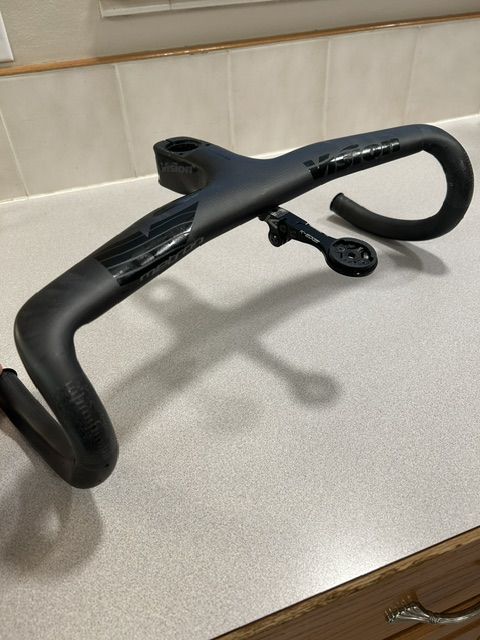
As a FYI, I just locked in my handlebar, I scored a Vision Metron 5D ACR Evo-L, 420x100, $200 used with less than 1000 miles on it, from my local classifieds!
Thanks for sharing bikegeo.net, visualizing how HTA and fork offset tweak the front-center against my current reference bikes is super helpful.
Good point on weight balance too! Since I’m running a 1x setup capped at 700x40c tires, I’m hoping to keep the stays a bit punchier than a standard bikepacking/2x setup while keeping enough front-center to avoid toe overlap.