My son’s bike (Specialized Riprock20) has a graunchy sounding freehub that I’d like to fix. I haven’t come across this kind of hub before - the wheel bearings are cup & cone and I can’t figure out how to get to the freehub mechanism. Any suggestions on how to find a guide on how to get in there and check it out would be welcomed. Here’s a pic:
Odds are it’s a hub shell design that’s not just specific to kids bikes.
FWIW, I’ve seen cup-and-cone rear hubs where the allen bolt holding the freehub is accessed from the drive side and others that are accessed from the non-drive side. I have at least 10, 11, 12mm allen wrenches for removing such bolts.
There’s also a tricky factor that sometimes an allen wrench will engage flats from the drive side, but the actual bolt (usually larger) is accessible from the non-drive side. So just because your wrench is engaging something, doesn’t mean it’s an actual bolt.
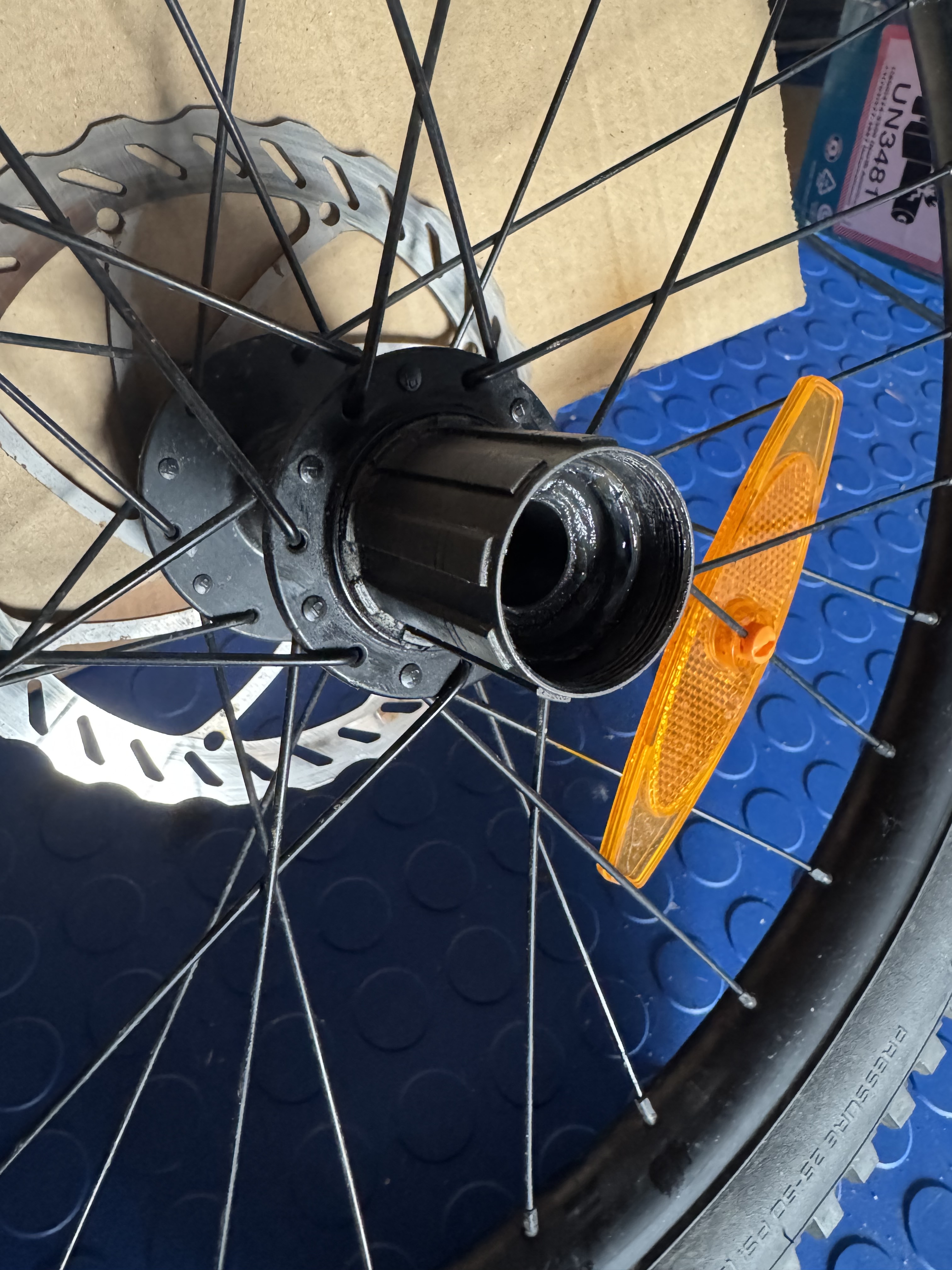
A shop mechanic will probably recognize immediately how to get it off, if you want help but just that part, and then you’ll know which side and what size allen key you need.
It is my understanding that these kinds of freehubs are designed to be replaced rather than serviced when they are no longer working nicely. To remove it from the hub, you would use a large allen key inserted through the centre (where the axle goes), as described by @DrTallRider. Unfortunately there are several different brands and styles, and many of them are sold unbranded or rebranded, so identifying which replacement you need isn’t always easy. Most bike shops should be familiar with the common ones and have some stock available. The most common I’ve seen are Shimano (in this case the hub is usually branded and you can use the model code to check the Shimano tech documents for the freehub part number) and Formula (usually rebranded by Giant, Specialized/Roval, Cannondale, etc). The easiest would probably be to take the wheel to a Specialized dealer and ask them to identify the freehub and sell it to you or replace it for you, but you should also be able to find the compatible freehub from another brand that uses them, like Giant.
However, most of these freehubs that I’ve seen do have two opposing notches in the outside of the cup, and you could use a tool to engage these notches and loosen the cup to access the internals. I don’t think the tool is widely available, but I know mechanics who have made their own. Beware of lots of tiny bearings falling out if you do open it up. Also consider that there might not be much you can do with it besides cleaning it and installing some fresh grease. If the pawls are worn you probably won’t be able to easily find replacements. You might be able to replace the bearings, but if the races are worn then you’re back to replacing the whole freehub anyway.
Here are some photos of a new freehub that looks very similar or could even be the same. The first shows a view from the outside of the driveside looking inwards so you can see the tool interface (11 mm hex in this case):
(For what it’s worth, this is a Giant S-XC freebody, but we’ve also sourced them from Cannondale. They fit one of the common Formula hubs used by many brands.)
Graham, what do you think of my approach with these? In the case of a gritty no-name freehub (or even most Shimano ones), I usually just remove the seal (usually just one on the hub-shell-facing side) and flush some solvent through the freehub, give some time to dry. Then drip in some oil and spin the freehub to assist gravity in the distribution, replace the seal, make sure it freewheels smoothly, then re-seat and tighten onto the hub shell before repacking bearings. Maybe more work than just buying a replacement freehub, but probably less work if you don’t know the freehub model or don’t have a good way to get ahold of it.
Thanks all. Have sourced what I think is the correct freehub (thanks Specialized for having detailed spares lists). Haven’t had another look for the flats as the wheel is back on the bike and in use but I’m hoping that I can figure it out now.
I spoke to a couple of mechanic pals about the freehub and they advised not to bother trying to crack it open to service. Lets hope the next one lasts a bit longer.
It’s certainly worth a try. In cases where the freehub is just a little dirty this may be enough to get it running smoothly again, and it’s always nice to fix what you have before replacing it. In my workshop experience, however, customers using this spec level are seldom sensitive to minor roughness, and by the time they are aware of an issue it is too far gone to be fixed by a clean and lubrication. But you lose nothing by trying, and if it sorts it out then that’s a win. Sometimes it’s enough to buy you a little more time while you source the correct replacement. We’ve done it when we haven’t had a replacement on hand.
A few of you might remember Paul Morningstar and his tools…
This is a Shimano-like freehub cleaner and grease/lubricant injector of his. Clean the outboard surface, seat the “O” ring injector and push solvent followed by lubricant of choice. It was easier than a full service on a beater bike that wasn’t maintained.