105 R7170 levers with GRX 820 caliper bad braking

I have three drop bar bikes, all set up with 105 R7170 Di2 hydraulic levers. Two of the three (road and all-road) also have the matching 105 calipers, and the braking is great. My Tarmac has been going for 2.5 years without being bled once, over 5k miles, braking feels great. The All-Road bike was just built up and feels great.

The problem child, my gravel bike, came with GRX mechanical, which I took off, rebuilt the drivetrain with 105/GRX di2, but kept the stock GRX RX820 calipers and connected them with 105 di2 7170 levers. The braking has frankly been trash from day 1 and despite being bled recently still feels pretty lame.

The freestroke has been adjusted to the minimum, yet it takes far too long for the pistons and pads to actuate, like there’s just a ton of initial slop in the lever. Once the pads hit the rotor, everything feels pretty good, but the moment of pulling with no pad-rotor contact happening makes braking a bit awkward, especially on not-so-steep but twisty descents where I am just wanting to scrub some speed in turns.

Based on how my other two bikes brake systems perform, I am starting to wonder if there is some compatibility issue with the 105 lever and GRX caliper, as unlikely as that seems? Or maybe not incompatibility, but like, suboptimal? I am thinking that maybe the design of the GRX caliper is somehow complimentary to the design of GRX levers, which have something going on that Shimano road hydraulic levers don’t have?

Again, the freestroke has been adjusted to the minimum, same as my other two bikes, because I prefer that feel. But compared to the 105-105 bikes, on this 105-GRX bike the initial brake pull yields zero slowing.

Thanks for any advice or tips.
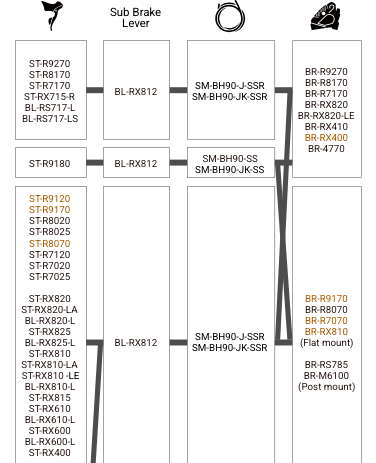
You’ve adjusted the Freestoke to minimum. That changes the amount the brake lever travels before the pad contacts the rotor. Have you removed the wheel and mechanically expand the pads to close the gap a little more?

you’re saying to slightly pull the brake levers with the wheels out to move the pads in? I’m worried that would create pad clearance issues but could be reversed easily enough.

update: tried it. much less pad clearance and the feel seems a bit closer to the other bikes, but it seems weird that I would have to do this only with the GRX calipers. Maybe the pads just sit wider in that caliper, for mud clearance reasons…

Are they the latest gen GRX 820 callipers? If yes, pretty sure these have different piston size as part of a change to give more clearance from the rotor when retracted. My guess is the 105 levers are designed for the older caliper design.

2 Likes

This is not caliper specific issue. You can do this with all calipers if the pads have just not been paired close enough to the rotor as a personal preference. Once the square seals have been set and you’re happy with the lever feel, you’re good.

If you like them close n tight, (my preference) you might need to have some rotor truing patience to dial them in.

This chart seems to indicate that there are two generations of GRX calipers. The newer one, BR-RX820 is compatible with both newer and older levers (ST-R7170 and ST-R7020), but the older calipers BR-RX810 is not compatible with the newer levers, such as ST-R7170. Sounds like it’s either a compatibility issue, or just an imperfect bleed.

Not sure what gen of calipers you’re running on the gravel bike, @Stochastic. The newer calipers that came with the 12-speed groupsets were designed with slightly larger pad clearance, to reduce the possibility of pads rubbing the rotor, especially on extended descents (or similar situations). So, that could possibly be what you’re feeling at the brake levers, where the pads seem to take “longer” to contact the rotor.

That said, if I read you correctly, you’re partial to shorter throws, as I am. In that case, I’d much rather leave the free stroke adjustment well alone, and as a last resort option, for mid-ride tweaks, after the brakes have been fully bled, etc. I regularly do multi-week overseas rides, where I’d tend to prefer not to have to bleed brake systems, so the free stroke bit comes in handy.

As @Crosswind mentioned, you’d only need to bleed your brakes according to manufacturer’s instructions, pull the wheel off, brake gently to get the pads to the point where the throw is reduced (you might need multiple goes at the lever, GENTLY). So, brake a little > reinstall wheel and test lever throw > brake a little more if needed (wheel off), and repeat until the throw is what you’re after.

Note that this means that there’d be some air in the residual system, which I’d remove by simply topping up the reservoir.

Just updating to say I am using the latest gen GRX calipers, the RX820.

Did a very hilly gravel ride today after trying the suggestion to move the pads in by braking w/out the wheel in. Levers felt much better than they did previously. I did have some super brief rubbing but not enough to care.

I’d do a top up (of the reservoir) to purge the excess air that’s now in the system, with the pistons having advanced themselves to where they are now.

1 Like

I have a similar issue with a mixed generation of ultegra levers and calipers. The levers are R8070, I had to replace a caliper and they no longer make the R8070 so had to use a R8170 which the Shimano chart shows as compatible. I have a similar issue that the lever moves a long way before engaging.

In this case there is an extra 0.5mm pad clearance built into the R8170. My understanding is that the newer R8170 levers have a slightly different hydraulic curve that peaks earlier so the pads move further for the same throw.

When I investigated this a year ago I think I found comments online that suggested rebleeding after moving the pistons out was a bad idea because the reservoirs would be overfilled and could become damaged. I’m just an amateur so I’d be interested to hear thoughts from more proficient mechanics. It would be great to have a good lever feel back.

The reservoir/bladder often sits behind the piston (within the brake lever, not the ones in the calipers), which gets actuated whenever you pull on the brake lever. In most drop bar brake setups, this reservoir is usually a sealed unit that you can’t easily get to (unlike MTB implementations). On drop bar setups, the reservoir gets opened when the lever is pulled to equalise the pressure that exists in front, and behind, the piston. Any air in the hydraulic lines would also migrate to the reservoir (often over multiple brake lever actuations). This is the key reason why the reservoir sits in the brake lever body, where it’s likely in the higher point possible, under normal circumstances.

As such, assuming a clean bleed with the pistons (in the calipers) fully retracted into the caliper bodies, advancing the pistons, and hence, the brake pads, will result in air being drawn into the system, which will be replaced by the excess brake fluid currently in the reservoir, as the brakes are applied. So, adding more fluid would, simply be the function of “topping up” the fluid in the reservoir, instead of forcefeeding more fluid into the system, so to speak.

Some clarification on pad expansion and the suggestion to bleed the brakes.
Expanding the pads does not introduce air into the system (brake lines) and the is no need to bleed anything. The fluid level in the reservoir has simply dropped slightly as a result of the expanding piston and a top off of the reservoir is all that is needed.

1 Like

This is all very interesting - I have a set of R7170 levers and DeoreXT Wireless that I was going to stick on a bike coming with GRX Mechanical 1x. I did get the 105 brakes with the levers, but had planned on using the GRX RX410 brakes. The Shimano compatibility chart says this will work, but based on the above it sounds as though I just need to use the matching 105 calipers.

I will skeptically ask…
What exactly is incompatible?

Thanks, and you’re right.

I glossed over a step or 2 right there, but when the caliper pistons (and pads) are advanced beyond their normal range of movement, when compensating for pad wear for instance, air is drawn into the bladder/reservoir, displacing the fluid that has now moved into the hydraulic lines in front of the piston of the master cylinder.

It’s the air that now sits in the bladder that I’d be rebleeding for. This is mostly a matter of preference though, but I generally prefer minimise the amount of air in my lines as much as possible.

I think think is a confusion of terms or possible semantics with incorrect terms and actions. I’m not sure of us being on the same page, but I think we are close.

If air remains in the bladder from expanding the caliper pistons, the only air that has entered, is in the master cylinder reservoir or the bladder. It has not gone anywhere else. we have not pumped the reservoir dry and allow air to enter the brake lines. Do you agree?

If so, nothing has entered the brake lines and there is no air in the brake lines, there is no need to bleed anything. The only thing that has happened is that the fluid level in the reservoir has lowered. All that needs to be performed is to top off the brake reservoir. No air has entered ANY of the brake lines. There is nothing to bleed. Topping off the master cylinder /brake fluid reservoir is not bleeding.

2 Likes

Definitely semantics. Unlike Shimano’s MTB brake levers, the reservoirs/bladders of Shimano’s drop bar brake levers are only accessible by the bleeding process. As a consequence, the process of refilling those reservoir/bladders is to fill the lines, and pump the lever a few times, to allow the fluid that was originally in the lines to migrate into the reservoir bladders, which often sit at the highest point in the system.

In the instance that you’re simply advancing the pistons, in a system that has already been bled, then yes, there shouldn’t be air in the lines, though it’s not impossible to come across bikes which do. If it’s the latter, the fluid in the reservoir/bladder will then flow into the lines to replace the air in there. In a properly set up hydraulic brake system, there shouldn’t be air in there, and the fluid in the reservoir will ensure this is the case.

Agree that it should be topping off the reservoir, as opposed to a rebleed, to replace the air that now exists in the reservoir with fluid.

@Crosswind thanks for catching that. I’ve amended my responses above for sharper clarity.

Thanks for the explanations, I think that’s clear now. A follow up question, why does the wheel need to be removed to advance the pistons. I had hoped that the pads would advance a bit naturally similar to how they should with pad wear. Is it something to do with the geometry of the seals? Certainly at the moment the lever feel doesn’t improve with time (nor does it get worse).

In most instances, the pistons extend a finite amount of distance before retracting back into the caliper. This distance is defined at the point of caliper design and isn’t something that could be modified at the user level, unlike rim brakes, were the amount of travel can be easily tweaked with the cable adjusting screw. Likewise, when the brake pads wear down, the pistons have a (slightly) increased distance to travel, beyond the pre-defined design amount. This results in the corresponding extension that you’d see, where the face of pistons no longer sit flush with the caliper, when the pads are new, and with the pistons fully retracted.

In the OP’s case, @Stochastic was matching a set of 105 R7170 levers with RX820 calipers, the latter having been designed with 10% more pad clearance. In that instance, the levers would likely require greater throw, in order to advance the calipers’ pistons sufficiently to ensure adequate pad contact. To circumvent this, and to achieve a shorter throw than what the calipers were designed for, the suggested solution was to remove the wheel (and the rotor), to create a scenario where the calipers’ pistons would have to move beyond the designed distance and retract a little, to achieve a “resting state” (if you will) where the pistons remain somewhat extended, but also achieving a reduced pad to rotor distance. Correspondingly, this reduces the throw at the brake lever.

To add further detail, the pistons are meant to extend only as much as is required for the pads to make contact with the rotor. Ideally, the pistons should also retract by the same amount. So, the only way to ensure that the pistons extend themselves and retract to a position that reduces the pad to rotor distance, to essentially “fool” the pistons into compensating for pad wear, but essentially coming to rest in a position that sits them closer to the rotor.

Hope that makes sense.

:roll_eyes:

It’s all about the square seal.

1 Like