There are two main problems with heavily dished rear wheels - i.e. 11+ speed road wheels.
Excessive tension on the RHS potentially leading to rim cracking
Inadequate tension on the LHS resulting in spokes becoming detensioned and then loosening
The two are, unfortunately, connected. #1 can be overcome to some extent by choosing a rim rated for a high maximum tension, e.g. 130kgf. This helps with #2 as the higher tension the RHS can tolerate, the more tension there will be on the LHS to keep the wheel correctly dished.
There are other things that can help keep the LHS spokes from detensioning.
Move the LHS flange inwards (not popular as it reduces lateral stiffness)
Use 2:1 spoking so all spokes end up at roughly the same tension (requires special hubs and rims)
Use the smallest cross section LHS spokes possible - more stretch = less chance of detensioning
Even the slight extra tension from interlacing the LHS spokes (as opposed to radial spoking) can be enough to help matters
Asymmetrical rims help directly by reducing the dish and tension imbalance
Radially stiffer rims (deeper ones) will deflect less, also reducing the odds of detensioning
Maybe flexible spokes like Berd’s might help too(?)
Thread locker on the nipples may prevent the spokes unwinding if/when they are detensioned, but won’t help with fatigue
Some rims unfortunately cannot reliably be built with enough tension to stop the LHS spokes loosening, for example Stans Crest MK3 were officially limited to 95kgf, which gave ~48kgf on the LHS of a wheel with a DT Swiss 142x12 11 speed road disc hub. 48kgf was not adequate!!!
More stretch in a spokes does not necessitate that the spokes are less likely to detention. This is only true if it keep the spoke thickness constant, which we are not doing!
Perhaps it would help people to think of it like this. Using thinner spokes is somewhat analogous to using less spokes. And to equalise the stretch, because the tension is so different between sides, it’s the equivalent of using a LOT less spokes. A 32 spoke wheel using 1.6mm spokes has approximately the same spoke cross sectional area as a 20 spoke wheel with 2.0mm spokes!
Alternatively, you can remind yourself of the opposite case. When you upgrade a wheel to larger spokes, which is commonly done for people who breaks spokes, you generally can’t increase the spoke tension meaningfully unless you upgrade to a beefier rim. So you will have less stretch in all the spokes. According to this theory, the new wheel should detention more easily. I know from a lot of experience, they don’t.
Orbit in the UK used to make their touring bikes with offset rear ends too, however it’s not something one can normally implement retrospectively.
As for Thomas’s points, I’m having trouble making sense of some of them.
I don’t think it’s debatable that for instance a spoke with a 1.5mm centre is going to stretch more than one with a 2.0mm centre. Given these are non-zero amounts, the rim must deflect by a equal or greater amount in the load affected zone than this before the tension can become zero. This is unfortunately not impossible with some rims in severely dished wheels. While this stretch probably isn’t as crucial as in pre- or post-stressed concrete beams it does matter.
As for the idea that 20x2.0mm spokes is effectively equivalent to 32x1.6mm spokes, this totally ignores load distribution. In practice, rims flex radially(!), some much more than others, so the stiffness (and offset, if present) of the rim are also extremely relevant to wheel stability.
"On a simplistic theoretical level, I don’t really see how thinner non drive side spokes help. Yes, they’ll stretch more for the same tension (and the tension is set by how high you dare tighten the drive side spokes, then dishing the wheel) but they’ll be less stiff and detention at the same force. "
This would only be true if the spokes were the only contributors to lateral stiffness. Fortunately, we also have the rim stiffness at play. I don’t know what the contribution split is here, but it’s significant.
I’ve built (rim brake) rear wheels optimizing all of this sort of stuff. My maximize-theoretical-marginal-durability-gains rear wheel had 2.2/1.8/2.0 triple-butted drive-side spokes and 2.0/1.6/2.0 non-drive-side spokes with thinner center section (more elongation). I buy that both of these changes (compared to just using 2.0/1.8/2.0 spokes all around) decreases the probability of wheel failure. But I also suspect the gains here aren’t that big, which is why companies don’t muck around with the added complexity of different drive- vs non-drive rear spokes. (Along those lines, I also built a touring rear wheel that uses the same 2.0/1.8/2.0 spokes on both sides, with an asymmetric rim, drive-side spoke-nipple-washers, and possibly a less-than-tangent non-drive cross pattern making up the length difference. Easy to carry spare spokes, although never needed.)
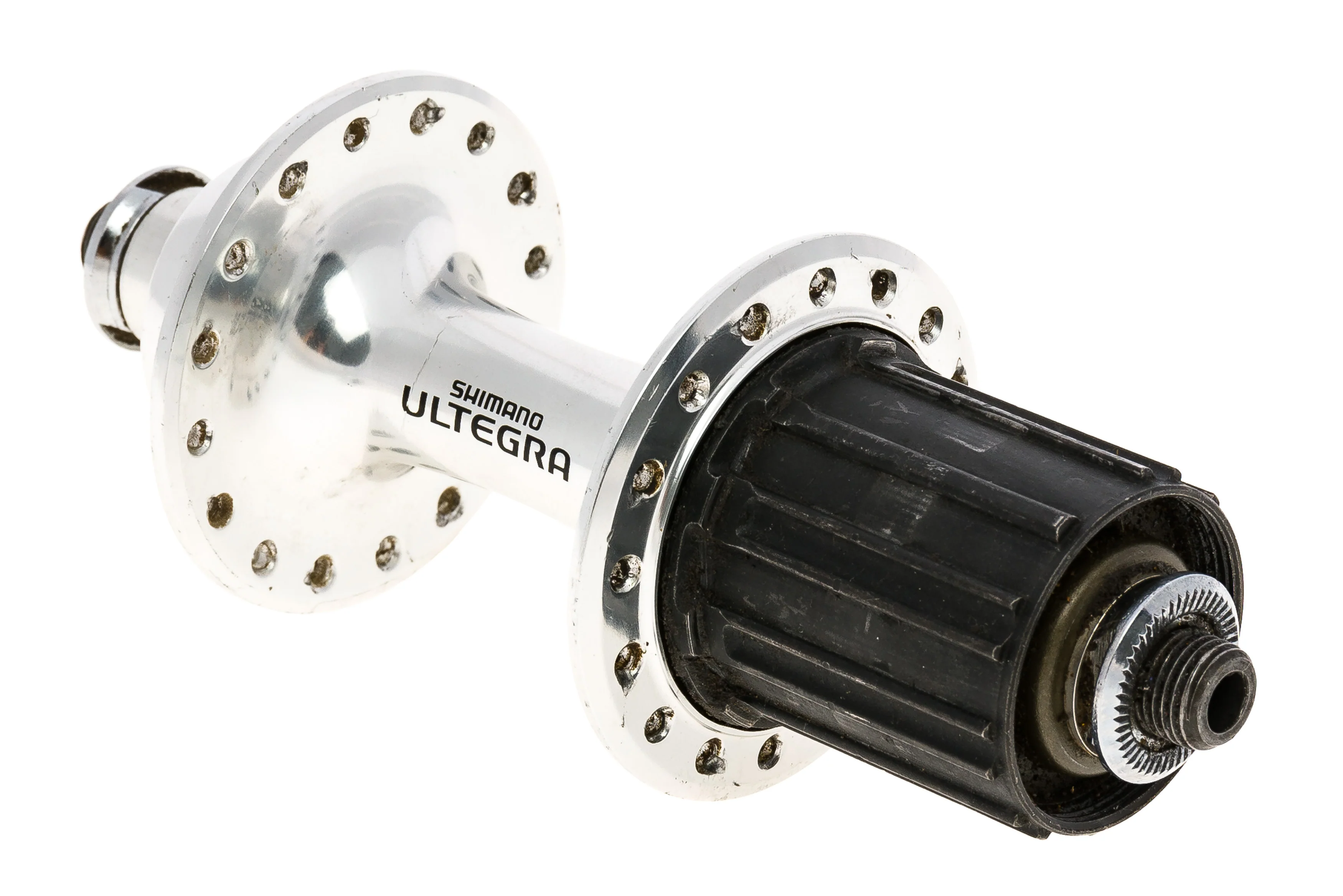
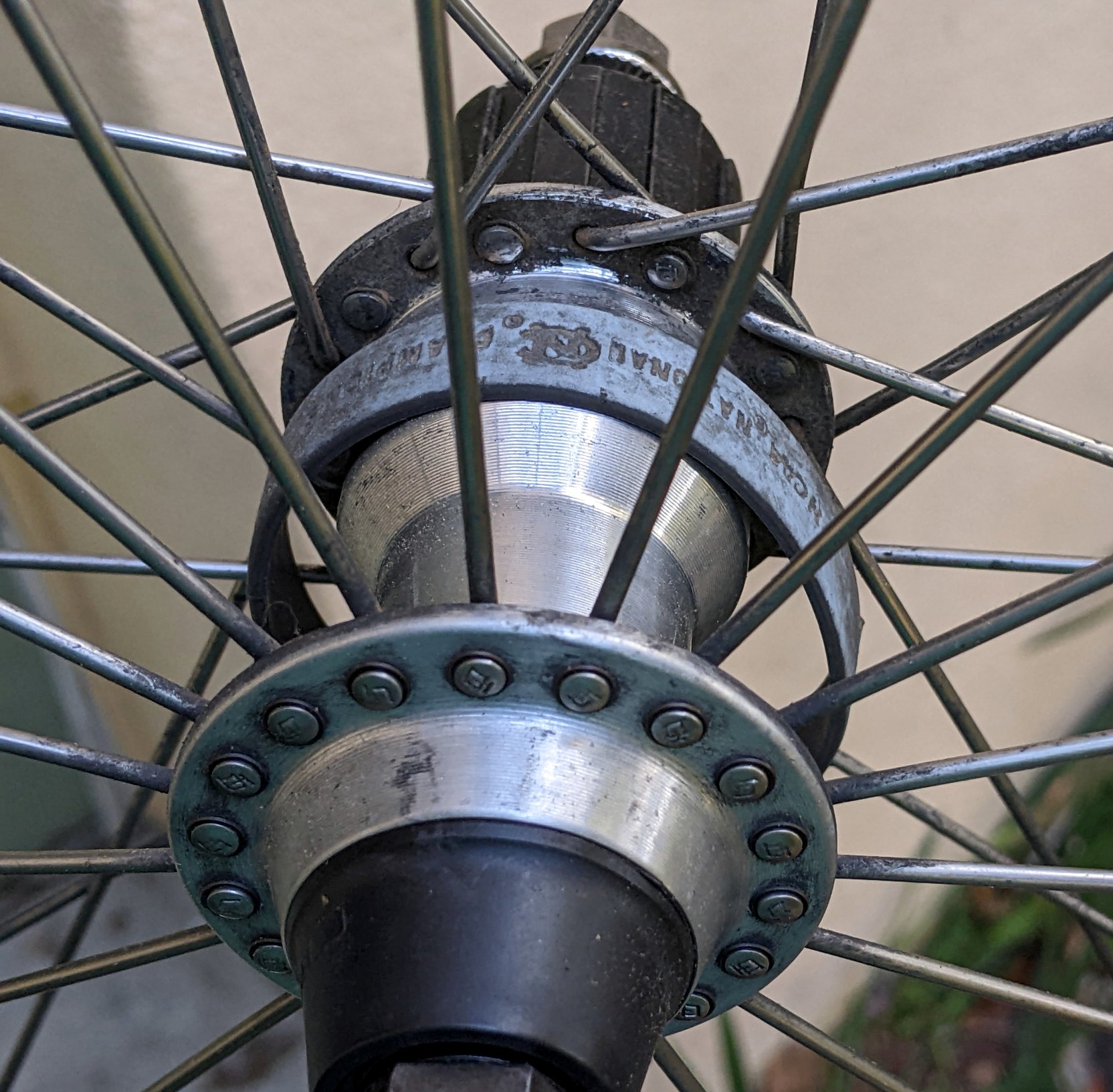
That all said - for disc wheels, there’s less value/incentive to thinner non-drive-side spokes. Modern hubs have a larger-diameter center section (compared to, for example, 9-speed-and-prior Shimano - see pic below) and better transmit torque through the hub shell, but even so nobody is doing radial non-drive-side lacing on disc rear wheels. It’s possible there’s some marginal value for doing this on front disc wheels (thinner spokes on the non-disc side) but a disc doesn’t add that much dish to a front wheel compared to an 11-speed cassette in 130mm of locknut spacing (equivalent to 137mm with thru-axle measurement).
A hearty agreement on this point. When I was a poor grad student first building wheels, I used tension only. Once I got a tensionmeter, I use it to set the baseline of spoke tension.
Plucking remains an important part of my process for truing and tensioning wheels, because it’s a quick way to assess relative tension of spokes. If I have a group of spokes in an out-of-true area of the wheel, I’d ideally like to tighten a lower-tension spoke on the side that needs to be tightened, and loosen a higher-tension spoke on the side that needs loosening. Of course this isn’t always an option (or the spokes that could be loosened/tightened are both on one edge of the area that is out of true) but it’s nice to have available for quick assessment.
Not quite no-one. Fulcrum have at least one example in their range (alu spokes, interestingly), and I’m pretty sure there are other examples kicking about.
Cool! It’s certainly possible, with larger-dia hub shells, for one side of the spokes to handle transmit-torque-to-rim from pedaling and braking, and the other side just handle wheel tension. You’d need the cross-spoked side to be a bit stronger (since it’s not sharing torque transmission duties). But that’s just an engineering problem which can be handled, and wheels like that do look cool.
There have been Shimano wheels with radial NDS lacing too, IIRC with 2:1 spoking. Perhaps a generation or two ago now, but there have been others too. At least one company (maybe Hunt?) is currently doing 15 spoke wheels with 2:1 spokes, radial on one side.