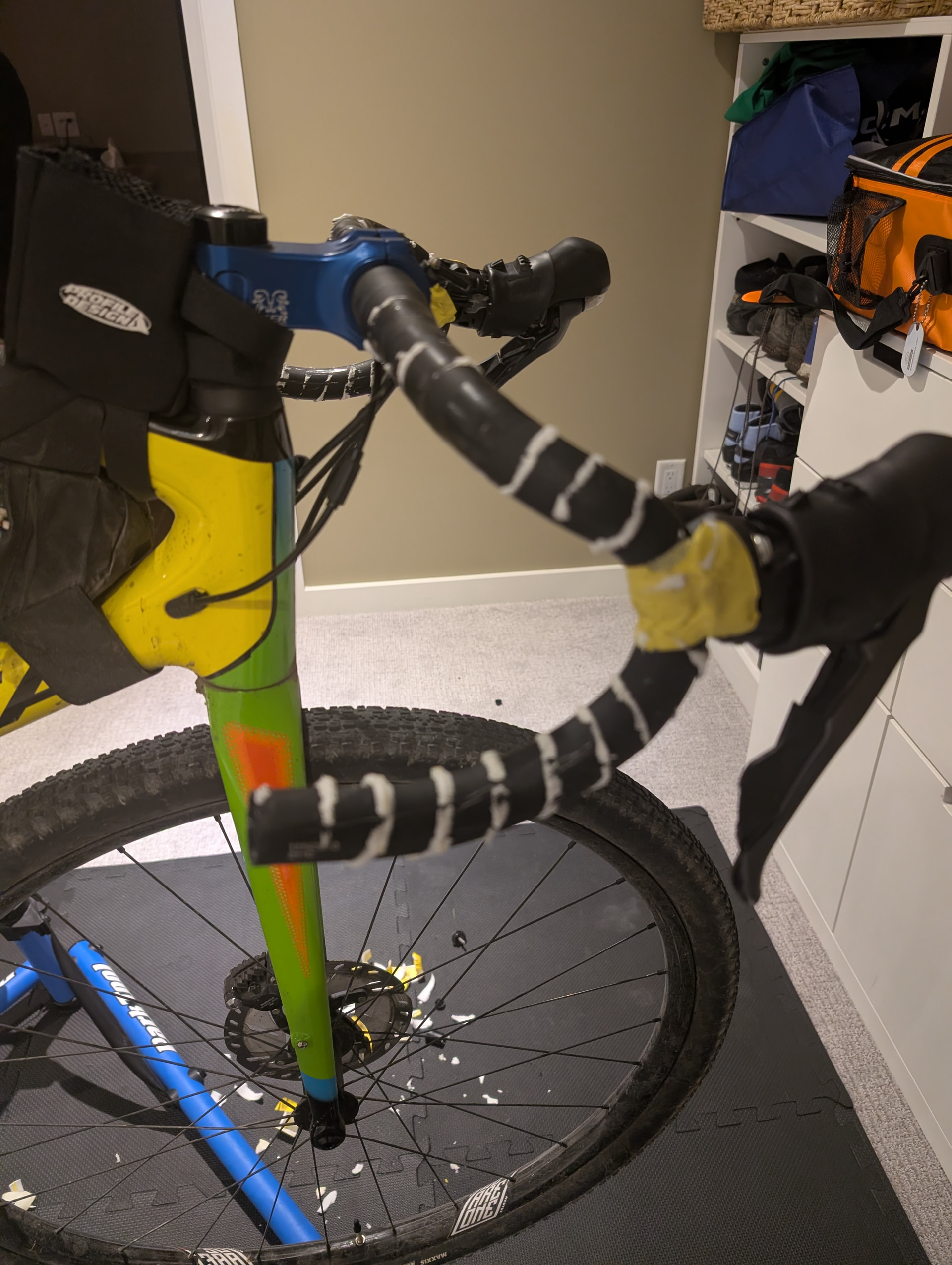
I’m a long time mountain biker who has relatively recently got into gravel… And it’s got to the stage where I needed to retape my bars. So I decided to take the old tape off and half the tape is still stuck to my metal bars. Is this normal? Does it all have to come off? How do I avoid this and any hints for part 2 of putting on the new tape… Where’s my lock-in grips.
Relatively normal. It doesn’t have to come all off but try to get the big stuff off. Use your fingernail or carefully use a knife. I don’t use solvent because it may affect the adhesive on the new tape. The wrapping is worse. Lemme know when you get there…
Looks like you’ve been using bartape that were made with double-sided adhesive, instead of the silicone. The latter often tends to be a little bit more expensive, but works infinitely better with re-use. And it’ll help you avoid this outcome.
That said, if you’ve got the time and patience, I’d suggest using your thumbs to gently knead those remnants off of your bars as best as you can, so that all your left with is the residue from the adhesive tape. When you get there, all you need is isopropyl alcohol to remove the adhesive residue. Some folks might suggest using a pen knife, a small box cutter, or similar, but I tend to stay away from that, to avoid nicking the coating/finish of the bars. Aside from the safety issue, it’s mostly about aesthetics (I like my stuff pristine, for as long as I can keep them).
Pressure sensitive adhesive (PSA) as used on many tapes is designed to fail within the adhesive layer because this increases peel strength for complicated reasons.
Failure within the actual tape, as your pic shows, means the adhesive used hasn’t done its job. I would get rid of it completely, using a solvent to clean the bars. IPA might work, if it doesn’t, try eucalyptus oil (cineole) it has Hansen parameters close to those of the acrylic commonly used in PSA.
The solvent will not affect the next tape if it isn’t contaminated with oil etc: although euky is commonly called an oil it isn’t, it’s a terpenoid.
As an aside, and apologies to the OP for the digression, but interesting nonetheless, so eucalyptus oil is similar or d-limonene extracted from citrus?
FWIW: Citrus solvent dissolves most tacky adhesives better than anything else.
My solution to this problem though is avoidance; I peel the sticky backing off before applying the tape. When it’s stretched appropriately it will stay in place anyway, and if it’s not the glue won’t do anything useful.
Yes, Cineole is a terpene oxide, limonene is a straight terpene.
For things like allyl acrylate esters in adhesives this makes cineole a better solvent than limonene because the extra oxygen gives a closer match on polarity and hydrogen bonding.
You can achieve this by other means: a 2:1 blend of toluene and acetone is an almost exact match for cineole in Hansen space. This blend is much cheaper but much more toxic and is entirely made from petrochemicals.
I am happy to pay for the cineole, partially because I buy it in reasonable quantities direct from the supplier who is also in regional Victoria.
Guilty secret: I used to give my bikes a final wipe over with cineole before I packed them up for shipping, partially so that when the recipient opened the box they were hit with the essential smell of the Australian bush.
As explained above, this isn’t the case. Limonene is very good for residues with very low polarity, other things work better when there are polar functional groups as is usually the case in adhesives.
Thanks for that, @Lyrebird_Cycles_Mark_Kelly! So, the takeaway then it’s “like dissolves like”, so limonene works better on stuff like oils, grease and lube.
FWIW lubes are usually not straight hydrocarbons because they don’t perform very well. Modern lubricants are usually based on esters which greatly improves the properties: this was well known even historically, the oil for which most of the world’s sperm whales were killed is mix of esters.
Taking this into account, the bio degreaser I developed uses cineole rather than limonene precisely because it is more polar.
The standards for degreasing efficiency are the chlorinated hydrocarbons such as trichloroethane. These are fantastically effective at stripping grease but equally effective at stripping the Ozone layer.
My formulation aimed to match TCE in Hansen space using a base of methyl oleate (one of the major ingredients in biodiesel) so that is is usable at high temperatures. I got a better match to TCE using cineole rather than limonene.
Rather than use a degreaser I use 90% rubbing alcohol. It looses up the stuff enough to get it off and doesn’t leave a residue which will screw up the new tape.
Just to be clear, I mentioned the degreaser in the context of using cineole in place of limonene to adjust parameters in Hansen space, not as a method of removing bar tape.