I have ultegra R8170 groupset. The brakes are comfy enough to use in terms of grabbing them with my hands. The front brake travels further than i would prefer before it hits the bite point. I’ve taken the wheel out and pulled the brake with a thin card to see if this resets the pistons near to the rotor but the lever went all the way to the bar wihout improving the situation.
Reading the shimano manual i’m a bit confused between reach and freestroke. If the position of the levers for my hands / fingers is fine but the bite point is late, which one should i adjust please? I think it’s freestroke but the manual is a tiny bit confusing to me. And i assume i will tighten?
You are correct that Free Stroke is what you are looking to change, which is the actual lever sweep until the pads hit the rotor. Reach is simply the starting position of the lever. Some brake levers have Free Stroke adjustment and most don’t. Shimano’s adjustment never seems very effective in my experience.
If your reach is set too close to the handlebar there may be too little lever travel to advance the pistons, leading to what you describe as well.
Thank you. I don’t think either has been adjusted since new and the levers look about right in terms of distance to the bar when not touched- and front and back look the same distance
@Simon_Lockwood, might it also be possible that there’s excess air in the front brake line? This is to ask if you’ve had a servicing or bleed done on the front brake recently. In my experience, Shimano’s drop bar brake levers rarely have you going all the way to the bars if they’ve been bled correctly. This, of course, is after the first couple of lever pulls, following the fresh brake bleed, with the pistons reset back into calipers.
As a related aside, these “empty” lever pulls allow the pads to advance as much as they need to, to compensate for pad wear, etc, to achieve Shimano’s desired pad to rotor gap. Once this happens, you should not have to pull the levers all the way to the bars with the wheel reinstalled.
I’d also caution against using a thin card (I’m thinking something with the thickness of a business card), as this risks having the piston extended too far out of the calipers. This, in turn, could create issues with piston misalignment (with respect to the piston bores), not to mention fluid leakage.
As mentioned, pad and/or rotor wear could be part of the problem in having too much free stroke, but a bleed first (even just a lever/burp bleed) is the place to start - if that doesn’t fix it then you need to look at other things.
If all is well and it is still happening you can force the pads to advance more by (gently) pulling the brake lever with the wheel out (often tricky to get the balance right in terms of how much to get them to advance without closing the pads up too much and not being able to get the wheel back in).
You can also do a caliper ‘overfill’. This is where you gently apply pressure to a syringe at the caliper bleed port whilst you close the bleed port off, thereby getting a touch more fluid into the system (you can’t do this at the lever because the excess will just squirt back out). Don’t go nuts if you try this as you risk the brake lever barely moving at all, and if you force too hard you can bust the lever reservoir seal.
Sounds like a great geek warning question to see what @Dave_Rome and co have to say.
It is the free stroke adjustment you want to adjust. But how much adjustment range they have can be underwhelming.
I believe the system needs to be bled with the free stroke at one end of the adjustment in order for it to work. If it’s bled with the free stroke already into its adjustment range then it will limit how effective that range is.
Wow! You’re correct. I’m surprised the pistons didn’t over extend. How did they not?
Only one pull of the lever?
What is his definition of a thin card?
I think we need clarification with this?
Thanks for all the replies. I did take the wheel out, then used a business card and very slowly pulled the lever to seee if the pistons could be reset nearer to the rotor (didn’t work) It was only then that it hit the bar before the pads hit the rotor. It doesn’t hit the bar when the wheel is in place.
I haven’t serviced or bled the brakes. That’s beyond my skills, so was just looking for an easy adjustment to improve it a bit. The brake still works ok, it’s just my preference that the bite point is earlier.
Hi @Crosswind, I’ve gone ahead and modified your earlier comment to clean the quotes up. Hope you don’t mind.
To do this on a desktop, you’d want to highlight the text to be quoted, and click the “Quote” button that appears in the floating window, which looks like the one below. Hope this helps.
You can place the business card (or nothing at all except for the relatively new pads still in place) and squeeze the lever several times to advance the pads. As long as the pistons are extending evenly, they will not extend too far and come out of the caliper.
I believe your pistons are sticking to the seals and over retracting. Once they break free from the seals, they will properly self adjust. You would need to then gently retract the pistons all the way in, place the actual rotor (or travel spacer) between the pads, and squeeze the lever several times for the system to self adjust.
It’s possible the pads will be closer to the rotor to the point that a small caliper alignment would be necessary.
This should all be step one, before a bleed is attempted. If the lever engages firmly at the pad contact point, then it is unlikely a bleed is necessary . Sometimes a bleed will “fix” this situation unintentionally, which can cause confusion as to what is actually required. Whatever you do, don’t “overfill” the system.
Thanks. This seems worth a try before any adjustment. I can give the caliper a clean whilst i’m at it. I did once have under retracting pistons on that brake, which would stick slightly after engaging - and cleaning carefully around the piston with brake fliud / cotton bud sorted that.
…then pushed them back in to reset. Took a few pulls for the thing to reset with the wheel back in. I think it was slightly improved but not much so gave the free stroke screw a single turn. That screw seems fragile / soft so I left it after one rev. I think it’s a tiny bit better. Not 100pc but good enough. At some point I’ll get it bled and serviced. Thanks for the help
Nice! All brakes benefit from a little TLC and piston “massage” from time to time. SRAM is most notorious for this, the pads wear enough to make the lever long but not enough to advance the piston and they get dirty and stuck, but it will happen to any brake system.
Having more info now I would definitely encourage a professional brake bleed sooner than later. Shimano brakes are pretty resilient to neglect and can handle a surprising amount of trapped air but you might be surprised what comes out during a flush especially at the front brake.
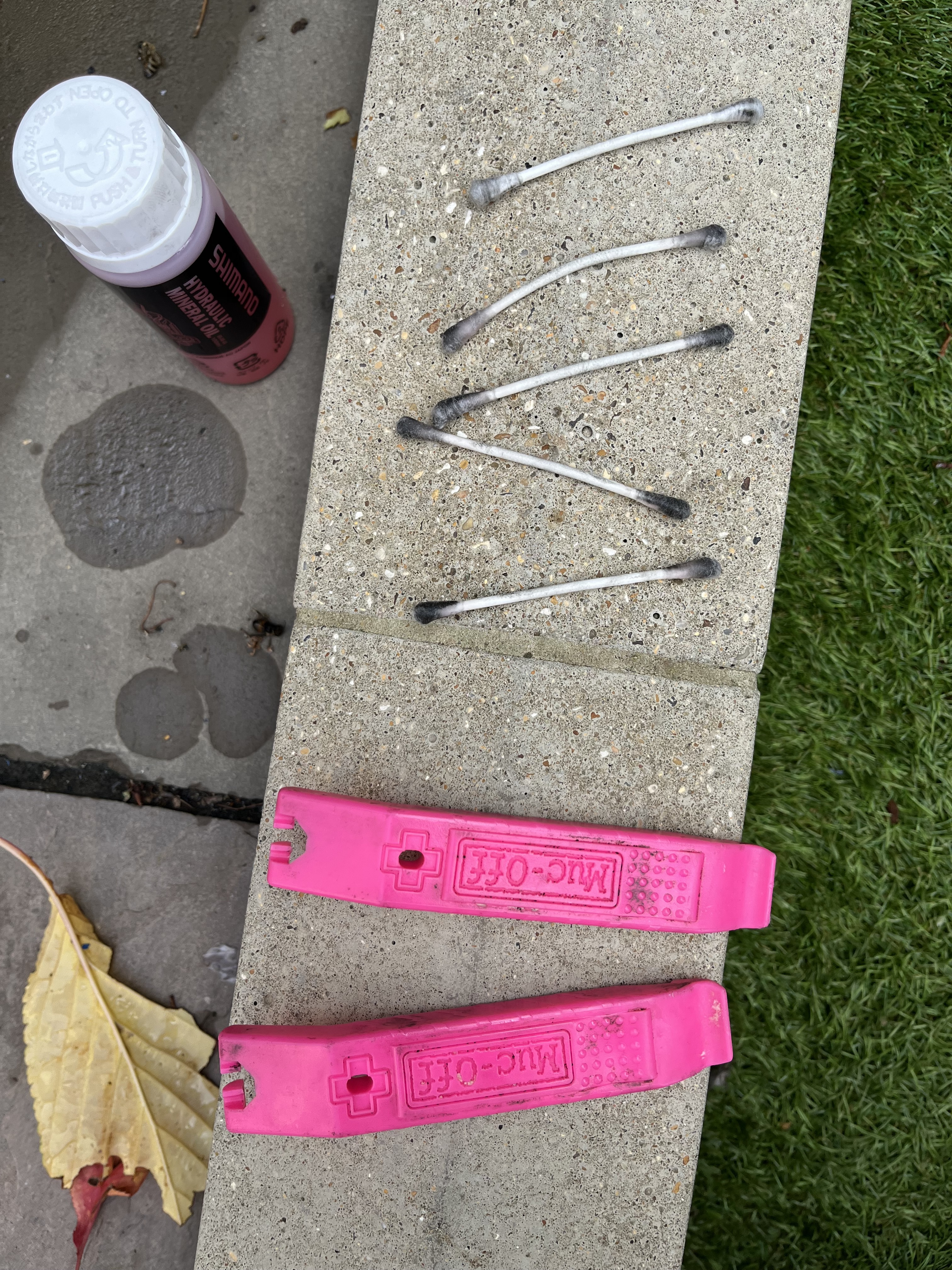
What did you use to clean the pistons? Hopefully not the brake fluid in the photo .
I see so many Instagram reels showing pistons being oiled before getting pushed back in and just dont understand why. The square seal in the piston won’t work, in my experience having bleed and piston massaged 100s of systems, as desired with oiled pistons.
I clean pistons with cotton buds soaked in isoproply alcohol, dry them with a handheld blower (Wolfbox MF100), repeat until clean, then push back in. Never, ever oil the piston.
I totally agree that oiling pistons is wrong and counter productive. I disagree on the consequences. Moving the pistons in n out through its range lubricates the piston just enough while minimizing what would be present on the exterior. Oiling from the outside lubricates the piston just the same. The difference is purely on how much remains on the outside, collecting dirt and possibly contaminating pistons. Lubricating the pistons with something other than the same brake fluid that is in the hose is what leads to piston roll back malfunction. This is most often seen when rebuilding a caliper (not a common thing with mineral oil brakes), and someone mistakenly greases the piston square seal.
This involves using the brake fluid on a cotton bud. Then i use a dry cotton bud, followed by IPA with a clean rag, then left it for 30 mins. It certainly cleaned the area and the IPA cleaned the excess fluid away, so not sure what the problem is?
I do see it as cleaning the whole area rather than lubricating the calipers, but maybe it’s doing both.

 .
 .