I want to do my first wheel build and would love a bit of help from the experienced builders here.
The Context: I commute year-round in Gothenburg, Sweden on a Lovens Explorer 1 cargo bike. Total system weight is around 180kg (me + two kids in the box). Because changing the front brake pads is much easier on this bike, I rely almost entirely on the front brake, which I guess subjects the spoke to unusual torque. At the 3000km, the front wheel (Ryde Andra 40 / Shimano Deore 36h) had one spoke snapped at the J-bend, repaired at around 3500k, and at 4000 another one broke.
The Plan: Instead of just replacing the spoke on the original wheel, I want to use this as an excuse to build an ultra-durable summer wheel from scratch, and repair the stock wheel to keep as a dedicated winter setup for my studded tires. My fork only accepts a 15x100mm thru-axle.
So far my research led me to this build:
Rim: DT Swiss U 663 (20" / ETRTO 406, 36-hole) Going with 30mm internal width to better support my 55mm Schwalbe Pick-Up tires.
Hub: Shimano Deore XT HB-M8110 (15x100mm, Center Lock, 36-hole) or if I can’t get it delivered in Sweden, the Hope Pro 5 Limited by the fork here
Spokes: Sapim Strong (2.3/2.0 single-butted J-bend) just want the absolute strongest possible
Nipples: Sapim Polyax Brass (14mm) same here
Standing questions:
Lacing Pattern: I’m planning on 2-cross. I know 3-cross is the disc brake standard, but on a 36-hole 20" rim paired with the XT’s flange, I assume 3-cross will create terrible nipple entry angles and spoke overlap at the hub. Is 2-cross the right call here?
The Hub Choice,32 vs 36 holes: I originally wanted to build a 36-hole wheel using a DT Swiss 350 hub (for the sealed bearings in winter weather). However, the 350 in 15x100mm maxes out at 32 holes. If I want 36 holes, I have to use a Shimano XT (HB-M8010). Given how short 20" spokes are, is a properly tensioned 32-hole wheel with Sapim Strongs genuinely enough for a 180kg system weight, or should I absolutely stick to 36 holes and just deal with repacking the XT cup-and-cone bearings?
Winter Wheel Repair: To fix my stock wheel, I plan to replace the two broken spokes and then properly bring the entire wheel up to a high, even tension. Will fixing the factory tension solve the fatigue issue, or do you strongly recommend relacing the entire wheel with new spokes because the others are already stressed?
That’s a really big load. On the other hand, for a given load smaller Wheels need fewer spokes to be durable.
My guess as to likely factors behind the smoke breakage at the J-bend:
Spokes not seated optimally in the flange, which could be that 2.0 just isn’t large enough to seat optimally without spoke washers behind the head
Spokes just not strong enough for the loads, at the J-bend. Putting 2.3-at-the-J-end will help I’m likely take care of this.
Most OEM wheels I see are not stress relieved and have tension all over the place, or too high. And most wheels are fine anyway. If you or a shop never did careful stress relieving and tensioning of the wheel (or if you don’t know whether anyone ever did this) there’s a good chance the wheel build left a fair bit of durability on the table for the components they used.
I would recommend triple butted spokes (2.3/1.8/2.0) as making a stronger wheel. The whole point to spoke to the thinner center section is that they stretch more at a given tension, which gives a bit more buffer against peak forces. Assuming you can get triple-butted "tandem/touring spokes in the short length for your wheel size.
I’d also say to stay with 36 spokes, since that you broke to spokes at the J-bend on an earlier 36 spoke wheel. An optimally built wheel with triple butted tandem spokes might be fine at 32 spokes under the load you’re carrying. But also, on a bike this heavy, you seem to have near zero incentive to try to optimize for slightly lighter weight.
The standard on spoke crossing pattern for 36 spoke wheel would be three or possibly four cross I think. Yes this leads to sharper angles into the rim, but:
a) you’re using polyax nipples which will help someone there
b) you already have some evidence that the weak point of the wheel is at the hub.
I’m less confident about my feedback on spoke crossing, though, because I don’t have knowledge of the trade-offs for this wheel size. But I imagine you can get guidance from the original front wheel. If that wheel is three cross, then definitely stick with three cross for your new one.
Firstly, I’d check BMX specialists for 20" parts, as they deal with this stuff all the time. If you’re really paranoid, I’m pretty sure there are 48 hole 406 BSD rims for freestyle BMX, and there’s at least this hub…
…and most probably others aimed at freestyle and/or tandems.
It’s doubtful you’ll find 2.3/1.8/2.0 spokes in short enough lengths, but the 2.0mm section could (in theory) be cut off and the 1.8mm part threaded - easy enough if someone near you has a Phil Wood spoke threader but otherwise very tedious and time consuming. Really though, any decent quality spokes with 2.0mm ends should do the job.
As for XT hubs, the seals are decent so it’s not like you have to repack them frequently. The “advantage” with cartridge bearings is that you can run them into the ground without destroying the hub, but a little maintenance goes a long way with cup and cone hubs; which is better depends on your willingness to service, versus instead replacing the cartridge bearings when they die.
A large part of wheel reliability comes down to the quality of the build, or lack thereof. Some factory wheels used to be so bad that by default we loosened off all the spokes and rebuilt them from scratch when assembling those bikes.
Once spokes start breaking there’s a good chance they’re all fatigued and will fail in due course. One or two might not mean this, but IME it’s probably better just to replace the lot with new spokes and - most importantly! - a really good wheel build.
Bear in mind that the number of spokes in the load affected zone is proportional to the BSD, so 36 spokes in a 406 wheel is equivalent to about 622/406*36=55 spokes in a 700c wheel - that should be enough, even with 180kg.
And no. 4 of reasons for breakage at j-bend would be wrong spoke pattern. I’ve seen a scenario where with a disc brake wheel had an inappropriate spoke pattern resulting in the hub winding up a little under braking, resulting in slight rotation of the spokes in the flange, wearing and ultimately breaking them.
As per this and linked articles on Sheldon Brown’s site, you need to find the optimal spoke pattern to get the angle at the hub as tangential as possible without compromising the spoke angle at the rim.
Given the short length of the spokes, 2 cross is likely right, but maybe check other 20” wheels to see what different cross patterns looks like.
The angle that can be achieved at either end depends on the hub flange diameter and the rim ERD. The bigger the hub flange in relation to the rim ERD, the less tangential it’s possible to have the angle at the hub. Is has nothing to do with spoke count. See the article I linked which explains it much better.
Thank you all so much for the detailed answers! With the two kids I am not able to research as I’d like, so your pointers are incredibly helpful.
This morning, a third spoke broke (I got one repaired few weeks ago, so “only” two are broken right now). All three breakages have been on the disc side, and all snapped exactly at the J-bend. Since I lost confidence in this wheel, I ordered a brand new stock OEM Lovens front wheel (Loading…). I am also having a mechanic patch the currently broken spokes tomorrow just to survive until that replacement arrives and give me more time for reflection. TBH, considering the price and that it comes with the tire, I am pretty sure it won’t be of great quality, but it will give me few kms of piece of mind. Hopefully!
However, I am still 100% committed to building a proper custom wheel. Only to be able to easily swap winter and summer tires.
So far, the parts that I selected:
Hub: Hope Pro 5 or Halo MT (36h). The Halo is cheaper, but I assume the Hope is made from higher-grade material with better tolerances? I don’t care about weight—I just want it as tough as possible. If the forged flange of the Hope prevents spokes from breaking under braking torque, I will gladly pay the premium.
Spokes: I would prefer the fatigue buffer of a butted spoke, especially given how the factory J-bends are breaking at the hub. I was initially worried that cutting a 20" spoke would put the threads too close to the thin middle section. However, I now plan to use single-butted spokes like Sapim Strongs (2.3mm at the bend, 2.0mm down the rest of the shaft). A builder should have no problem cutting these short and rolling standard 14G threads, right? Does it matter if I choose Sapim, DT Swiss, or Pillar (with Swedish steel OFC)?
Rim: I am still hesitating between the DT Swiss U 663 (20") and the Ryde Andra 25. The DT Swiss has a massive 30mm internal width, whereas the Andra is 25mm internal. Does this matter much for a 55mm cargo tire, and is one easier to build with?
I naively thought that a small 20" wheel with 36 spokes would be easier to build, but maybe I was ignorant and it is actually quite tough to get the angles right. Falling because a wheel I built buckled on my road bike is one thing, but I would have a very hard time forgiving myself if my kids got hurt because I made a mistake building this cargo wheel. Do you think it is better to leave it to a pro or you think that with good method and patience I would be able to get a good result?
Speaking as a novice wheel builder, I would encourage you to build a couple of much simpler wheels to get used to the process and gain some experience.
Wheel building doesn’t come naturally to me, so it’s been good to have a few practice wheels to build up and rebuild. I’ve built several nicer wheels, and I’ve improved a little bit each time, but having simple wheels for practice is a huge benefit. They get used on old bikes I ride for errands or as spares. They’re not perfect and they don’t need to be, but they provide a lot of practice reps, which is what I need.
I don’t mean to discourage you from building the custom wheel—you should absolutely do that. I just know that my ambitions are often ahead of my abilities, so providing opportunities for practice is crucial.
I assumed the OP has plenty of experience truing and tensioning wheels, but he didn’t actually say that is the case.
If the OP does not have such experience, I would concur with Kuato here.
I think the lacing aspect of wheelbuilding is fairly straightforward, just rote time, and you get faster with practice. The part that where experience really pays off is in building up tension in the wheel while keeping tension fairly consistent between spokes (apart from compensating for rim imperfections or hops/dents in used rims).
But I’m mostly with Stephen here - your first wheelbuild can be an excellent wheel (mine from over 2 decades ago is still going strong) - you’ll just be quite slow, which is fine.
You can build your ideal/optimized front wheel, but I don’t think you’d gain anything by it other than experience.
Three broken spokes (all at the same type of spot) indicates a systematic problem.
I don’t think you’ve addressed the question of whether the original wheel was ever optimized by a good wheelbuilder/wheel-truer. I suspect that it was not. If an experienced mechanic stress-relieves the spokes and optimizes consistent tension in the build, I suspect the new-OEM wheel will last a really long time. New spokes should go in the same spot (for hub and rim) as the old spokes, which will make the wheelbuild easier. If you go this route, make sure you take pictures of the current front wheel before disassembling.
I would also bet that the original OEM rim and hub are fine, and if you want a spare wheel, why not rebuild with wider-at-the-j-bend (2.2 or 2.3mm) spokes? A forged flange will be stronger than a cast or billet-machined flange that uses the same amount of material (although typically, non-forged constructions will be strong enough simply by using more material). I also think that having a wider (WideR? hello UCI!) rim doesn’t matter here. 25mm is plenty of non-aero-optimized support of a 55mm tire.
It also may be valuable here if the mechanic who replaced the first broken spoke commented anything about the wheelbuild (e.g., tension was too high, or too low).
I also think you don’t need to worry about the wheel folding over and endangering your kids, A poor wheelbuild could eventually result in broken spoke, or a gradually cracking rim by a spoke hole.
It is unbelievably unlikely that the wheel would suddenly fail. I have seen people riding around on wheels where the spokes are so loose the hub and bike are visibly moving side to side, and others with multiple broken spokes, and none have collapsed. They were far from ideal for a good, safe riding experience, but they hadn’t collapsed.
There is a lot of redundancy in bike wheels (except for some recent carbon spoke wheels where the spokes were not captured at the hub and were able to fall out following detensioning of a couple of them).
There is something extremely satisfying building a wheel, but it can also be extremely frustrating, especially at first. So as others have said, take your time, and be prepared to rewind some steps, or even go right back to the start.
Re the rims…. I’d say go for the 30mm inner width to give the tyre good support. My GSD has rims that are 30mm inner. I have no evidence to back this up, but given the carrying capacity, I feel the wider rim will really help the tyre.
But….
Regarding your current wheel …. Get it re-laced. Indeed, maybe you don’t need to get a new hub and rim, and maybe instead just rebuilding your current wheel is the sensible thing to do. Given you had another spoke break, I’m willing to bet they are all fatigued or worn at the bend, so you will only have more go. Rebuilding with good spokes, at the right tension, maybe with a different pattern (I’m assuming the current pattern is a problem, it might not be), and I’m betting the wheel will be completely fine.
but the wheel folding over like a taco and his kids sliding along the ground in the bucket like a spaceship crash-landing in a movie does make for a good mental image
If it was me I’d definitely replace all the spokes in the existing wheel now that three have failed, otherwise you’ll just end up replacing them one at a time until they’re all done. Better to start with all new and known to be good spokes, stress relieve the wheel properly, and build to as even a tension as the rim allows. (Rims vary quite a bit in both roundness and flatness, so don’t get obsessive about all spokes having exactly the same tension.)
FWIW, I have set of lightweight 26" MTB wheels that have remained true since they were built circa 35 years ago, proof that carefully constructed wheels can indeed last…
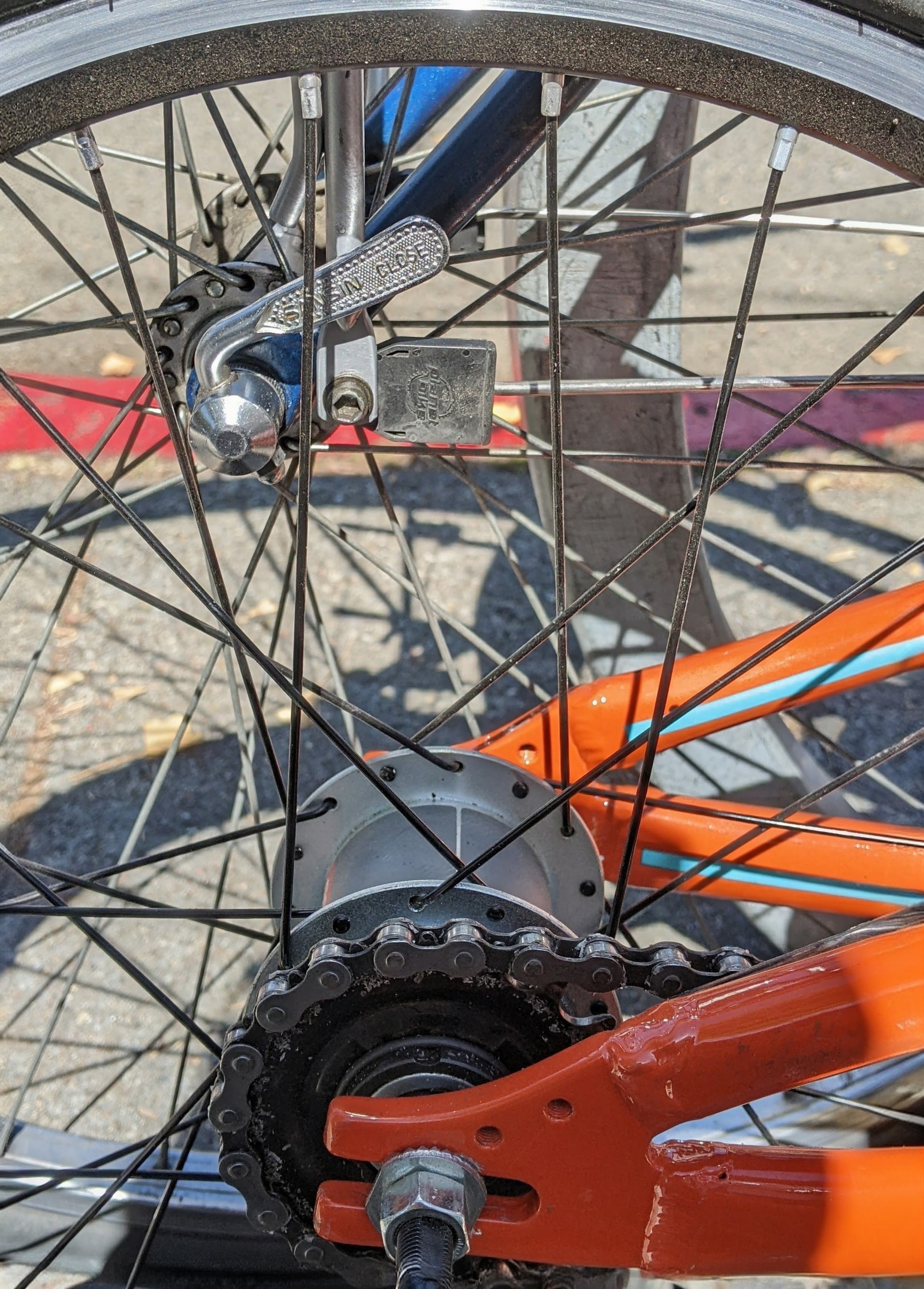
The spoke bend at nipple/rim is pretty striking on my 4-year-old’s 20-inch rear wheel. Large flange (internal ear hub) makes it worse. 2-cross with 28-spoke.
If the bike saw heavier loads, would benefit from polyax nipples and potentially nipple washers designed to complement. (I haven’t looked into those systems in awhile.) But I’m sure a 28-spoke dishless rear wheel is fine for a system weight under 60 lb (27 kg). Kind of a shocking overbuild for OEM.
Seriously - that’s equivalent to a 43-spoke 700c wheel - and again, dishless. That’s an overbuilt rear wheel for 200-lb me with a rear-biased touring load. I assume because SRAM only made that IGH in 28-holes minimum. The newer singlespeed version of that bike has 20 spokes rear as well as front.